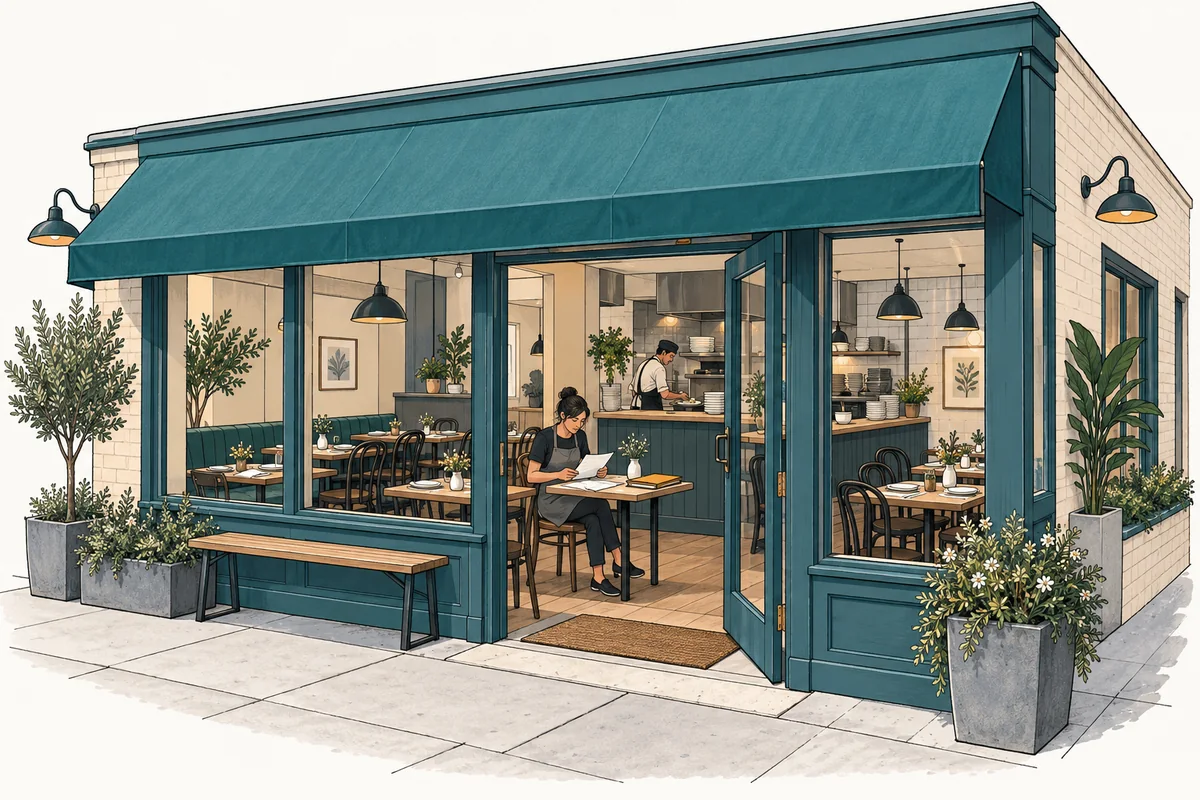
What customer problem would your drive-through solve?
Start with the trip, not the building. Describe who would stop, where they are going and what makes your meal worth choosing on that journey. A convenient lunch stop and a family dinner pickup suggest different order contents and busy periods. They are hypotheses to investigate, not customers already counted in a forecast.
The drive-through burger planning case offers a clear boundary for that investigation: an independent restaurant with one ordering station and one handover window. It earns sales when completed vehicle orders are handed over. It does not include a dining room, delivery revenue or franchise royalties. Those exclusions make the case specific; they do not prove that another format would be less attractive.
On a small screen, scroll horizontally to compare the concept questions.
| Concept question | What the selected case commits to | Evidence that would strengthen your idea |
|---|---|---|
| Why would someone stop? | A complete meal purchased from a vehicle | Customer interviews and observations tied to a specific trip and service period |
| Can the site support that visit? | A restaurant building plus its vehicle access and lane area | A site-specific review of access, circulation, waiting space and permitted use |
| Can the menu be delivered consistently? | Coordinated ordering, kitchen preparation and handover | Observed production and service trials using realistic mixed orders |
| Who will do the work? | Paid management, preparation, production and lane service | A workable paid roster that covers opening, busy periods, cleanup and relief |
| What could make you reject the idea? | Ongoing premises and staffing commitments | Written limits on acceptable commitments and unresolved site or service problems |
A useful concept statement connects those questions: “We intend to serve this customer, on this trip, with this meal, through this site and team.” If the statement only says that the road is busy, it leaves the reason to choose your restaurant unexplained. A count of passing vehicles is not a count of orders you can expect to win.
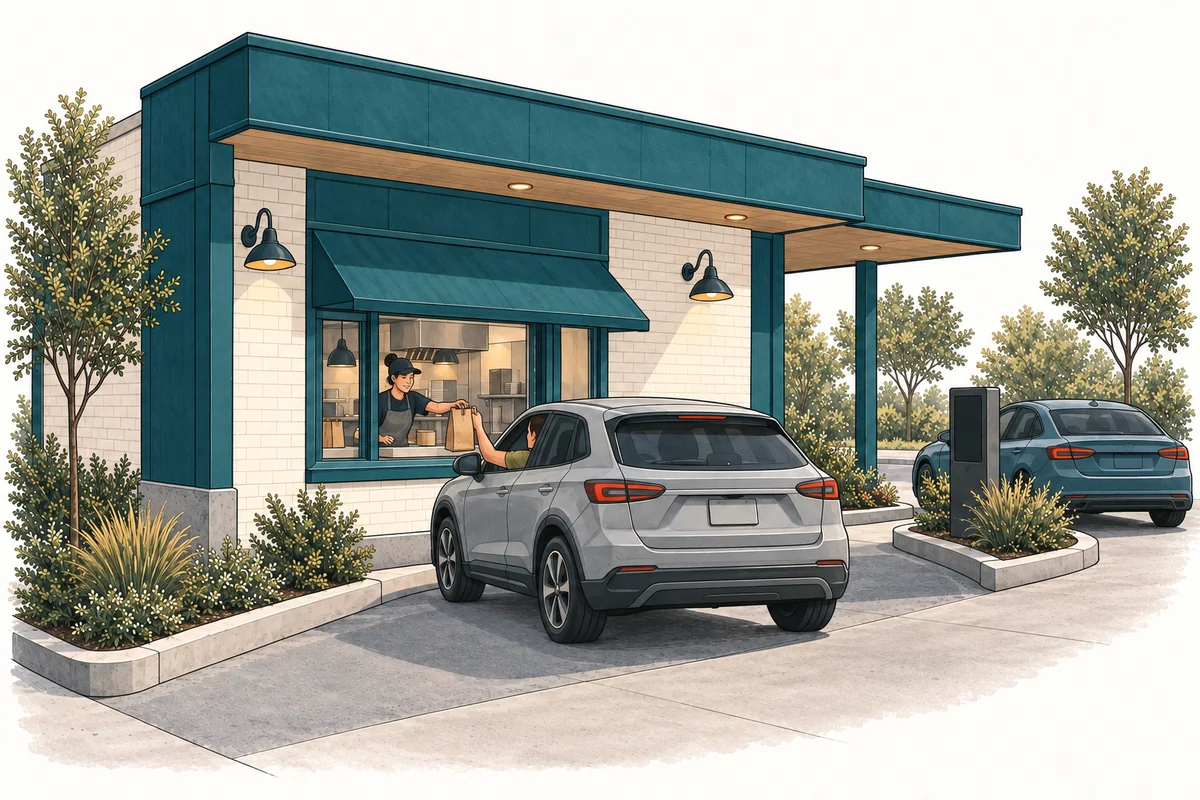
Are you choosing a compact kitchen or a complete vehicle site?
The selected case places an existing 1,000-square-foot restaurant building on a 21,875-square-foot pad. These are planning dimensions, not a required site specification. They illustrate why the footprint of the kitchen tells only part of the story. The modeled investment separately includes lane pavement, drainage, a canopy, ordering equipment and exterior systems.
That distinction matters to business suitability before detailed budgeting begins. Consider whether you want responsibility for an outdoor customer route as well as food preparation. Establish who controls the access points, which areas you maintain and what work the lease permits. A sketch may reveal questions to ask, but it cannot confirm a layout’s approval or safe capacity.
The model assumes an already entitled restaurant with the premises secured before the forecast. Its refurbishment period does not establish a development timetable for vacant land or an unapproved building. Land purchase is also excluded. If your idea depends on owning a new site, your proposal has a materially different scope from this reference case.
Does the menu support the service promise?
In the selected case, a meal combines a main, side and drink. The important concept question is whether the menu can produce the experience you promise when several different orders arrive close together. A menu should be assessed as a set of production tasks, holding decisions, packaging requirements and customer choices, as well as a list of items people might buy.
Use a service trial to observe a mixed sequence of orders. Record where staff wait for ingredients, where an order is corrected and when a completed bag becomes ready for handover. Treat those observations as evidence for revising the concept. A single easy order prepared successfully does not demonstrate how the intended menu works during a busy period.
The guide to drive-through lane, crew and production capacity explains the detailed calculation. For business selection, retain the underlying distinction: ordering, kitchen work and handover must all function. An elapsed customer journey is not the cycle time of each station, and an equipment rating is not a promise of completed customer orders.
Would you want to manage the whole working day?
This format can look like a kitchen selling through a window, but the source case funds several different kinds of work. The owner manages the business; other paid roles cover preparation, cooking and assembly, ordering and payment, handover, and utility work. Removing a dining room does not remove management, cleaning or coordination.
Consider which of these tasks you can lead and which require a capable hire. Think about the hours before the first sale and after the final handover, as well as the visible rush. The model pays the working owner and reserves part of paid time for nonservice tasks. It does not count the same owner or preparation hours again as extra cooking capacity.
This is also a test of personal fit. An owner who enjoys product development may need help with routine staffing and service execution. An owner who enjoys operations still needs a credible food offer. The paid owner time guide helps keep the founder’s contribution visible when testing either arrangement.
What would earn this idea a place on your shortlist?
Shortlist the concept when you can explain the customer occasion, identify a plausible site, demonstrate the core service process and describe a paid operating team. Keep a separate list of assumptions still awaiting evidence. This creates a basis for a detailed plan without turning every encouraging observation into a forecast sale.
Before making premises commitments, identify the relevant local reviews for the proposed use, site work and food operation. The SBA explains that licensing requirements depend on business activity and location; its launch guidance is a starting point for finding the responsible authorities. It is not approval of this site or a complete local checklist.
Write down what would change your decision. Examples include an access problem you cannot resolve, a menu that requires more service time than the concept allows, or a paid roster beyond your acceptable commitment. These are editorial decision tests, not universal rejection thresholds. Revise the idea when evidence warrants it.
The financial model can then test the defined proposal, including slower demand, different station times and staffing changes. It does not simulate minute-by-minute queues, road spillback or a detailed shift schedule. Use the assumptions guide to distinguish inputs from established facts, and keep site feasibility and operating trials alongside the spreadsheet.