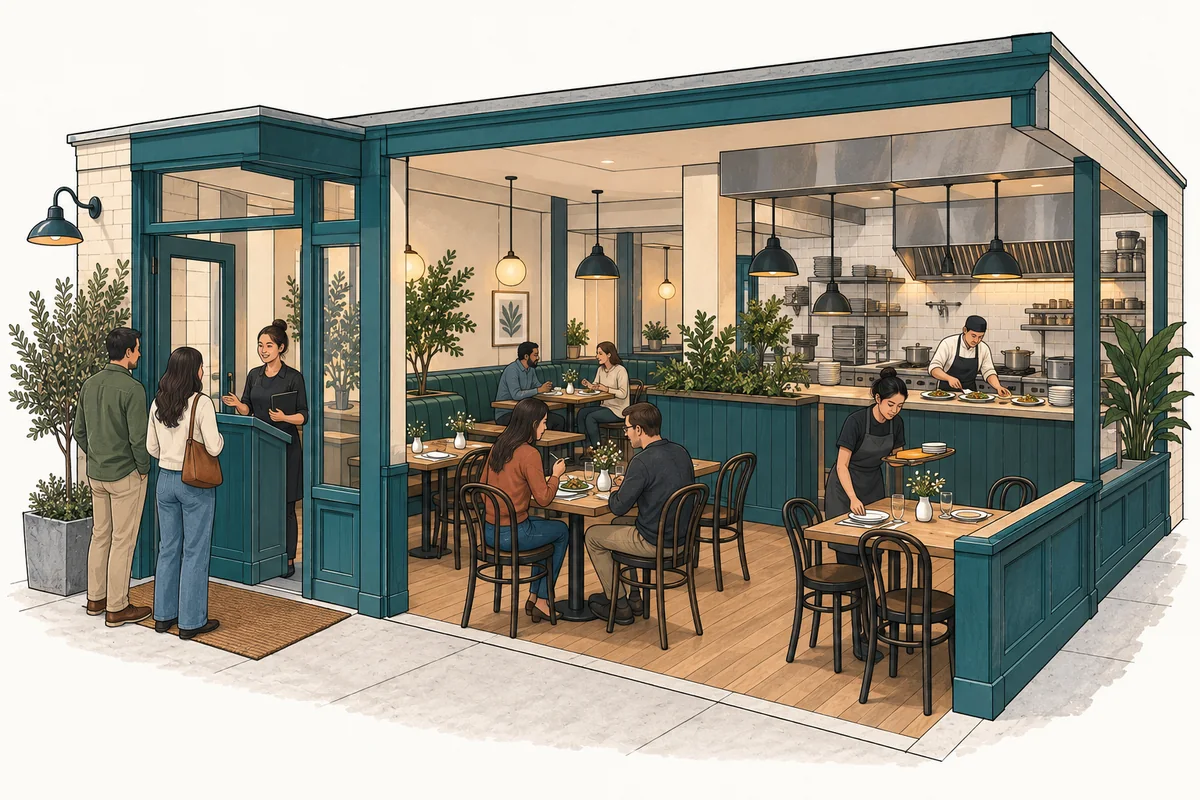
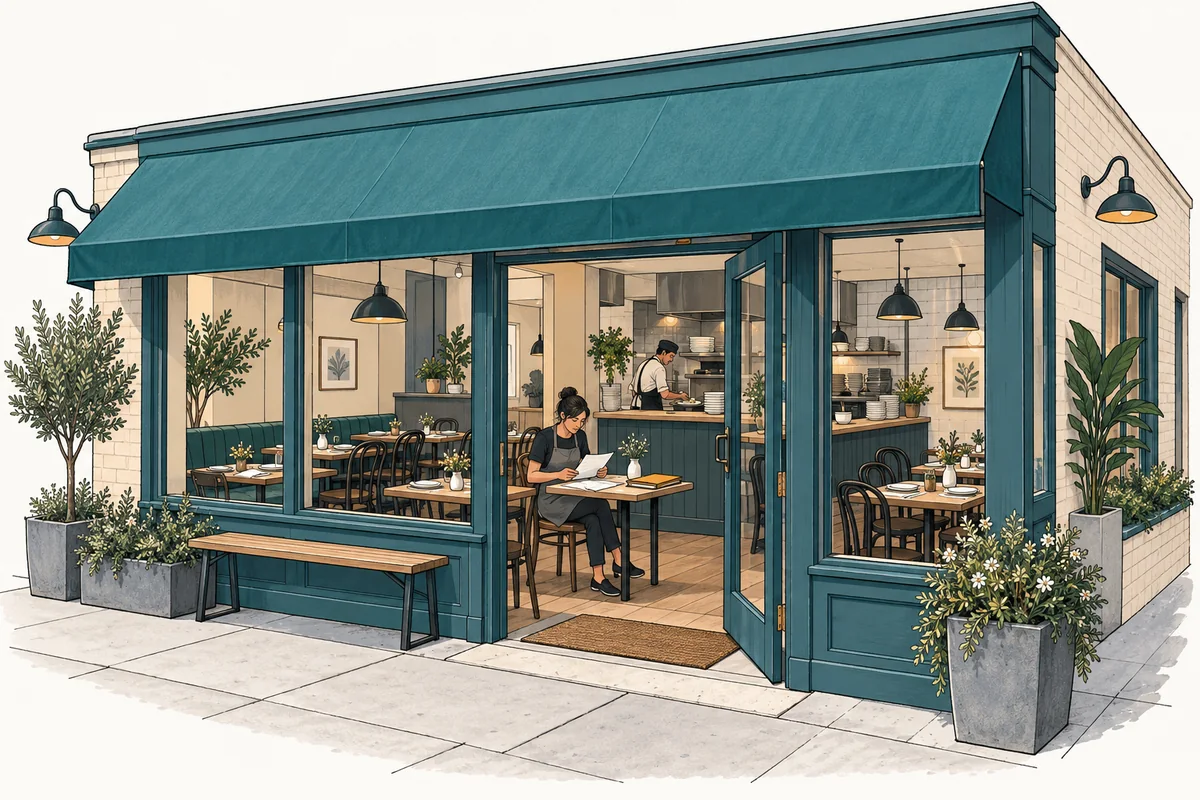
The selected U.S. fast-casual case uses 2027 Base assumptions for a 50-seat restaurant with two assembly stations and a shared kitchen. Its dine-in and takeaway orders draw on the same production resources. These are planning inputs for one format, not measured averages or a forecast for a particular operator.
What changes when a portion is customized?
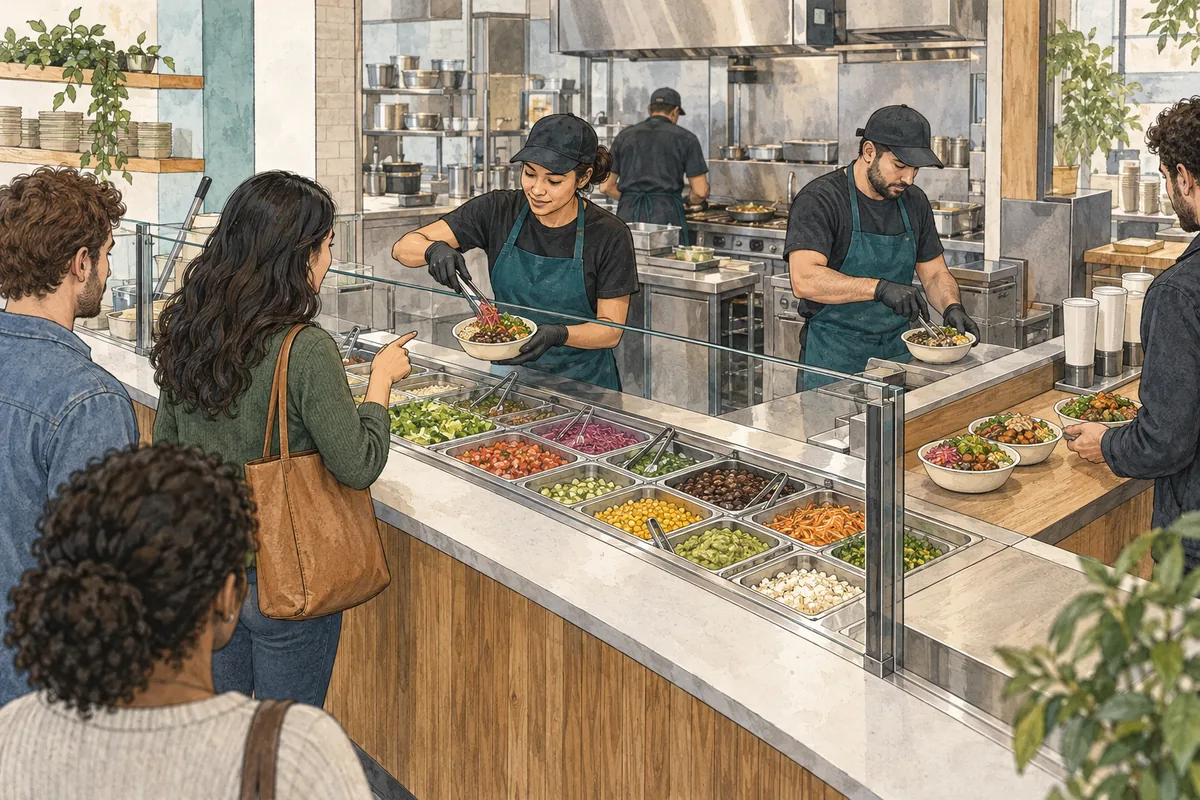
The standard portion is priced at $14, including a bowl and beverage. In this case, 35% of portions receive customization that adds $4 to the selling price, $1 of ingredient cost before preparation yield, and 1.5 assembly minutes. Standard assembly already takes 1.5 minutes.
Those three changes belong to the same portion. Customization is not another order, and the included beverage is not another billable transaction. The weighted selling price becomes $14 + 35% × $4 = $15.40 per portion. At 1.25 portions per order, expected order revenue is $19.25.
The ingredient calculation also follows portions. The selected food inputs total $4.10 before customization and yield. Adding the expected $0.35 customization input and dividing by the 90% preparation yield produces approximately $4.94 per portion. Preparation loss is recognized once; it is not an additional charge on top of that yield-adjusted amount.
How much assembly time does the menu mix require?
Average assembly time is 1.5 + 35% × 1.5 = 2.025 minutes per portion. With two stations continuously available for one productive hour, the isolated physical rate is 120 ÷ 2.025, or about 59.26 portions. Standard-only assembly would produce an isolated rate of 80 portions in that same productive hour.
On a narrow screen, scroll within the table to compare the two menu assumptions.
| Measure | Standard-only assumption | Selected 35% custom mix |
|---|---|---|
| Selling price per portion | $14.00 | $15.40 |
| Expected customization ingredients before yield | $0.00 per portion | $0.35 per portion |
| Food cost after 90% preparation yield | $4.56 per portion | $4.94 per portion |
| Assembly time per portion | 1.500 minutes | 2.025 minutes |
| Two-station physical rate per productive hour | 80.00 portions | 59.26 portions |
These rates exclude demand, breaks, the monthly staffing schedule, and the other operating constraints. They should not be multiplied by opening hours and presented as achievable sales. The workbook funds assembly separately: its initial 2.2 assembly full-time equivalents have a 75% productive-time assumption, while station availability provides a physical ceiling.
Which constraint determines fulfilled orders?
The model first limits dine-in demand by seating. Eligible dine-in and takeaway demand then encounter shared hot-preparation, assembly, and handover constraints. One common fulfillment fraction applies to both channels, with final orders rounded down. Rejected dine-in demand does not automatically transfer to takeaway.
Adding assembly hours helps only if assembly is the effective limit and station time remains available. Adding a station without enough paid assembly time can leave the additional equipment idle. If hot preparation or the one-counter handover step already limits output, shortening assembly time may leave fulfilled orders unchanged.
The same logic prevents a universal conclusion about menu complexity. More customization can increase revenue per order while leaving volume unchanged when spare capacity exists. When assembly binds, it can reduce completed orders. A useful comparison therefore follows contribution from the fulfilled mix through total payroll and fixed expenses, rather than judging the premium alone.
What should an operator measure before expanding the menu?
Measure standard and customized assembly time separately, along with the actual customization share, portions per order, and time available for production after nonproductive duties. Observe preparation and handover at the same time. A slow assembly step during one busy period is evidence to investigate, not proof that it constrains every month.
The fast-casual restaurant model lets those physical inputs be examined together. Its monetary price, cost, and salary scenarios do not automatically change the physical menu mix or service time. To test a more complex menu, change the relevant operating assumptions and inspect the resulting constraint.
Finally, distinguish the operating calculation from monthly expense presentation. The selected case reconciles annual packaging costs, but whole-order rounding can create small monthly allocation differences. Use the detailed operating quantities to investigate throughput and the financial statements to assess the full cost of the chosen staffing and menu plan.