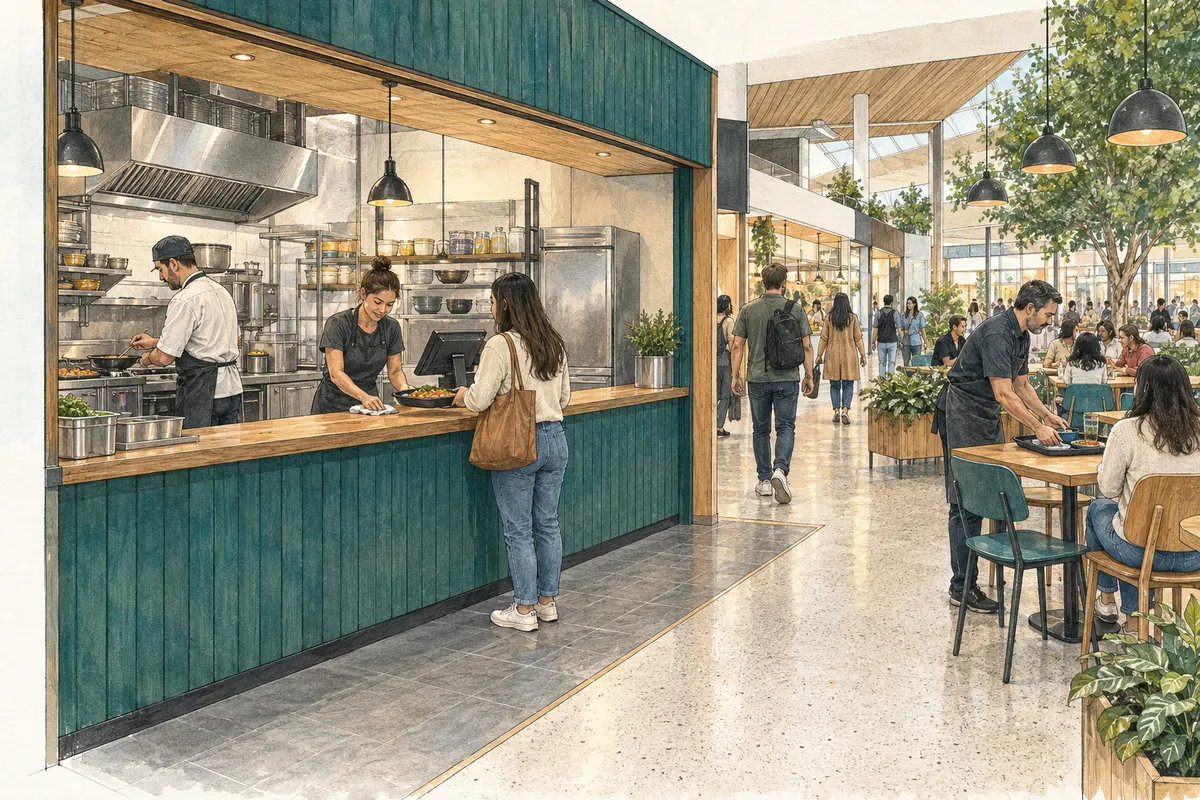
The food-court concession case models a 600-square-foot U.S. meal stall opening in March 2027. Its January 2027–December 2031 Base forecast uses a selected fixed-only agreement and USD amounts. The rent, traffic, conversion rates, and service allocations below are planning assumptions, not a current venue quote or national benchmark.
How does host footfall become stall demand?
The venue’s visitors are the starting audience, not the stall’s customers. The selected mature-day funnel begins with 2,000 host visits, captures 15% at the stall, and converts 70% of captured visits into purchase requests. The calculation is 2,000 × 15% × 70% = 210 requested orders per day, before launch ramp and operating limits.
At the selected 50/50 channel split, those requests become 105 dine-in orders and 105 takeaway orders. One meal and one guest are assumed per order. Host visits can include repeat visits, so neither the initial footfall nor the orders should be described as unique customers.
A $15 net meal price makes the unconstrained mature-day request value $3,150: 210 × $15. This is potential order value under the assumptions, not recorded daily revenue. Actual dates, the opening ramp, and shared production and counter resources still determine how many orders are fulfilled.
What does the inclusive rent cover?
The selected $4,800 monthly concession payment includes a defined common-service bundle. Its scope removes the need to budget those same host services a second time. It does not remove the tenant’s costs inside the stall or provide ownership of the common dining area.
On a narrow screen, scroll within the table to read all columns.
| Resource or cost | Host scope within rent | Tenant budget or action |
|---|---|---|
| Shared dining and cleaning | Common seating and common-area cleaning | Stall sanitation labor plus $250/month sanitation and pest service once open |
| Utilities | Common utilities | $650/month for metered stall power, gas, and water |
| Promotion | Host marketing | $500/month stall promotion once open; a separate $5,000 launch campaign |
| Property and insurance | Property taxes and building insurance; no second CAM charge | $350/month tenant property, liability, and cyber allowance |
| Kitchen and ventilation | No tenant equipment purchase is supplied by this rent assumption | Cooking, refrigeration, fitout, and a $25,000 hood/duct/suppression capital allowance |
| Concession payment | $4,800/month fixed payment | No turnover rent in this case; confirm any sales-based charge in the actual agreement |
The distinction between common and tenant cleaning is especially useful. Paying the host to clean shared tables does not clean the cooking station, replace tenant sanitation staff, or fund pest service inside the stall. The same boundary applies to the host’s building insurance and the tenant’s own operating coverage.
Which commitments start before meal sales?
The concession payment begins in January, two months before service. At the 2027 input rate, twelve months cost $57,600: $4,800 × 12. Of that amount, $9,600 falls in January and February. A forecast that charges rent only during the ten trading months would omit that pre-opening commitment.
The tenant also pays its owner-manager from January and preparation and cooking staff from February. Initial tenant capital totals $149,600, including a fully spent capital contingency; it is separate from rent and payroll. Common dining furniture, host restrooms, and common-area construction are outside that capital budget. An $8,000 tenant equipment replacement is scheduled for January 2030.
These dates explain why a low equipment footprint does not define the whole opening cash requirement. The model funds pre-opening commitments and working capital as well as assets. Any refundable deposit or host fitout contribution in a real agreement needs its own cash treatment; neither is assumed here.
Are the common seats and host hours guaranteed capacity?
The case attributes 18 shared seats to the stall’s customers for planning. That allocation is not an exclusive right to 18 seats. With ten service hours and a 30-minute visit, its isolated seat ceiling is 360 dine-in orders per day: 18 × 10 × 60 ÷ 30. Takeaway customers do not consume that seating allowance.
Both channels still use the same kitchen and counter. The equipment ceiling is compared with funded cook time; order-taking and handover together require two paid counter minutes per order. A separate ordering endpoint has its own limit. When resources bind, both eligible channels receive the same fulfillment fraction, then round down to whole orders. Rejected dine-in demand does not automatically become takeaway demand.
What changes if the agreement includes turnover rent?
The saved case contains a fixed payment only. It cannot answer the cost of an actual percentage-rent clause without its rate, breakpoint, sales definition, and relationship to base rent. Those details determine whether the charge is additional, conditional, or a replacement payment; adding an arbitrary percentage would create a different unsupported agreement.
Before using the concession model, document the host’s service scope and the tenant’s remaining obligations in the same matrix. Pair that scope with measured venue traffic and stall conversion. The restaurant cash-reserve guide explains why funding the commitments and retaining cash are separate parts of the plan.