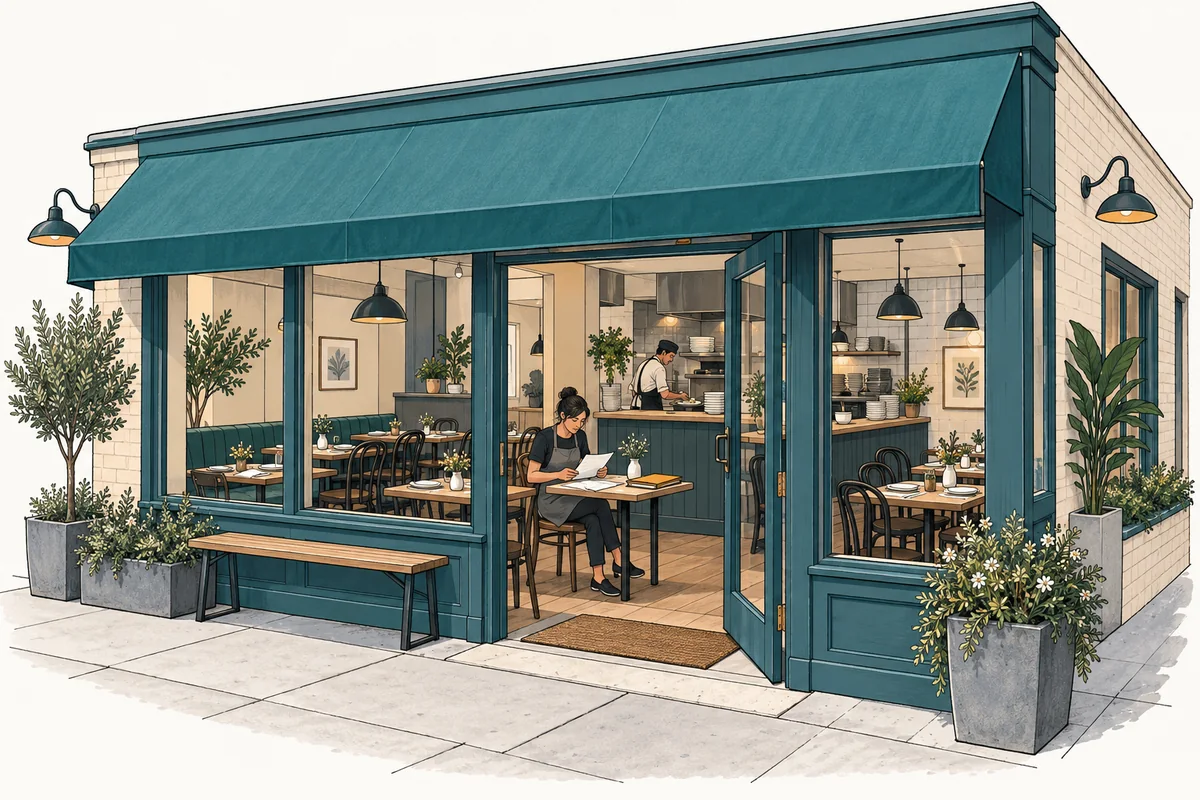
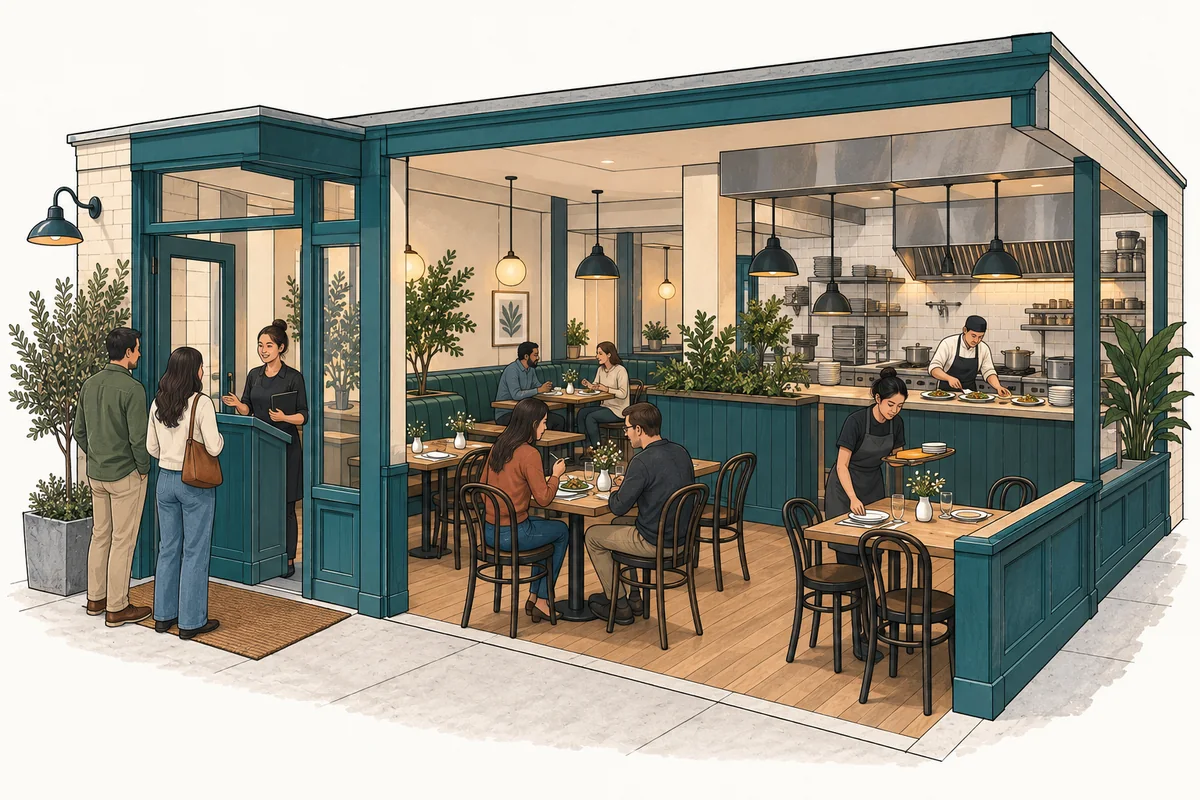
The counter-service takeout restaurant case models an independent U.S. pickup operation with individual and family orders. Its Base forecast runs from January 2027 through December 2031, with service starting in March 2027. The following 2027 inputs are selected planning assumptions in USD, not typical takeout margins or recommended prices.
What remains from the selected order mix?
The case’s mature daily demand combines 100 individual orders at $18 and 25 family orders at $45. That 80/20 mix gives a $23.40 average net order: $18 × 80% + $45 × 20%. Both types receive the same fulfillment fraction when resources are constrained, so rationing does not favor the larger ticket.
Food is budgeted at 32.4% of net sales, packaging at 3.5%, and payment expense at 3.85%. Together they leave 60.25% of sales to cover scheduled payroll and the remaining business costs. The table applies those selected rates to the blended order, with each result rounded to cents.
On a narrow screen, scroll within the table to read all columns.
| Component | Calculation | Amount |
|---|---|---|
| Net order sales | $18 × 80% + $45 × 20% | $23.40 |
| Food cost | $23.40 × 32.4% | −$7.58 |
| Packaging | $23.40 × 3.5% | −$0.82 |
| Payment expense | $23.40 × 3.85% | −$0.90 |
| Contribution before scheduled payroll and overhead | $23.40 × 60.25% | $14.10 |
The $14.10 remainder excludes payroll, employee health benefits, rent, other fixed expenses, depreciation, financing, and tax. It is neither the owner’s income nor cash available to withdraw. It also differs from the model’s gross-profit subtotal, which subtracts food cost but leaves packaging and payment expense in operating expenses.
Why not subtract one fixed labor charge per order?
The staffing plan pays for available work over time. It funds 7.4 full-time equivalents at opening, including a paid owner/manager, while different roles start in January, February, or March. Payroll does not disappear just because fewer orders are fulfilled.
Dividing annual payroll by annual orders can describe the average labor burden of that year. It does not tell you the incremental cost of the next order or how many people must be present at a busy pickup counter. The first forecast year also includes payroll before the restaurant opens, so its average cannot be treated as a mature service-day labor rate.
The importance of the distinction is visible in the saved Base results: 2027 revenue is $686,293 and loaded payroll is $328,158, yet EBITDA is negative at −$54,575 after the remaining operating costs. A positive contribution per order can coexist with a loss-making year. These are modeled results for this case, not a forecast for another operator.
Can more orders use the same paid team?
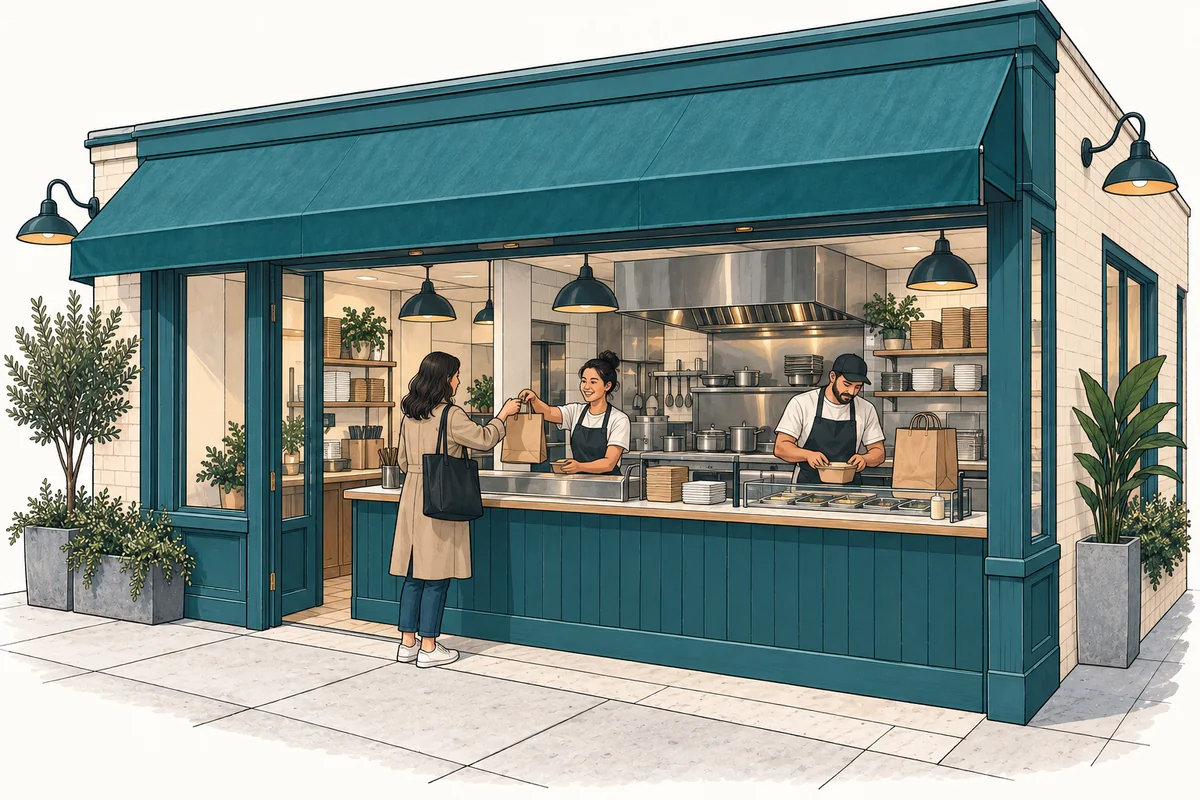
Only if the kitchen and pickup counter can fulfill them. An individual order requires one kitchen workload unit; a family order requires 2.5. They are equivalent production tasks, not a count of people eating, and both products draw from the same kitchen and counter resources.
The case assumes prepaid pickup takes less counter time than a walk-in transaction. With 60% prepaid orders taking 40% of the three-minute walk-in handling time, the weighted requirement is 1.92 minutes per order: 3 × (40% + 60% × 40%). This is a service-time assumption, not evidence that prepaid cash arrives in an earlier forecast month.
Check the constrained workload before adding sales to a scenario. Extra demand beyond available kitchen or counter time is lost in this model. Conversely, adding staff increases the payroll commitment even if demand does not use all the added capacity.
Which assumptions need review when the basket changes?
Food and packaging use percentages of sales in this workbook. The underlying packaging allowance helps explain the selected rate, but the model does not purchase a calculated number of containers for each revised order mix. A price increase therefore raises these modeled costs unless their rates are reviewed.
Payment expense is also a blended approximation based on channel mix and ticket size. Changing prepaid share can affect both handling time and the appropriate payment-cost assumption; changing one input does not establish that the other remains suitable. There are no third-party delivery commissions in this pickup-only case.
- State the individual/family mix and the workload of each order type.
- Check packaging and payment rates against the revised basket and channels.
- Compare total contribution with dated payroll and overhead, then review cash needs.
Use the assumptions review guide to record those changes. The takeout model connects fulfilled orders, paid capacity, expenses, and funding so that the per-order calculation remains part of a complete plan.