The delivery-only kitchen planning case uses one 600-square-foot fitted kitchen and contracted delivery. The examples below use its selected 2027 Base inputs in USD. They describe two ways to sell the same food basket, not current platform offers or guaranteed courier prices.
Which delivery charges belong to each channel?
The marketplace order earns a $32 food subtotal. Its selected commission is 25% of that food amount, and platform delivery is included in the commission. Applying another direct-carrier charge or the direct-payment tariff to the same order would duplicate a cost the case already includes.
A direct order earns $32 for food plus a $5 delivery charge retained by the operator. The kitchen separately pays its contracted courier $8. The retained fee therefore leaves a $3 delivery subsidy to recover from the food sale before considering packaging, payment expense, or labor.
Customer charges kept by a platform are outside operator revenue. Sales tax and courier tips are also excluded. The comparison starts with what the kitchen earns and pays, rather than the total a customer might see at checkout.
What remains from the selected food basket?
Food is budgeted at 32.4% of food sales, so both orders use $10.368 of food cost. The $5 retained direct-delivery charge does not attract that food percentage. This is a sales-based food budget, rather than an itemized recipe or purchasing-yield calculation.
Direct processing is 2.9% of modeled gross tender plus $0.30. Its calculation is $37 × 1.08 × 2.9% + $0.30 = $1.45884. The 1.08 multiplier is a selected fee-base allowance; it does not establish any location’s tax rate.
On a narrow screen, scroll within the table to read both channels.
| Component | Marketplace | Direct |
|---|---|---|
| Food revenue | $32.00 | $32.00 |
| Retained delivery revenue | $0.00 | $5.00 |
| Food cost | −$10.37 | −$10.37 |
| Packaging | −$1.25 | −$1.25 |
| Marketplace commission | −$8.00 | $0.00 |
| Direct courier | $0.00 | −$8.00 |
| Direct payment processing | $0.00 additional | −$1.46 |
| Contribution before scheduled labor and overhead | $12.38 | $15.92 |
The unrounded remainders are $12.382 and $15.92316. Their $3.54116 difference favors the direct order under these particular inputs. It does not establish that direct delivery creates more total business profit: the comparison has not allocated customer-acquisition costs, scheduled staff, or fixed overhead to either order.
Can the kitchen simply switch to the higher-contribution channel?
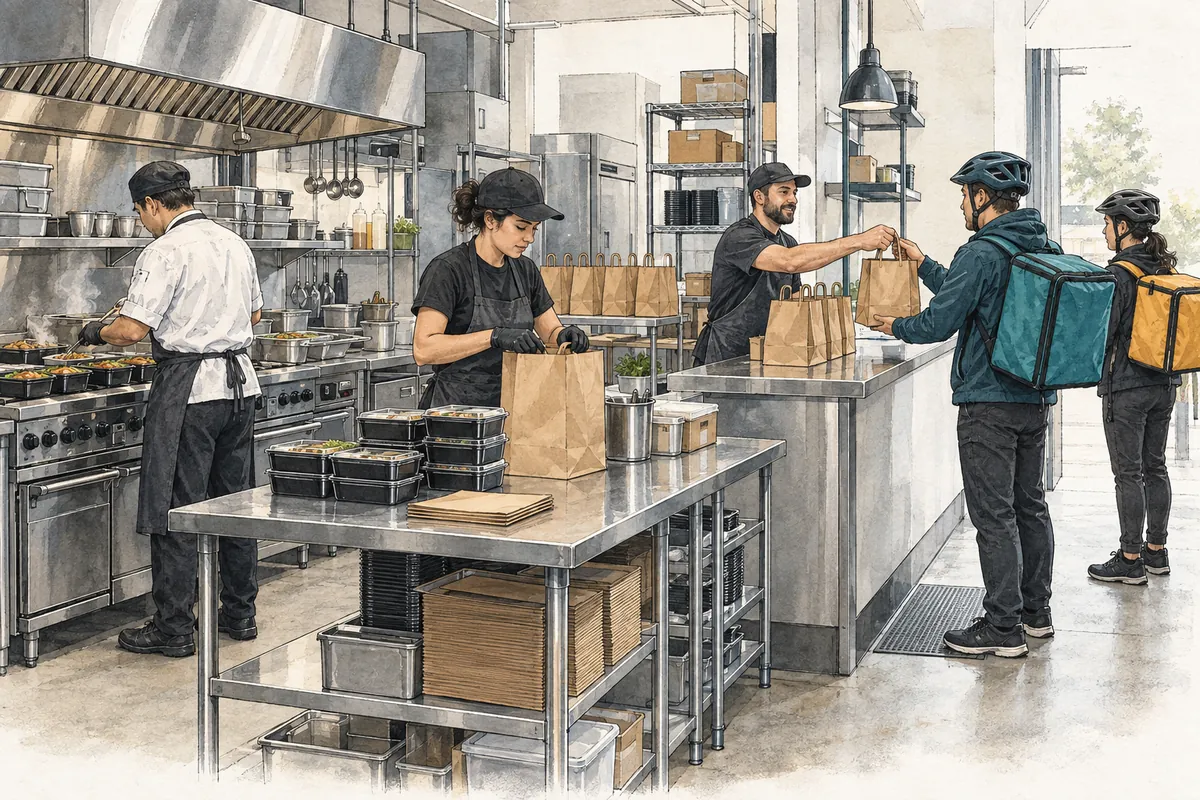
Both channels consume the same funded production resources. Each order needs 1.5 meal-equivalent kitchen units, while internal packing and dispatch take two minutes for marketplace orders and 2.5 minutes for direct orders. The higher direct contribution comes with a different dispatch workload.
The workbook limits fulfillment by kitchen output, paid dispatch minutes, and a shared courier-availability budget. It applies one fulfillment fraction to both channels, preserving the requested mix within each fiscal year. It does not automatically prioritize the more profitable order, optimize delivery routes, or carry lost requests into a backlog.
That distinction matters when testing growth. A channel-level contribution calculation can reveal pricing pressure, but it does not prove that the same team can fulfill a new mix at the same volume. Change the operational assumptions as well as the sales target.
Which evidence should replace the selected fees?
Obtain the actual marketplace agreement and route-specific courier pricing before using this comparison for a launch decision. Check whether delivery, payment collection, promotions, refunds, and optional services are included. A quoted starting fee does not establish the cost or availability of every delivery.
The model’s annual expense ratios reproduce its Base monthly channel costs because the within-year mix and fulfillment factor are shared. Independently varying monthly mixes would need a different monthly cost interface; inherited monetary scenarios also approximate fixed per-order fees. Read those limits alongside the guide to financial assumptions before interpreting a changed sales total as a new operating plan.