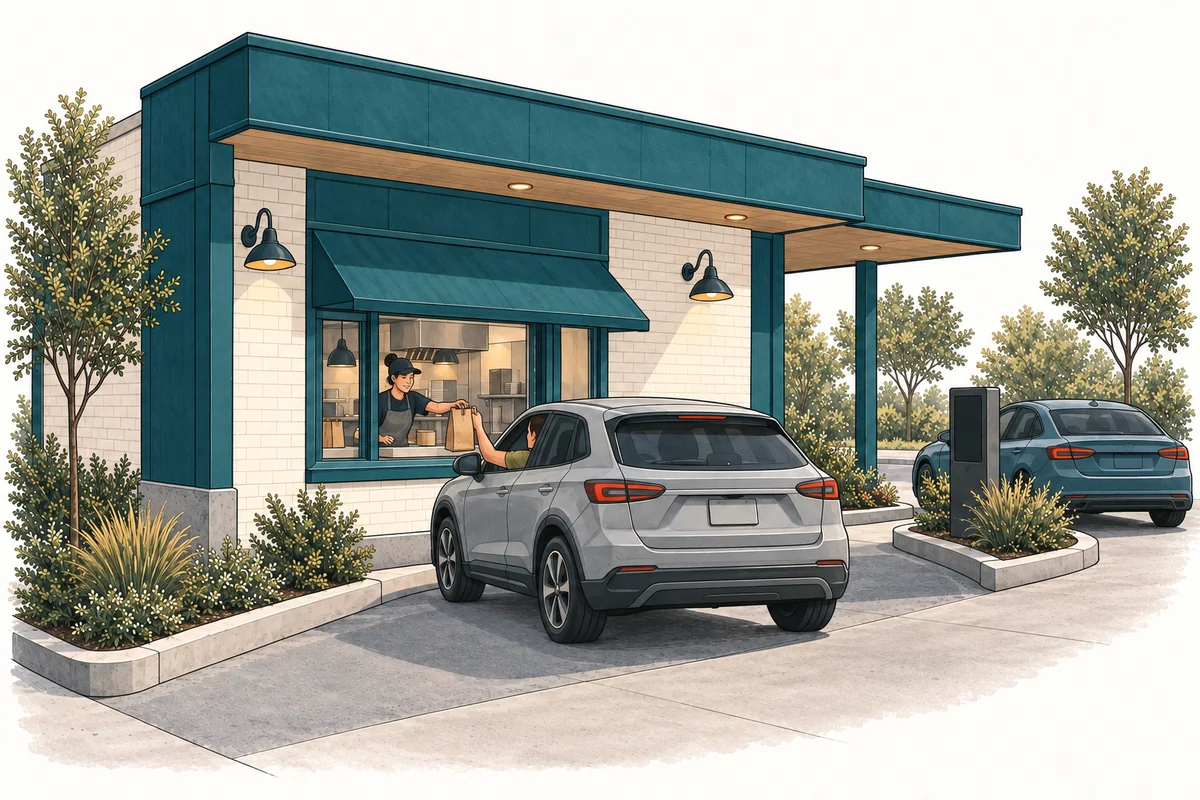
The drive-through burger case is an independent operation in an existing, entitled 1,000-square-foot building on a separate drive-through pad. It has one ordering station and one handover window, with no dining room, delivery business, land purchase, or franchise royalties. The drive-through burger business idea guide addresses suitability; this guide covers the work needed before opening that format.
Is this an approved drive-through site or a development proposal?
Establish the site’s starting condition before building a schedule. Ask what use is approved, whether your proposed operating pattern changes it, and what work or further permissions are required. Obtain the actual approval documents and operating conditions. An existing restaurant building and a large paved area do not by themselves answer whether the planned drive-through can operate there.
The source forecast assumes the premises are secured and entitled before its two pre-opening refurbishment months. That is an explicit case boundary. It is not an estimate of how long a new site, change of use, or new driveway will take. Your opening schedule should identify unresolved approvals rather than borrow the case’s March 2027 service start.
Confirm the responsible planning, building, fire, food-service, and road authorities for your address. The SBA explains that licenses and permits depend on both location and activities. Record the agencies’ actual requirements, submission dependencies, and fees in the site file. SBA launch guidance.
Can vehicles enter, wait, collect, and leave without blocking the site?
Commission a site-specific review of entrances, exits, turning movements, queue storage, deliveries, pedestrian routes, and emergency access. Include waste collection and staff arrival in the review. A lane that appears adequate while empty may conflict with a delivery vehicle or with customers trying to leave other businesses on a shared site.
Confirm who controls the road connection as well as the property. For example, TxDOT’s guidance requires a permit process for constructing or revising access driveways on the Texas state highway system and addresses drainage and engineering review. That is a jurisdiction-specific example, not a national procedure; ask the relevant road authority how your location is treated. TxDOT driveway permits and design guidance.
On a narrow screen, scroll within the table to compare the site checks and required decisions.
| Site element | Question for the project team | Evidence to retain |
|---|---|---|
| Road connection | Which entry and exit movements are permitted, and who approves changes? | Authority confirmation and the relevant access drawings or permissions. |
| Waiting vehicles | Where can the expected queue stand without blocking circulation or leaving the site? | A reviewed layout and a demand/queue assessment for the proposed operation. |
| Pedestrians and deliveries | How do staff, suppliers, and other site users cross or avoid the lane? | Agreed routes and delivery/servicing arrangements. |
| Drainage and weather | What work keeps the lane usable under local site conditions? | Engineering scope, maintenance responsibilities, and itemized costs. |
| Ordering and handover | Can customers see, hear, order, pay, and collect in the proposed configuration? | Installed-system demonstration and a recorded service trial. |
The financial model does not simulate minute-by-minute queues or spillback. Keep that assessment separate and feed any resulting changes in lane availability, service speed, staffing, or site cost into the operating plan. A favorable daily sales total is not evidence that peak queues fit the property.
What opening menu can the kitchen hand over consistently?
Develop the opening burger, side, and drink range as a complete order. Test how cooking, holding, assembly, bagging, condiments, and drink preparation interact. Record ingredient quantities and usable yield, and evaluate quality at handover. A fast grill is of limited value when fries, drinks, or order checking delay the bag.
The selected case uses 1.5 meal equivalents per vehicle order. Consequently, a 20-vehicle rehearsal represents 20 × 1.5 = 30 meal equivalents at that assumed mix. Twenty vehicles is an illustrative test size, not a prescribed opening capacity. A real test should include uneven baskets, modifications, and clustered arrivals rather than treating every vehicle as an identical meal.
Design an exception process before launch: incorrect orders, rejected payments, equipment faults, and unusually large baskets. Decide how staff communicate and where any waiting vehicle can be directed under the approved site plan. Do not improvise a holding area that obstructs accessible routes or the exit.
How will you test the lane with the funded crew?
Observe each stage separately and the customer journey as a whole. Record order-taking time, kitchen completion, handover activity, accuracy, and queue growth. A customer’s total elapsed visit includes waiting and overlapping work; it is not interchangeable with the repeat cycle of a single station.
Rehearse with the roles and relief actually funded. In the case, ordering and handover have separate paid crews, while kitchen preparation, cooking, utility work, and management have their own allocations. Its 11.5 initial full-time equivalents are an annual paid-hours budget, not a verified minute-by-minute shift plan. Check that the actual roster covers peaks, breaks, cleaning, and equipment downtime.
The lane, crew, and production guide explains the model’s separate peak and off-peak limits. Use the opening trial to choose credible inputs and identify the limiting stage. Adding another station should follow evidence that it resolves a constraint and can be staffed, supplied, and accommodated on the site.
What belongs in the opening budget beyond the building?
Obtain separate bids for kitchen work and the vehicle-service infrastructure. Include pavement, drainage, canopy, lane audio, menu boards, lighting, signage, payment systems, and installation where the project requires them. Clarify which assets and repairs belong to the landlord and which are the operator’s responsibility.
The source case separately budgets $90,000 for lane pavement, drainage, and canopy within $507,100 of initial capital spending. Those allowances show why a compact building does not imply a small complete project. They are not site quotations or a national cost standard. Land purchase and franchise costs are excluded from this independent leased-site case.
Map payments to the real construction sequence and funding availability. Account for rent, paid management, training, initial stock, loan costs if applicable, and the cash needed while orders ramp up. If approvals or works delay opening, review each cost start date; the original financing input will not automatically resize itself to the new cash requirement.
What should be complete before inviting opening traffic?
Release the opening date when the site approvals, safe circulation, commissioned kitchen and lane systems, trained roster, and funding are aligned. Confirm a response for failed ordering audio, payment outages, a blocked lane, and unavailable equipment. The test should show how the team reduces or pauses service without losing control of the site.
Begin with a menu and demand level the demonstrated process can support. Track fulfilled orders, order accuracy, queue conditions, meal mix, paid hours, and cash settlements. Use those observations to refine the forecast before extending hours or adding a second channel. More traffic is useful only when the site and operation can convert it into completed orders.