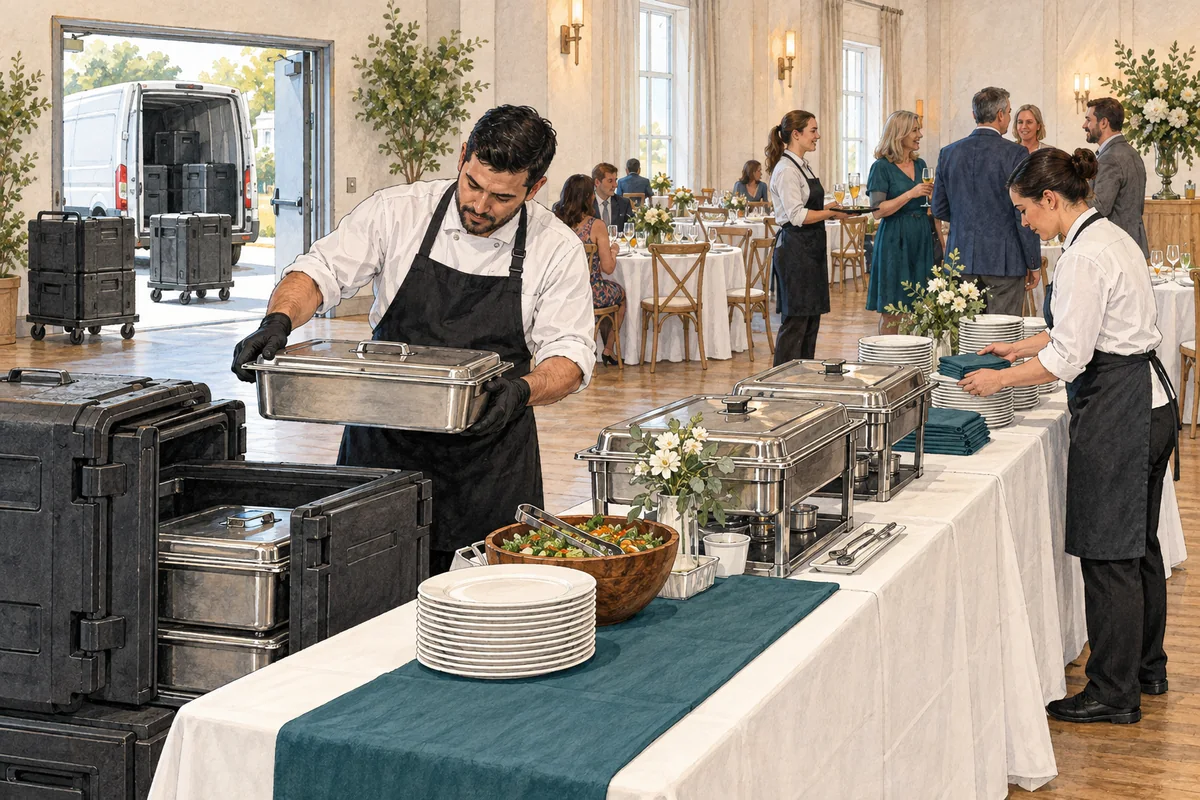
What are you offering beyond a room?
Choose the gathering you intend to serve and describe what the buyer expects you to organize. A room, a meal and a managed event are different promises. A prospective customer needs to understand which decisions remain theirs and which tasks your team takes responsibility for. That boundary also determines the kind of business you will run.
The full-service own-venue planning case operates a dedicated leased banquet venue with owned fitout and equipment. Here, “own-venue” means events take place at the operator’s controlled premises; it does not mean the business buys the real estate. The selected package combines buffet food, soft drinks, furniture, linens and ordinary event service.
On a small screen, scroll horizontally to compare the package boundaries.
| Part of the promise | Selected case boundary | Decision for your concept |
|---|---|---|
| Location | Events at one dedicated leased venue | Whether you want a continuing premises commitment rather than traveling to client locations |
| Food and basic service | Buffet, soft drinks, furniture, linens and ordinary event service | The menu, presentation and service standards your team will deliver |
| Guest numbers | An inclusive package with a supplement above its included guest allowance | The guarantee, price boundary and practical service limit in your offer |
| Reserved time | One exclusive reservation including setup, service and reset | How much of the working day each accepted event occupies |
| Separate services | No alcohol, bartending, DJ, photography or lodging sales | What is excluded and how customer-arranged services may interact with the venue |
This format differs from catering at a client’s location. It gives the operator a recurring setting to prepare and manage, while retaining the ongoing cost and responsibility of that premises. That is a business choice to assess, not evidence that either venue operation or off-site catering is inherently better.
If the attraction is mainly a beautiful space, consider whether you also want to manage the included food and service. If the attraction is mainly cooking, consider whether you want responsibility for a fixed event venue. Your answer may change the concept before a detailed forecast becomes useful.
Can you state exactly what one booking buys?
Write the package as a specific customer offer. Identify the included guest allowance, what an additional guaranteed guest changes, which services are included and where the reservation begins and ends. A package price without these boundaries cannot be compared meaningfully with another venue’s offer.
In the selected 2027 planning case, the base package is $9,500 for the first 100 guests, with a $60 supplement for each additional guaranteed guest. At a guarantee of 120, the event price is $9,500 + (120 − 100) × $60 = $10,700. These are analytical inputs for this case, not a national event-price average or a quote for your venue.
The example helps define the product: the first 100 guests are already inside the base package, while food and service still have to cover them. The supplement does not turn those included guests into another sale. If you change the menu, service scope or guarantee, reconsider the resources needed to deliver the whole package.
Customer conversations can test whether the offer solves the intended problem. Show the actual inclusions and exclusions, ask what the buyer would still need to arrange and record objections. Interest in a room photograph is weaker evidence for this particular business than interest in the complete proposed service at a stated price.
Would your premises and calendar support that promise?
The selected venue occupies 6,000 square feet and has a conditional 150-guest ceiling. Neither number certifies a proposed building’s legal occupancy or service suitability. Kitchen throughput and paid staff can constrain the usable event capacity even within the selected guest ceiling. Your own layout, menu and service arrangements need their own assessment.
The model allows one exclusive reservation per available Thursday through Sunday. Each reservation occupies ten hours: three for setup, six for service and one for reset. Those are case assumptions, but the decision they expose is useful: an event uses the premises before guests arrive and after they leave.
Think about the calendar you are willing to operate. Discuss when prospective customers want to gather and how their preparation needs interact with your team and space. Do not treat every unoccupied hour as another saleable event slot. A longer setup or a different cleanup requirement can change the offer and the work needed to deliver it.
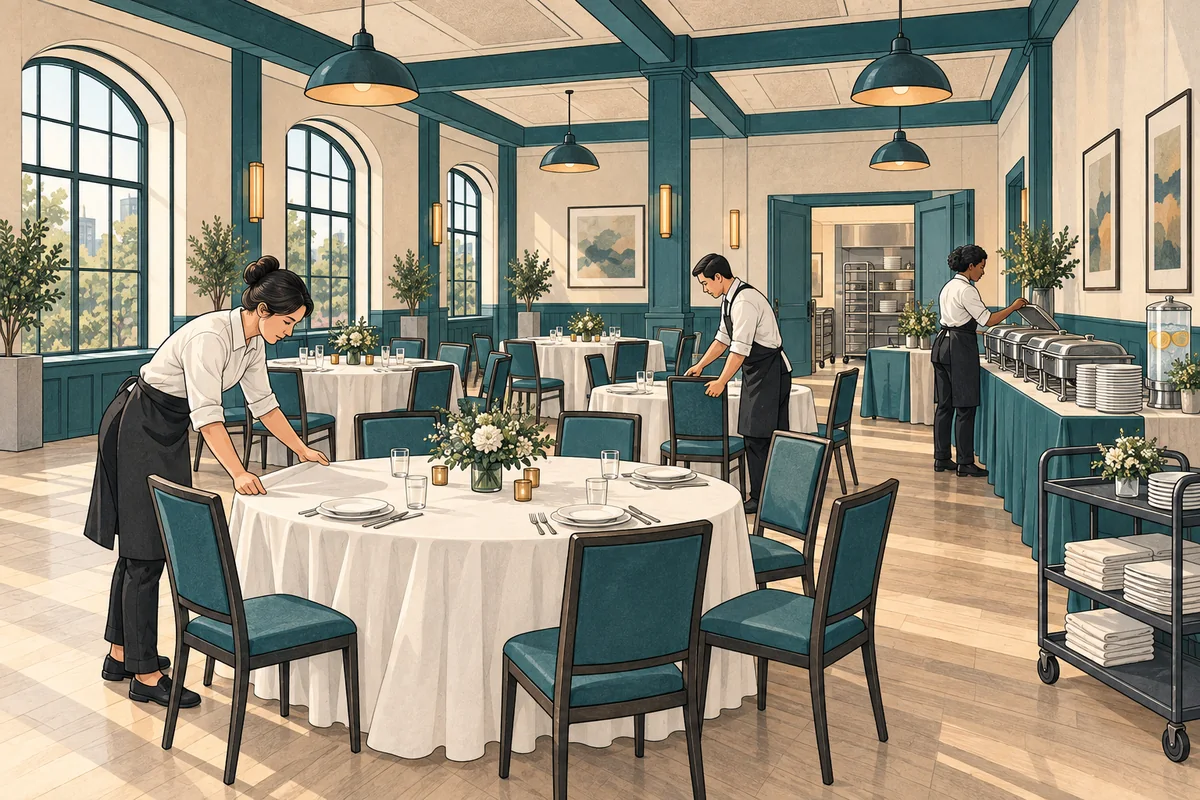
A venue tour should therefore test more than appearance. Trace how the intended furniture, food preparation, guest service and reset would work together. Keep measurements and operational trials separate from promotional imagery. A conceptual illustration can explain the service; it cannot validate a floor plan.
Do you want to manage the work between event days?
The source case funds an owner/general manager, coordinator, chef and event crew. Its crew capacity comes from paid annual staffing commitments, with unused capacity remaining paid. The rotating roster contains more people than the full-time-equivalent staffing measure: a roster headcount and funded labor hours describe different things.
This makes the quiet days part of the business decision. Someone must handle inquiries, explain packages, coordinate the agreed event and prepare the operation before service begins. Identify which responsibilities you will perform and which need paid help. Do not assume the founder can cover every gap without changing the planned workload.
You will also need a clear approach to cancellations and customer money. The selected case refunds the original deposit when an event is canceled, earns no event sale and retains the cost of original processing fees. Those are modeled contract assumptions, not a universal refund rule. The bookings, deposits and cash guide examines the accounting separately.
Business suitability depends on whether you want to manage these commitments consistently. An enthusiastic sales conversation and a well-run event are both necessary tasks in the proposed offer. Neither automatically pays for idle time, and a full-looking inquiry calendar is not the same as completed paid events.
What evidence would justify choosing this business idea?
A stronger shortlist case combines a defined buyer, interest in the complete package, a plausible premises arrangement and a funded team capable of delivering the promised service. Keep evidence of each separately. That makes it easier to see whether an unresolved weakness concerns the offer, the location, the operating plan or the commitments you are prepared to accept.
Before committing to a property, identify local reviews relevant to the proposed premises, food operation and event use. The SBA notes that licensing requirements vary with activity and location in its business launch guidance. The national planning case establishes neither local permissions nor a universally applicable opening timetable.
Set conditions for reconsidering the idea. You might reject a premises arrangement that cannot support the proposed service, narrow a package that creates too many delivery obligations, or delay a commitment while customer evidence remains weak. These are choices to define for your situation, rather than fixed industry thresholds.
Once the operating proposition is specific, use the model to examine fewer completed events, different guest guarantees, cancellation changes and the paid staffing required. Read the guide to financial assumptions alongside it. The goal is a decision about an identifiable venue business, with its remaining uncertainties visible.