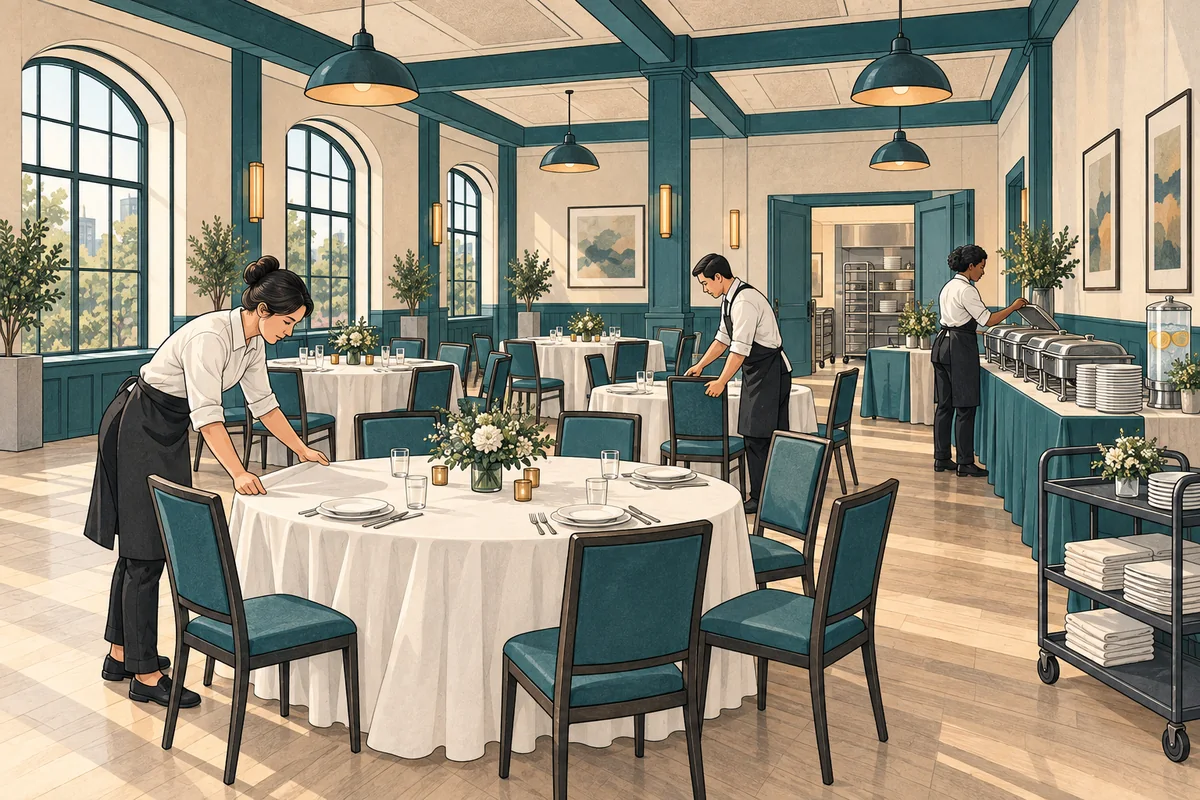
Two selected U.S. cases make the distinction concrete: an off-site catering operation and an event coffee bar. Both use a 100-guest guarantee, but their service commitments and cash rules differ. The figures here are 2027 Base planning assumptions in USD, not standard contract terms or market averages.
Which count determines the invoice?
The caterer charges the greater of guaranteed and actual guests. With 100 guaranteed guests and 95 attending, the selected $45 inclusive package earns $4,500. A separately priced $300 china-and-linen package brings the event total to $4,800.
Delivery, staffing, setup, and breakdown are already included in the $45 package. The extra china-and-linen charge covers a distinct optional service; the model selects it for every contract. Adding another general delivery or service charge would misstate the saved offer.
The coffee bar instead charges $9 per guaranteed guest for its defined service window. Expected attendance is 85%, and optional branding adds $100 on 25% of events. The resulting $925 is expected revenue across that branding mix, not the invoice for every individual booking.
On a narrow screen, scroll within the table to compare both packages.
| Quantity | Off-site catering | Event coffee bar |
|---|---|---|
| Guaranteed guests | 100 | 100 |
| Actual or expected attendees | 95 selected actual attendees | 85 expected attendees |
| Billing calculation | 100 × $45 + $300 | 100 × $9 + 25% × $100 branding |
| Revenue per event | $4,800 | $925 expected across the branding mix |
| Workload example | 23.83 aggregate casual crew hours | 110.5 expected drinks over 2.5 service hours |
| Monthly event units | Whole accepted events | Expected events, potentially fractional |
Which count determines food and labor?
The caterer’s ingredients and guest-service workload follow the 95 actual attendees. Casual service uses eight aggregate crew hours for travel, setup, and teardown, plus ten crew-minutes per attendee: 8 + 95 × 10 ÷ 60 = 23.83 crew hours. That total can be distributed across several workers; it is not a 23.83-hour event.
Casual event labor is a direct operating cost. Core production and driver staff are separately scheduled and paid, so their wages must not be added a second time to the casual-hours calculation. Actual attendance above the guarantee raises both the caterer’s billing and its resource requirement.
The coffee package requires 100 × 85% × 1.3 = 110.5 expected drinks. Those drinks must fit both preparation capacity and the machine’s 125-drink allowance over the selected 2.5-hour service window. A guarantee describes the promise being sold; it does not prove that the machine and crew can fulfill it.
Does an available date mean the event can be accepted?
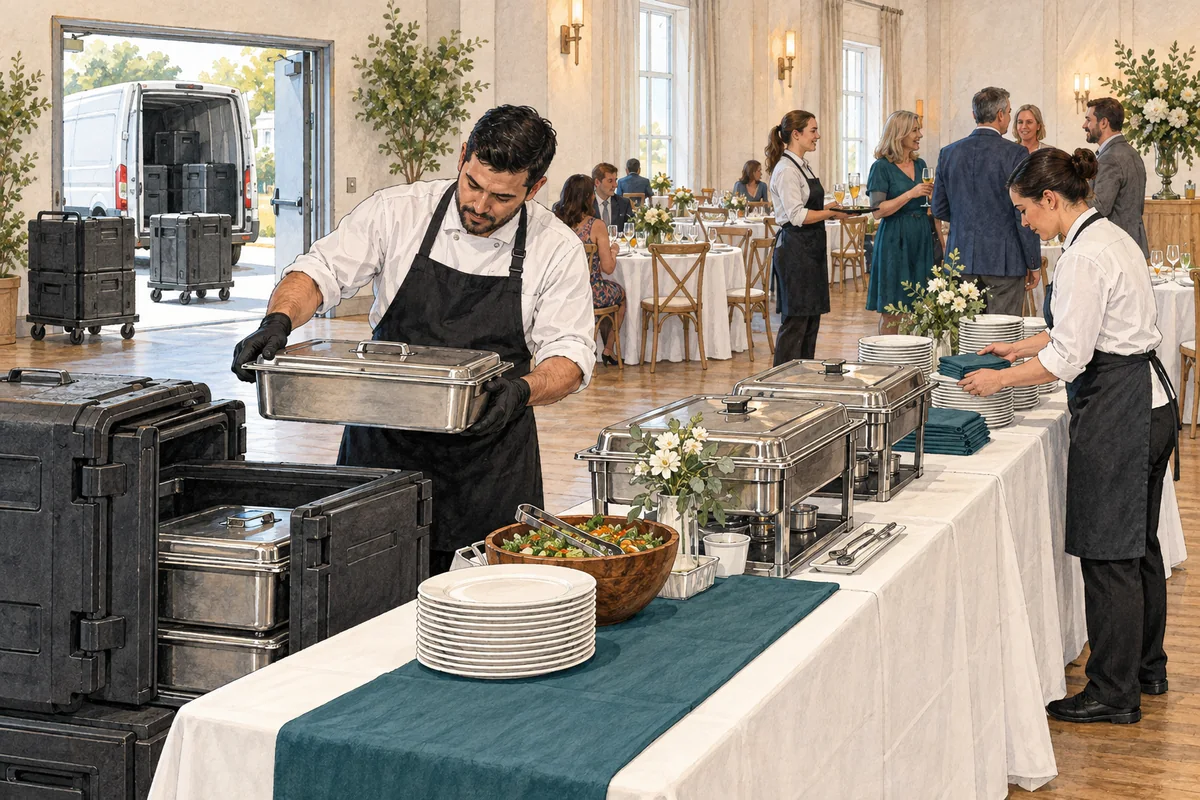
The caterer accepts whole events only after checking kitchen output, available casual crew hours, paid driver time, and equipment/calendar capacity. One funded van and reusable service set cannot automatically support simultaneous bookings at separate venues.
The coffee bar reserves six hours per crew member for service, preparation, travel, setup, and teardown. Its assistant has 120 paid monthly hours less 12 hours of relief allowance, supporting (120 − 12) ÷ 6 = 18 events. Selling only 2.5 hours of coffee service still commits those additional paid hours.
Neither case replaces a booking calendar. Catering assumes accepted events occupy distinct available dates; the coffee forecast can report fractional expected events. Check actual dates, travel, power, setup access, and overlapping commitments before converting either monthly forecast into accepted bookings.
How do the two cases treat advance cash?
The coffee model collects half the contract price one month before service and half at delivery, with the opening month’s advance collected within that month. Advances remain liabilities until service. Separate deposit and balance charges affect processing costs, and the case does not model cancellations.
The catering workbook deliberately omits an advance/deferred-revenue schedule. It recognizes fulfilled events and uses two-day receivables to approximate settlement, without cancellation cash flows. Importing the coffee bar’s advance benefit into the catering cash forecast would therefore add a mechanism that is absent from that model.
For a proposed business, settle the package scope, guest guarantee, overage rule, and cancellation terms before estimating the cash advantage of deposits. The venue booking guide shows a different deposit-and-refund design; its terms likewise belong to that specific case.