
Coffee Shop Financial Model: Event Coffee Bar
Plan a host-paid event coffee package with guaranteed guests, actual drink workload, crew commitments, branding and advance collections.
- Excel (.xlsx)
- Package: 100 guaranteed guests / 2.5 service hours
- Expected consumption: 85% attendance × 1.3 drinks = 110.5 drinks/event
- Resources: One bar / one two-person crew
Planning several types? Compare 8 coffee shop formats
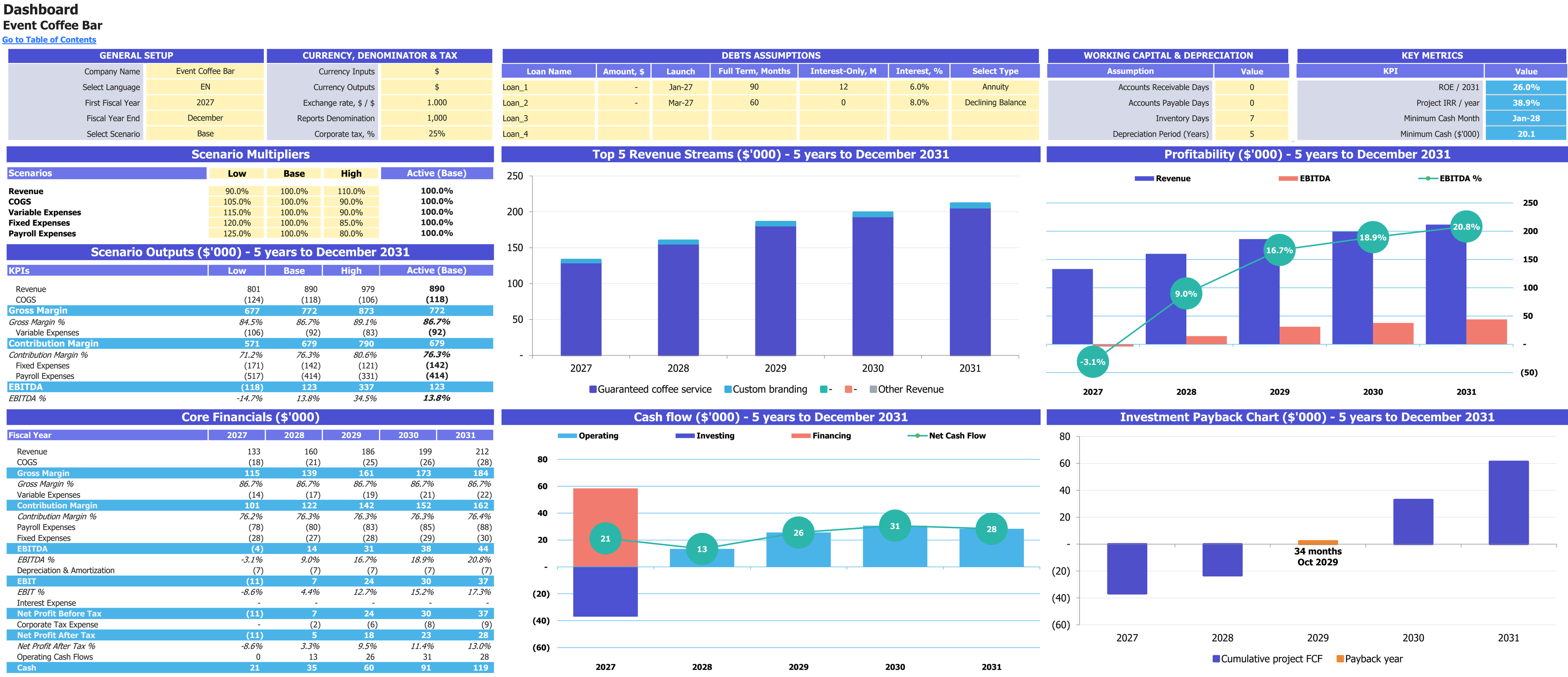
Base-case scenario controls, annual financial results and charts for 2027–2031. Financial report amounts are shown in thousands of USD; percentage measures retain their own units.
Enlarge image in a new tab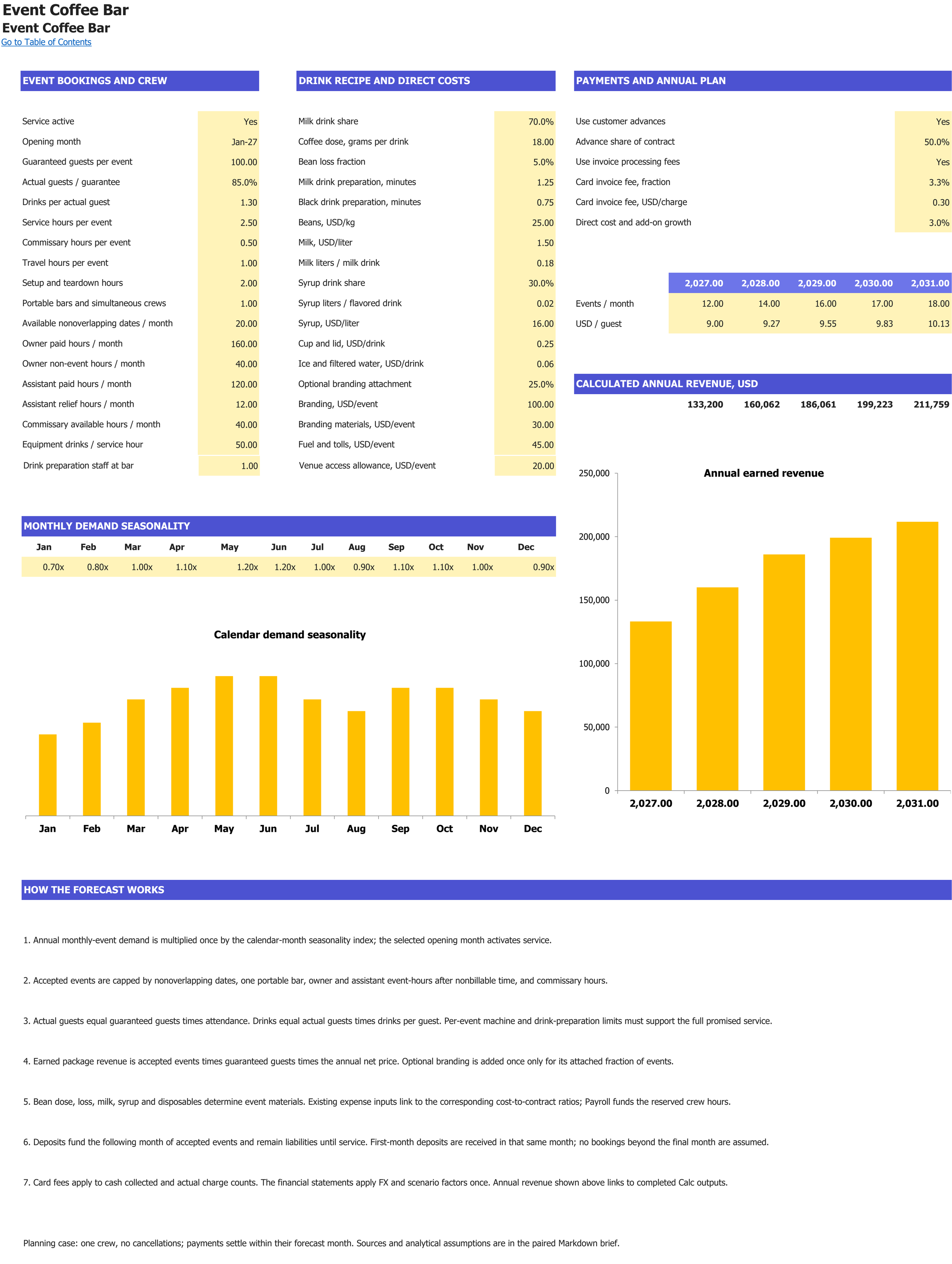
Event packages, guaranteed guests, portable coffee-bar throughput and paid crew hours. Monetary inputs and sales use USD; operating volumes retain their labelled units. Forecast years are 2027–2031.
Enlarge image in a new tab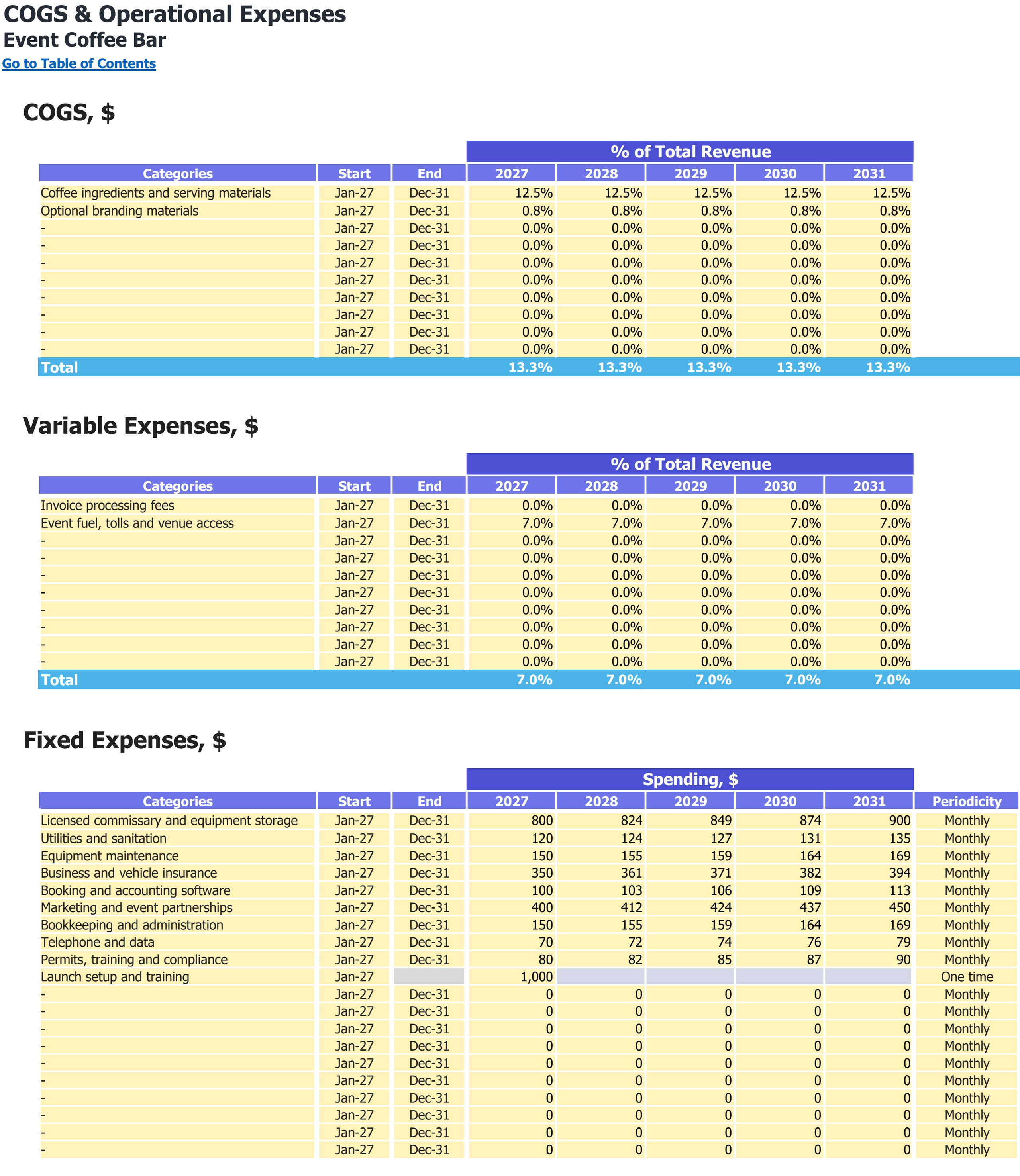
Food and other direct-cost categories, variable expense shares and fixed operating expenses. Monetary inputs are USD; the annual percentage columns are cost shares of revenue.
Enlarge image in a new tab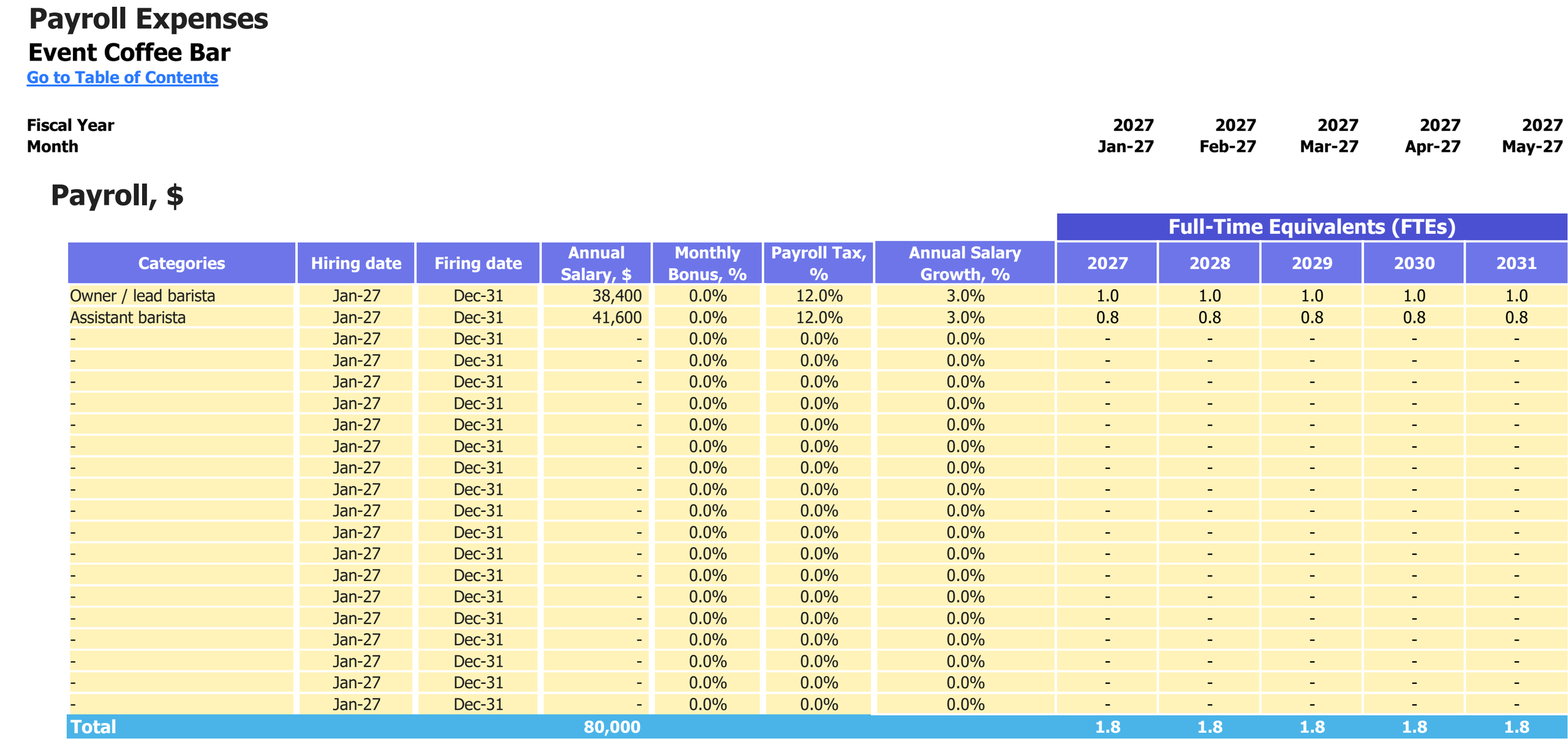
Paid roles, annual salary and employer-load assumptions, with staffing in full-time equivalents for 2027–2031. Salary amounts are USD; percentages and FTEs are labelled separately.
Enlarge image in a new tab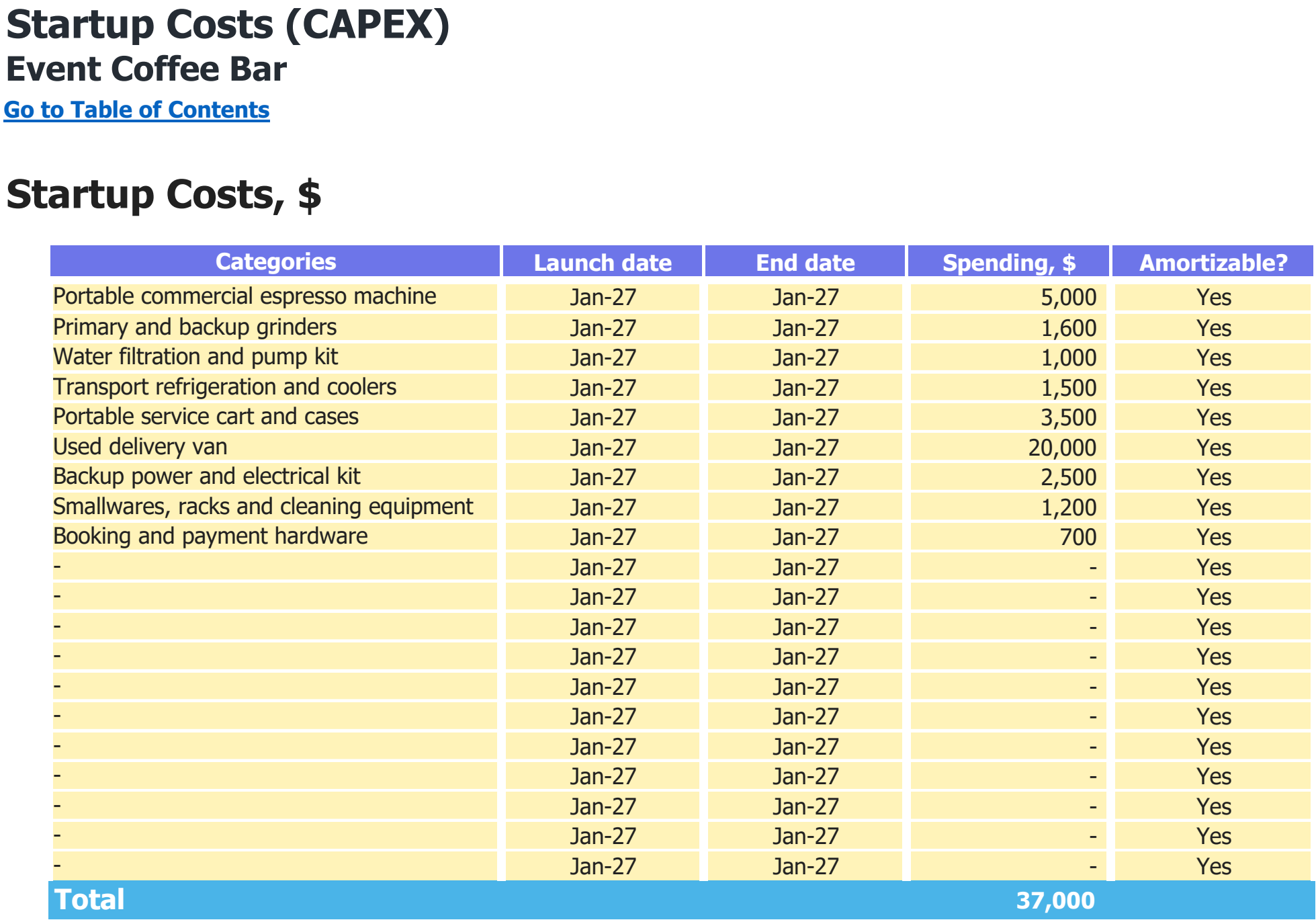
Asset categories, purchase dates and spending assumptions in USD. The total includes every scheduled purchase shown, including later replacements where present.
Enlarge image in a new tab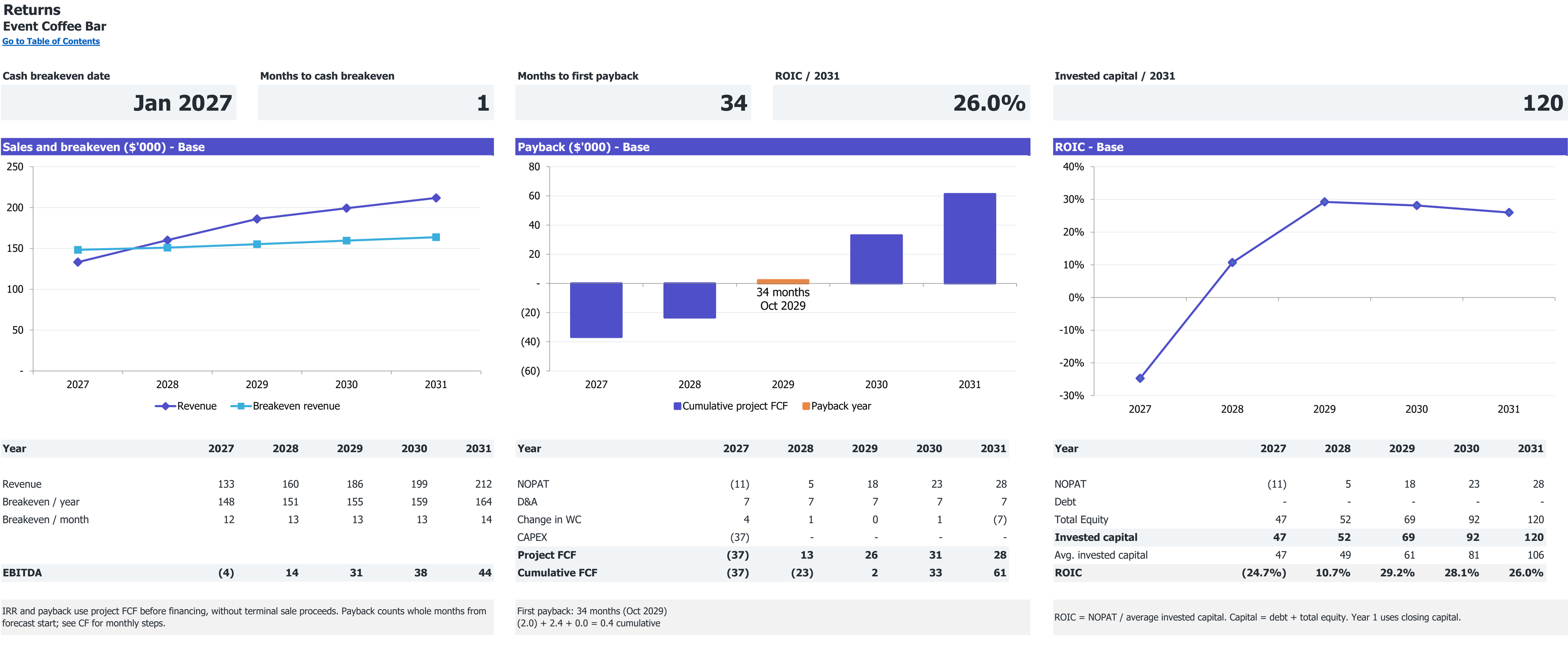
Excerpt from Returns: cumulative project free cash flow and first payback, if reached. 2027–2031 base case; dollar amounts in thousands.
Open full Returns view in a new tabExcerpt from Returns: revenue, annual and monthly break-even revenue, and EBITDA. 2027–2031 base case; dollar amounts in thousands.
Open full Returns view in a new tab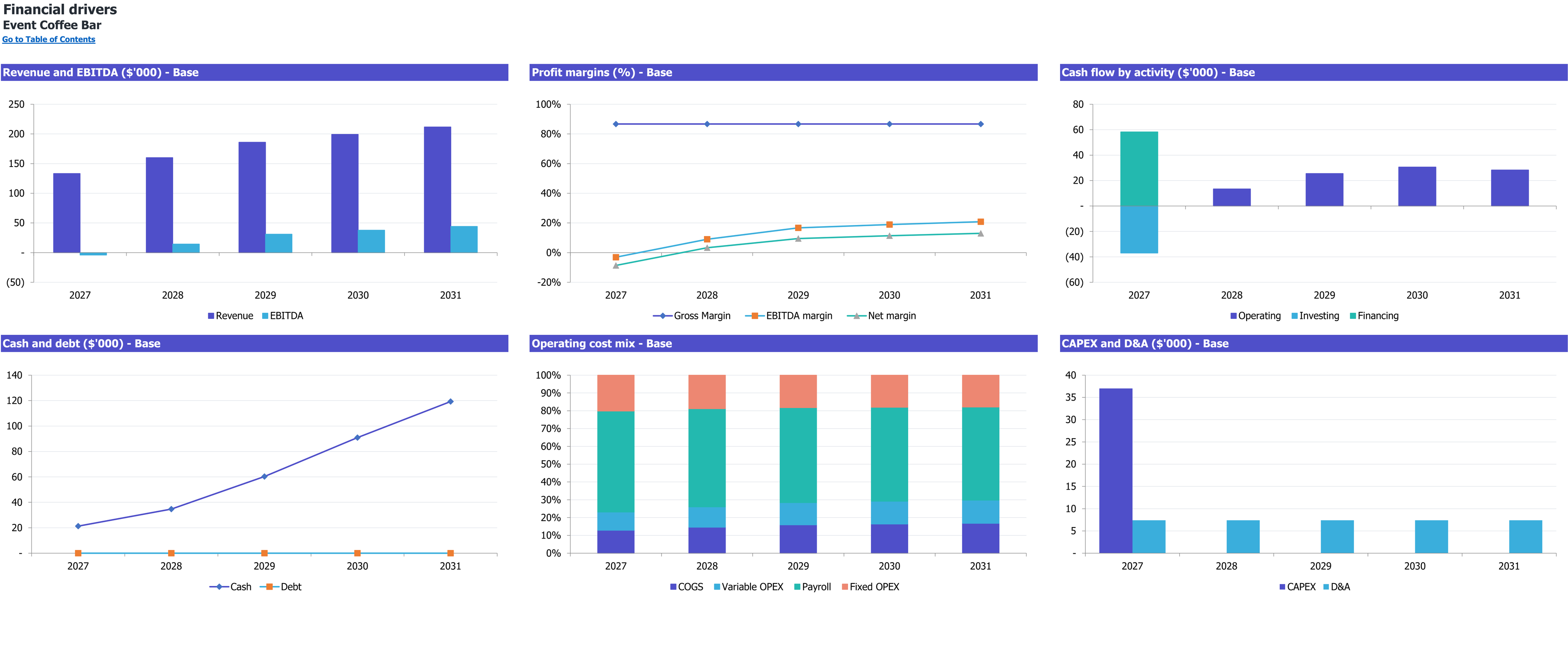
Six annual financial-driver charts for Event Coffee Bar, 2027–2031 (Base scenario). Dollar amounts are in thousands; margins and cost mix are percentages.
Enlarge image in a new tab8 selected worksheet views. Figures show this workbook’s starting case.
Workbook availability
What is inside the Excel model
Price a guaranteed-guest coffee package while testing the drinks and paid crew hours needed to deliver it. Track deposits separately from earned event revenue and keep seasonal cash needs visible.
Selected worksheets from the documented workbook. Forecast period: January 2027–December 2031. Model reference: PHY002-05.
Inputs you control. Results you can inspect.
On a small screen, scroll within the table to read every column.
| Planning area | Inputs you review | How they connect | Results to inspect |
|---|---|---|---|
| Bookings | 12 initial events/month before seasonality; 18 by year five. | Apply demand factors and the limiting paid event-hour capacity. | Delivered events, capped at 18/month in the saved case. |
| Package and workload | $9 per guaranteed guest; 85% attendance; 1.3 drinks/attendee. | Bill the guarantee while checking the entire expected drink requirement. | Earned package sales and feasible service. |
| Crew time | Six hours per person/event, including travel and setup. | Deduct owner administration and assistant relief before accepting events. | Paid event capacity and utilization. |
| Advance receipts | 50% before service; 50% at service; separate charge fees. | Release advance liabilities on delivery and unwind final bookings. | Collections, processing and customer obligations. |
| Funding | $37,000 assets; $58,000 equity; $20,000 reserve. | Include inventory, seasonality and advance movements in cash. | Minimum balance and project recovery. |
Is this the right model for your business?
Check the starting case before changing the assumptions.
The starting operation
- A portable espresso bar selling host-paid event packages.
- One two-person crew serving a fixed guaranteed-guest offer.
- An operator evaluating booking utilization and advance-payment cash timing.
Check the boundary
The saved case excludes simultaneous crews, cancellations/refunds, variable guest cohorts, individual guest billing and cross-month processor settlement.
Compare the other coffee shop typesHow this business makes money
Connect the unit sold to the resources required by this operating case.
Revenue logic
Delivered event packages billed on guaranteed guests, plus optional branding on the same event.
Attendance and drinks determine service workload; they do not replace the billing guarantee.
Why do guaranteed guests, attendees and drinks need separate inputs?
The guarantee sets the host’s package charge. Attendance and drinks per attendee set ingredients and service work. Increasing consumption can make a promised event infeasible even when the contract price stays unchanged.
- Billing
- 100 guaranteed guests
- Workload
- 110.5 expected drinks/event
- Paid commitment
- Six hours per crew member/event
What to establish for your own operation
- Validate guarantee, attendance and drink demand independently.
- Check the whole event against machine and preparation limits.
- Test deposit removal and low seasonal bookings against the cash reserve.
Follow the plan from demand to cash
Open each section for the assumptions, calculations, and limits of this workbook’s starting case.
Separate the guarantee from drink consumptionRevenue
The host buys a package for 100 guaranteed guests. Expected attendance is 85%, producing 110.5 drinks at 1.3 per attendee. Billing remains based on the guarantee, initially $900, with $100 branding attached to 25% of events.
One complete package must fit both machine and preparation capacity. The 2.5-hour machine budget allows 125 drinks. Branding adds consideration and materials without creating a second event in the volume count.
- Expected monthly bookings can be fractional.
- Actual event dates need a separate booking schedule.
- There are no cancellations or refunds in the saved contract.
Pay for six hours of work around 2.5 hours of servicePayroll
Each crew member reserves six hours for preparation, travel, service and setup/teardown. Owner administration and assistant relief are deducted before calculating capacity. The assistant’s remaining hours set the saved 18-event monthly limit.
The 70% milk and 30% black drink mix drives ingredients. Bean loss applies only to beans; milk and syrup use their stated portions. Paid owner and assistant wages continue when bookings fall, alongside fixed commissary, insurance and marketing costs.
- Year-one loaded payroll is $77,952.
- Travel and venue access start at $65 combined per event.
- Gross margin deducts direct materials only; it excludes payroll and transport.
Keep host advances separate from fundingCAPEX
January assets total $37,000, including a portable machine/cart, power and water equipment, refrigeration, hardware and a $20,000 used van allowance. Assets use five-year book depreciation.
Owner equity is $58,000 with no debt. Advance receipts also support cash, but remain service obligations. No bookings are assumed beyond month 60, so the final advance liability unwinds to zero. Minimum funded cash is $20,087 in January 2028.
- First-month advances are collected in that same month.
- Invoice fees follow actual deposits and balance charges.
- No additional equity, loan repayment or owner distribution is modeled.
Read seasonal cash alongside the first profitable event monthsCF
Base 2027 revenue is $133,200 and EBITDA is −$4,094. EBITDA first becomes nonnegative in April 2027, with later seasonal losses. Operating cash is positive in January partly because of advances, so that crossing is not operating-profit break-even.
Project payback occurs in October 2029, month 34, with no later reversal. It uses cumulative undiscounted unlevered cash after inventory, advance movements and CAPEX, before equity funding.
- Removing advances lowers minimum cash to $14,085 without changing earned sales.
- The Low monetary scenario produces −$93,722 minimum cash with Base equity fixed.
- Multiple cash-flow sign changes retain the disclosed IRR interpretation warning.
Selected results from the starting case
Modeled results in USD unless stated otherwise. These describe the selected inputs, not an estimate for your location or a guaranteed outcome.
- 2027 revenue
- $133,200USD, Base; delivered packages and expected branding.
- 2027 EBITDA
- −$4,094USD, Base; paid owner/assistant and seasonal costs included.
- Initial CAPEX
- $37,000USD; January 2027 portable assets and used van allowance.
- Minimum cash
- $20,087USD, funded Base balance in January 2028.
- Project payback
- October 2029 / month 34Cumulative undiscounted project cash recovery; no subsequent reversal or owner payout.
Make the case your own
Work from the operating plan toward the cash requirement.
Set package terms, guarantee and expected consumption.
Validate crew time and the complete service promise.
Replace materials, travel and portable-asset budgets.
Review booking seasonality, advances and fixed-funding downside.
Interpretation and scope
- Regional supplier offers do not establish national prices or a confirmed booking pipeline.
- Expected event counts are not a dated schedule.
- Cancellations, refund policies and sales-tax collection are outside the saved scope.
- The 25% tax allowance has no selected entity/state calculation or loss carryforward.
- The native IRR pattern warning prevents treating one displayed rate as a uniquely established return.
The workbook is an Excel file for local planning. Learn how to interpret assumptions and evidence.
Other coffee shop types
Each operating type calls for its own financial structure.
Questions
Does lower attendance reduce the bill?
No. The saved package bills the guaranteed guest count.
Is branding another event?
No. It adds revenue and materials to the same event.
Are deposits revenue on receipt?
No. They remain customer advances until delivery.
Can the bar cover simultaneous bookings?
No. The case has one bar and one crew.
Does January positive cash mean the operation is profitable?
No. Advance receipts help cash before the first nonnegative EBITDA month.
Can I buy this model now?
No. Purchasing and workbook downloads are not available on this site.
Which software does the workbook use?
The documented file is an Excel workbook (.xlsx). Compatibility with other spreadsheet applications is not established by the file extension.
Read the planning guides
Explore the relevant operating questions and how to interpret a workbook’s assumptions.
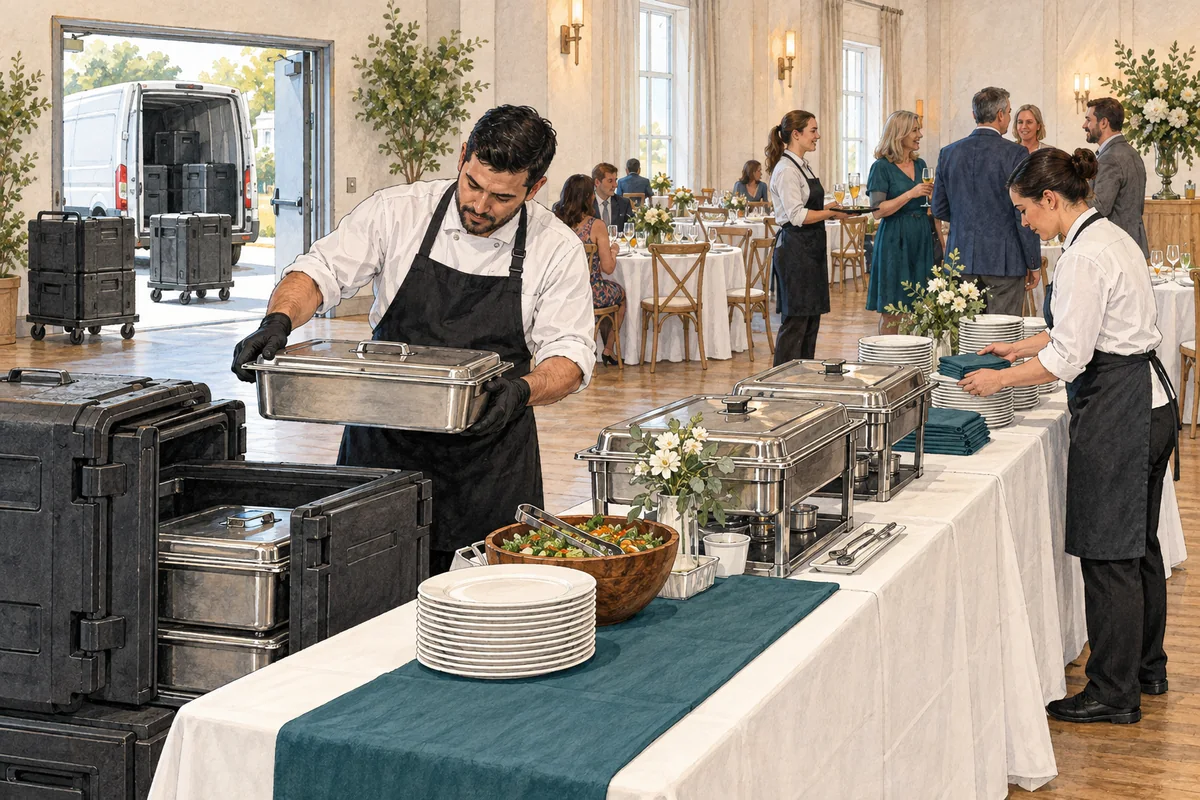
How do event guarantees differ from actual service workload?
Compare a staffed catering package with an event coffee bar to separate guaranteed billing, expected attendance, crew capacity, and advance cash.
Read the guide
How to read financial assumptions before editing an Excel model
Follow the chain from operating assumptions to calculated results, check units and timing, and keep a useful record of changes to a financial workbook.
Read the guideEvidence and scope
A related category or operator is referenced. Do not interpret the link as independent proof of this exact configuration or its viability.
The links below provide operating-format context; they do not verify the workbook’s selected inputs or calculated returns.
The workbook guide and figures describe model PHY002-05, revision r01, for January 2027–December 2031. These are a documented planning case, not observed results for a particular business.