
Coffee Shop Financial Model: Seated Coffee Shop
Plan a seated coffee shop with drink-and-pastry tickets, dwell time, barista capacity, recipe costs, startup funding and five-year cash flow.
- Excel (.xlsx)
- Forecast: 60 months · January 2027 opening
- Starting scale: 32 seats · 1,600 sq ft
- Planning case: U.S. · USD · Base
Planning several types? Compare 8 coffee shop formats
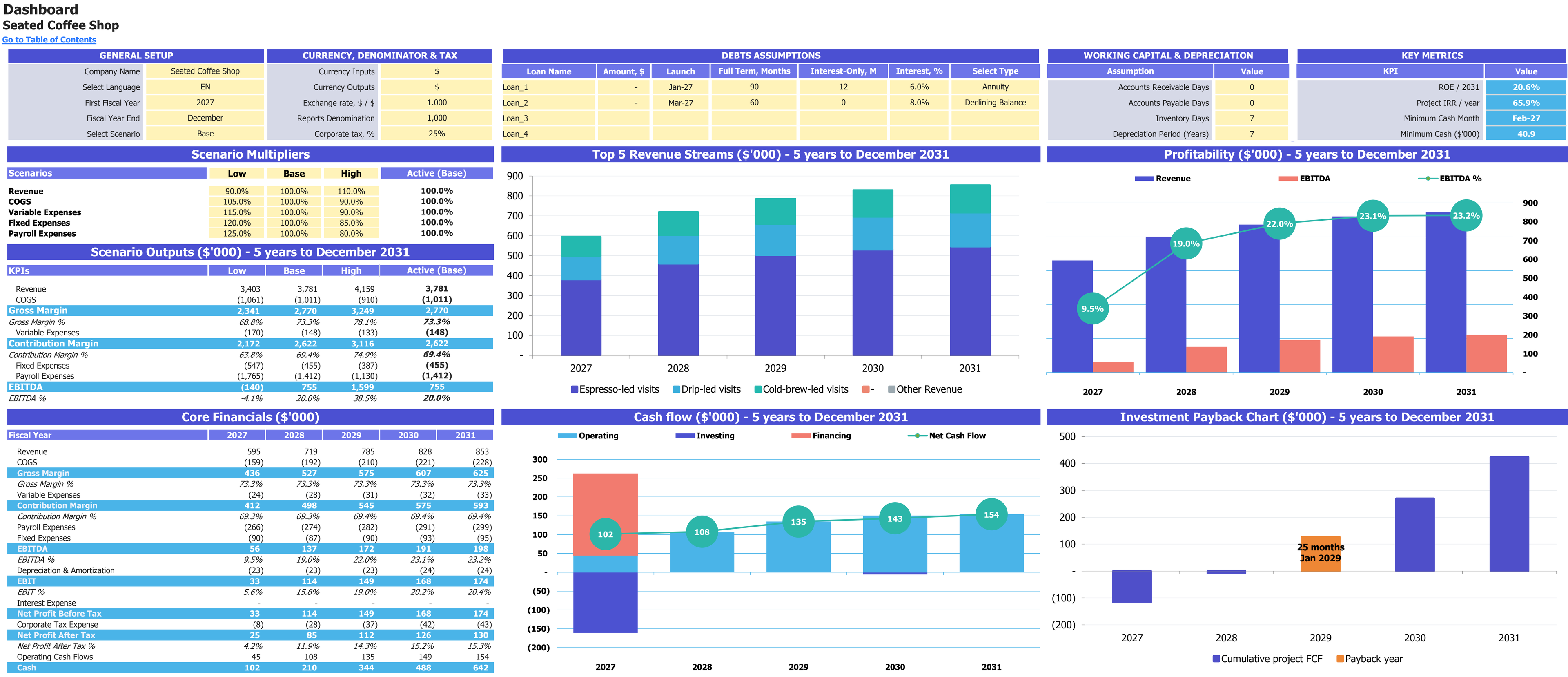
Base-case scenario controls, annual financial results and charts for 2027–2031. Financial report amounts are shown in thousands of USD; percentage measures retain their own units.
Enlarge image in a new tab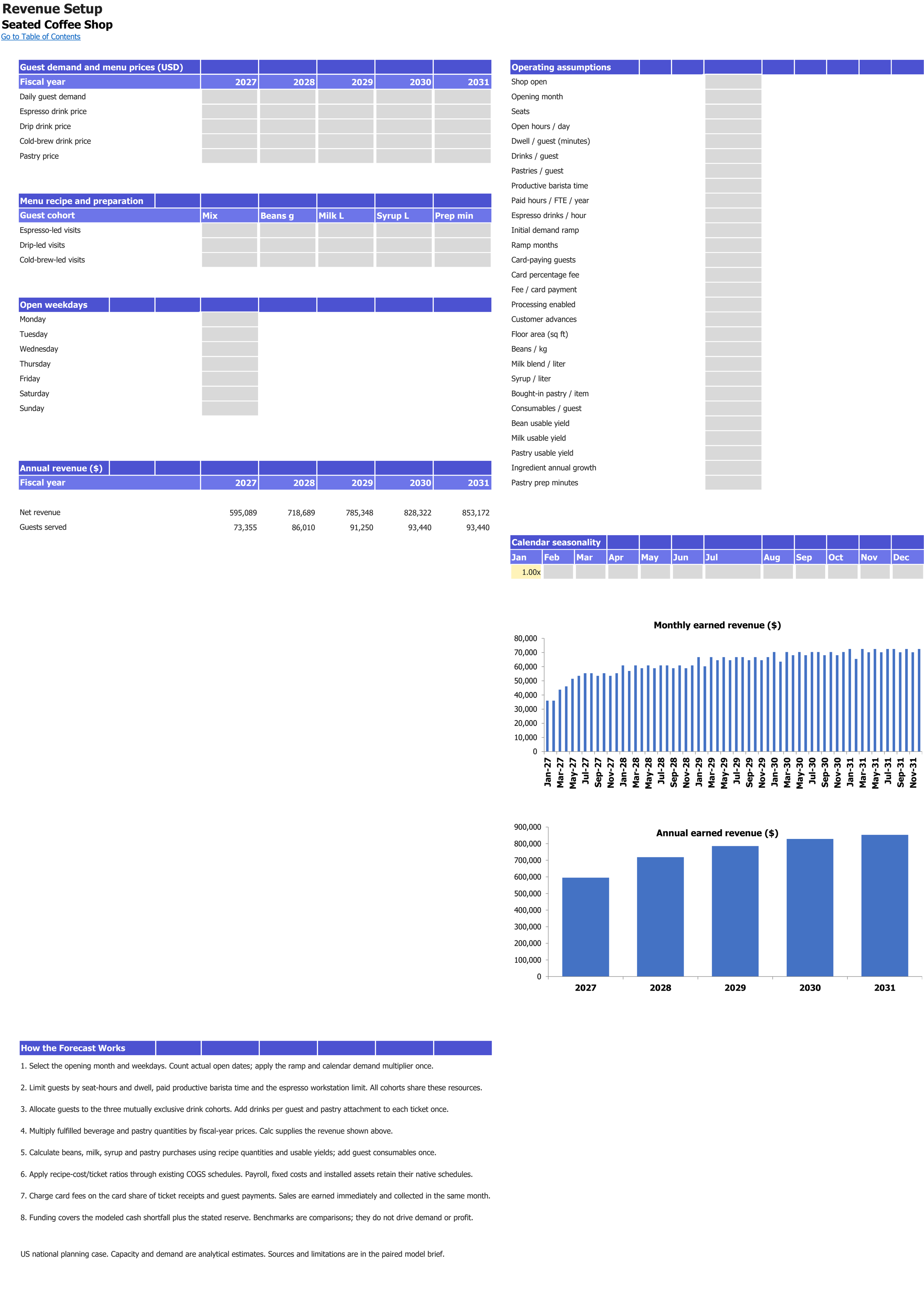
Guest demand, menu prices, dwell time and paid preparation capacity with monthly and annual operating results. Monetary inputs and sales use USD; operating volumes retain their labelled units. Forecast years are 2027–2031.
Enlarge image in a new tab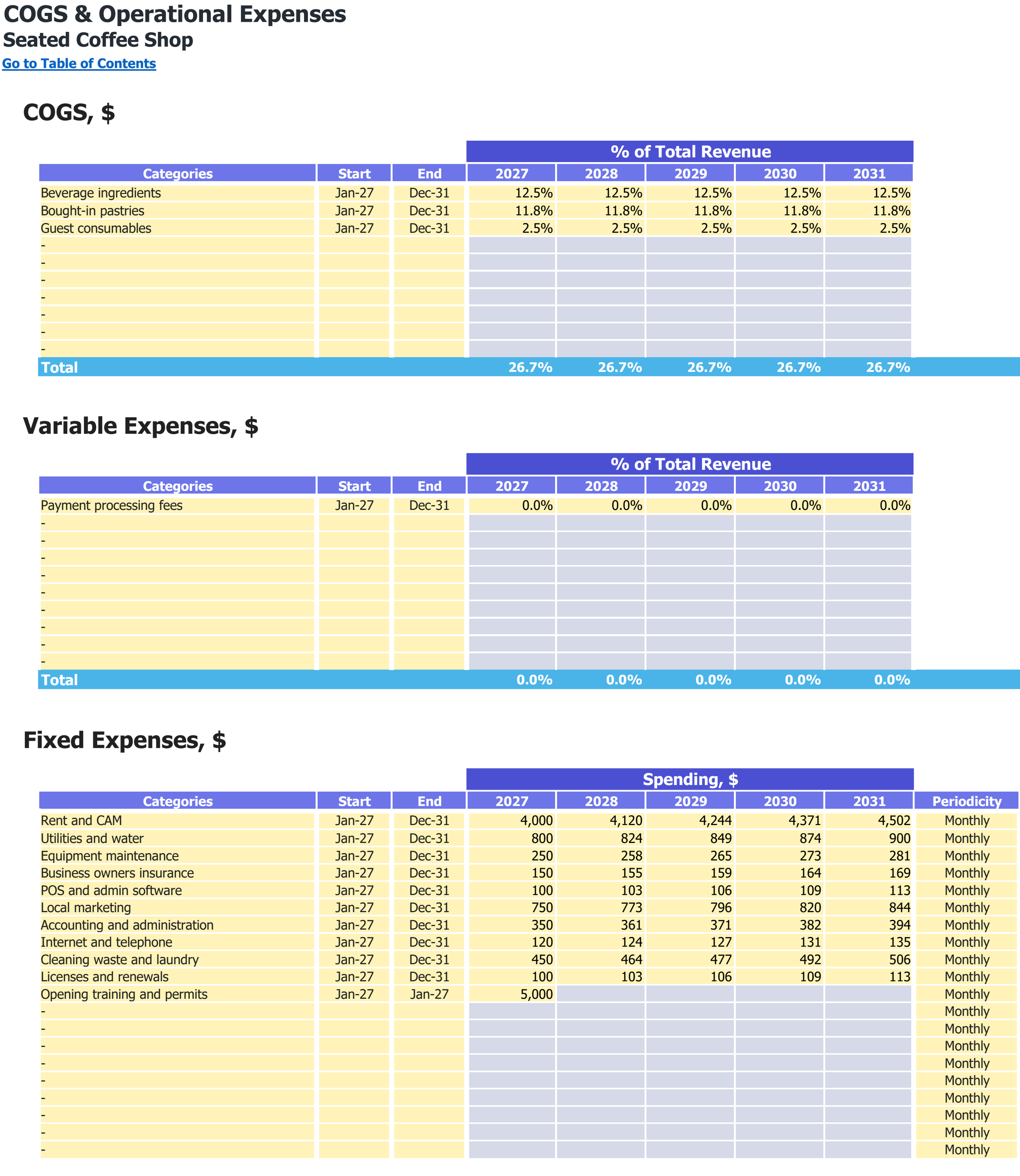
Food and other direct-cost categories, variable expense shares and fixed operating expenses. Monetary inputs are USD; the annual percentage columns are cost shares of revenue.
Enlarge image in a new tab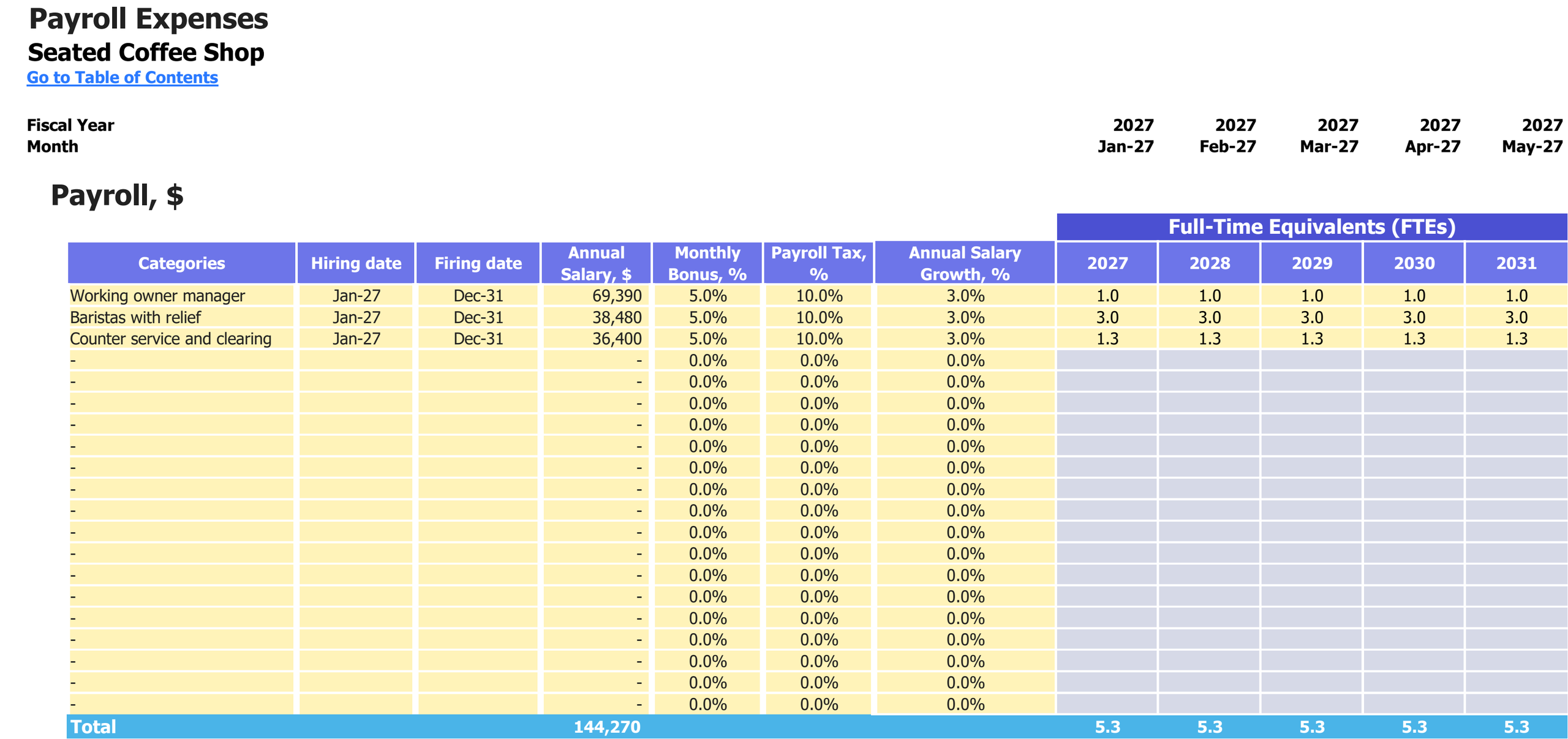
Paid roles, annual salary and employer-load assumptions, with staffing in full-time equivalents for 2027–2031. Salary amounts are USD; percentages and FTEs are labelled separately.
Enlarge image in a new tab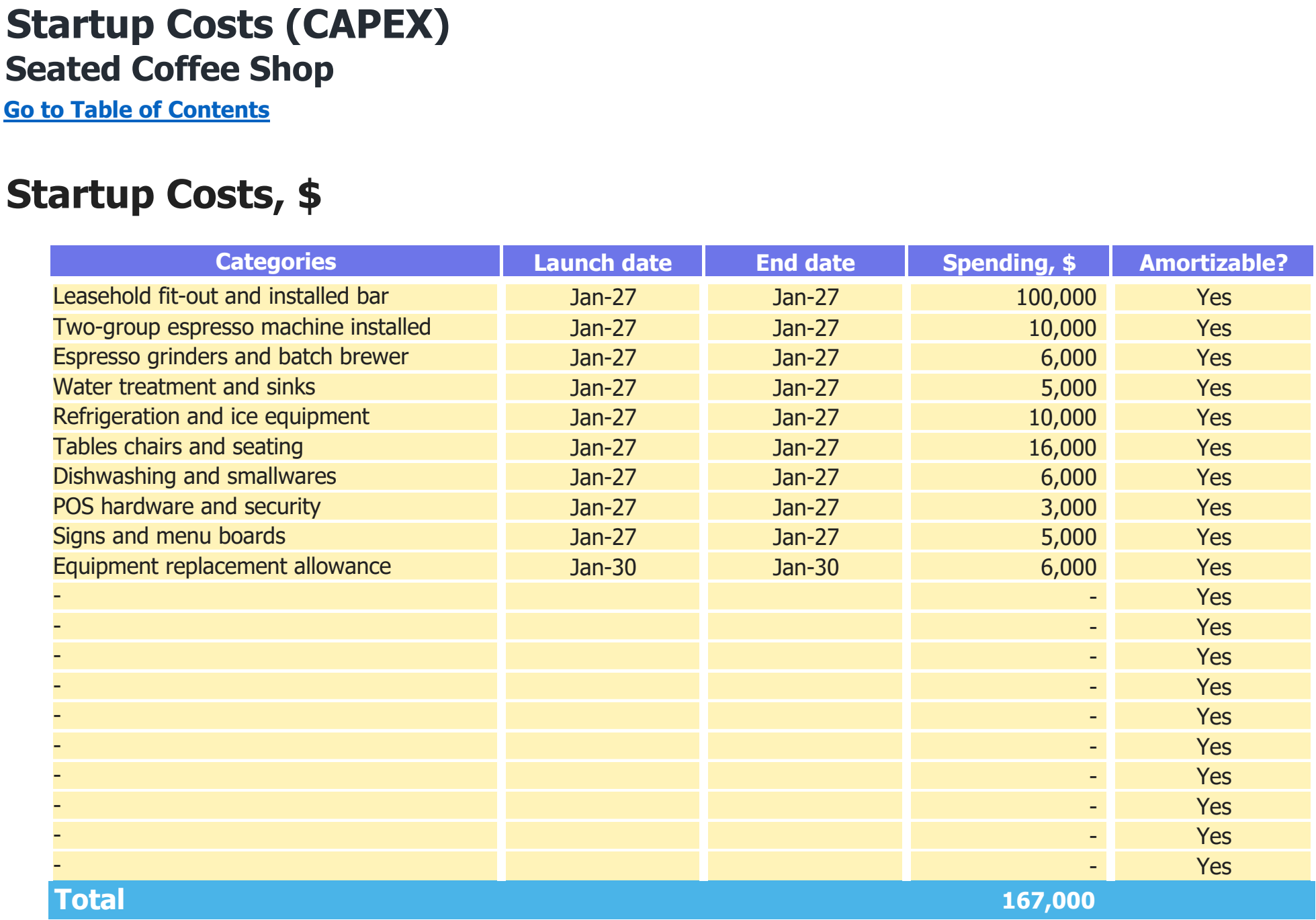
Asset categories, purchase dates and spending assumptions in USD. The total includes every scheduled purchase shown, including later replacements where present.
Enlarge image in a new tab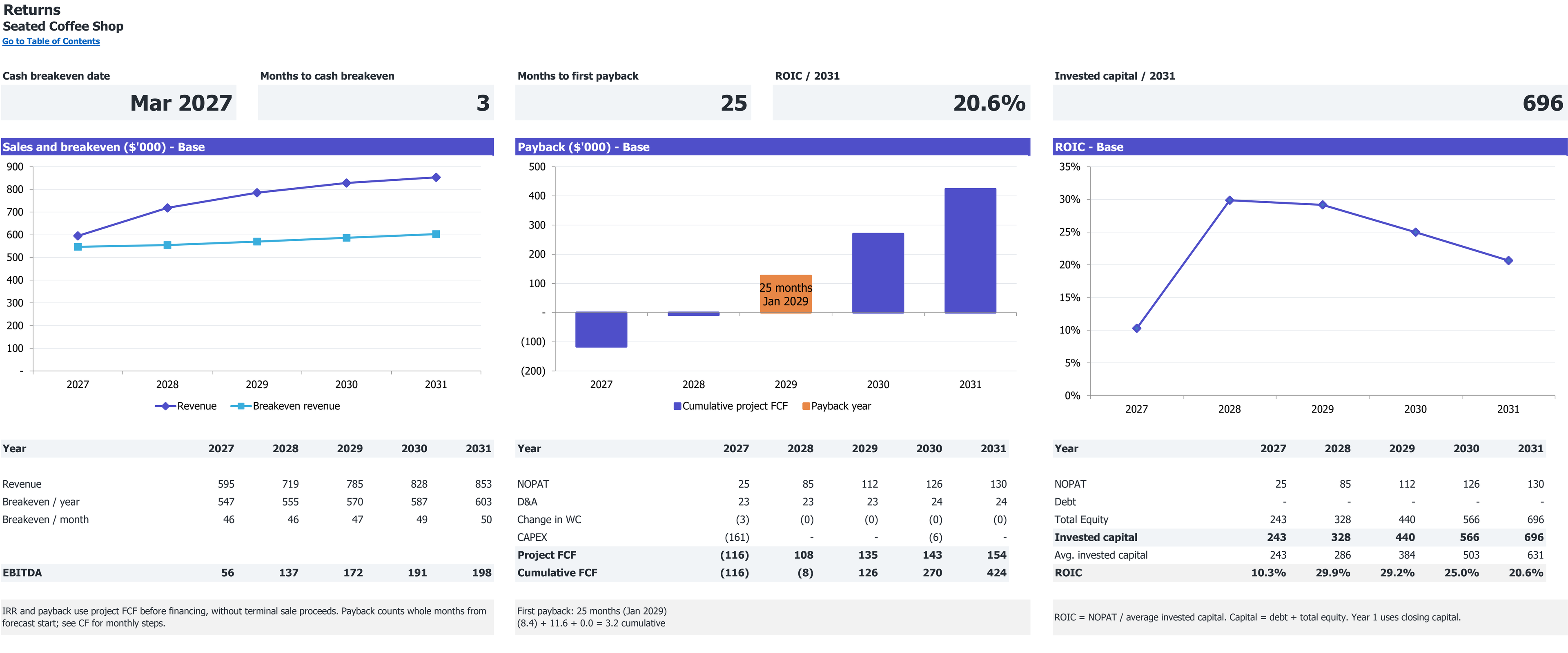
Excerpt from Returns: cumulative project free cash flow and first payback, if reached. 2027–2031 base case; dollar amounts in thousands.
Open full Returns view in a new tabExcerpt from Returns: revenue, annual and monthly break-even revenue, and EBITDA. 2027–2031 base case; dollar amounts in thousands.
Open full Returns view in a new tab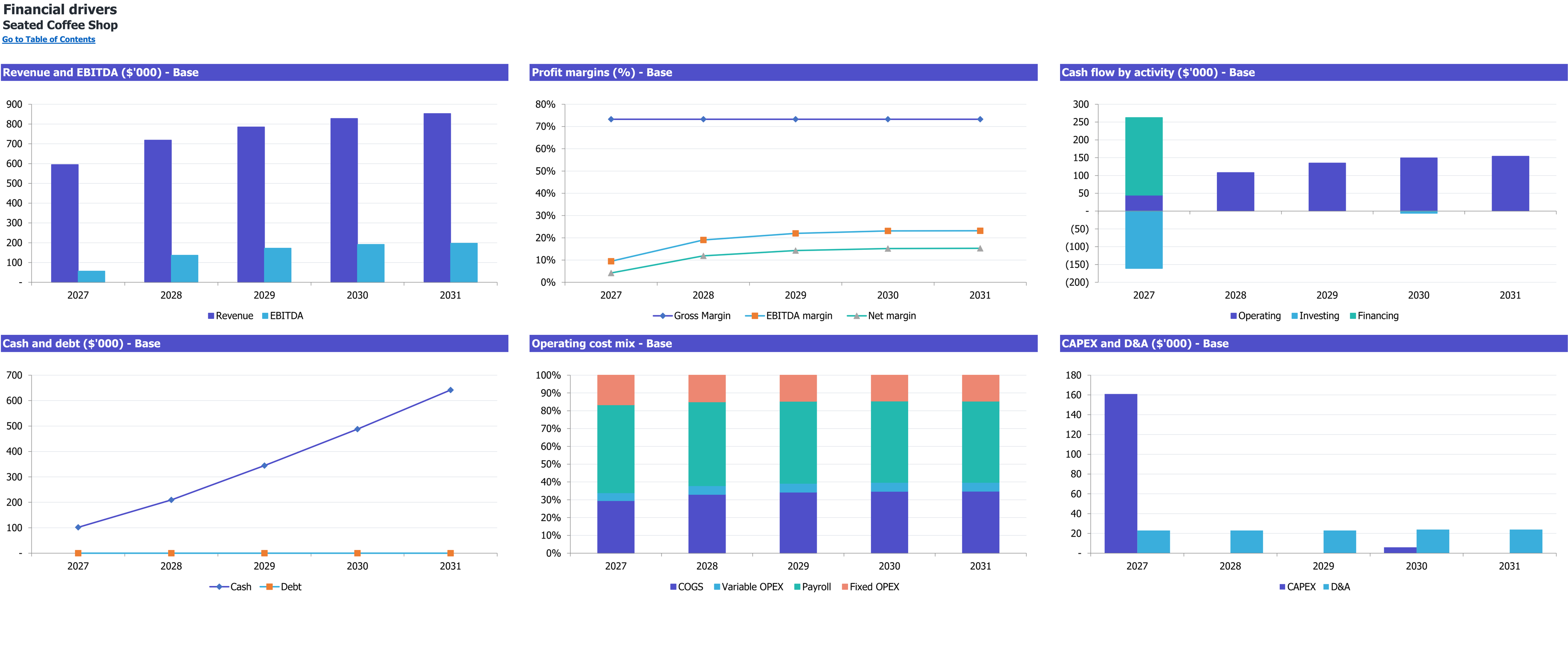
Six annual financial-driver charts for Seated Coffee Shop, 2027–2031 (Base scenario). Dollar amounts are in thousands; margins and cost mix are percentages.
Enlarge image in a new tab8 selected worksheet views. Figures show this workbook’s starting case.
Workbook availability
What is inside the Excel model
Test whether your seats and funded barista hours can support the sales plan. This workbook follows seated guests through drink recipes, pastry purchases, payroll and monthly cash.
Selected worksheets from the documented workbook. Forecast period: January 2027–December 2031. Model reference: PHY002-01.
Inputs you control. Results you can inspect.
On a small screen, scroll within the table to read every column.
| Planning area | Inputs you review | How they connect | Results to inspect |
|---|---|---|---|
| Guests and seats | Daily demand, open dates, ramp, seats, hours and dwell time. | Demand is capped by seat time and production resources. | Served guests and unmet demand. |
| Drink and pastry mix | Guest-cohort shares, drinks and pastries per guest, menu prices. | Each guest belongs to one cohort; its ticket includes pastries once. | Sales by cohort and physical item quantities. |
| Recipes and labor | Ingredient doses, usable yields, preparation minutes and funded baristas. | Purchased quantities include yield loss; paid productive hours constrain preparation. | Ingredient costs and feasible guest volume. |
| Operating budget | Role pay, benefits, on-cost, processing terms and overhead. | Loaded payroll and dated expenses combine with physical purchase costs. | Operating earnings and cash requirements. |
| Investment and cash | Fit-out, equipment, replacement timing, inventory days and equity. | Opening and replacement outflows flow into monthly cash. | Funding reserve and project payback. |
Is this the right model for your business?
Check the starting case before changing the assumptions.
The starting operation
- One 32-seat coffee shop in a suitable second-generation space.
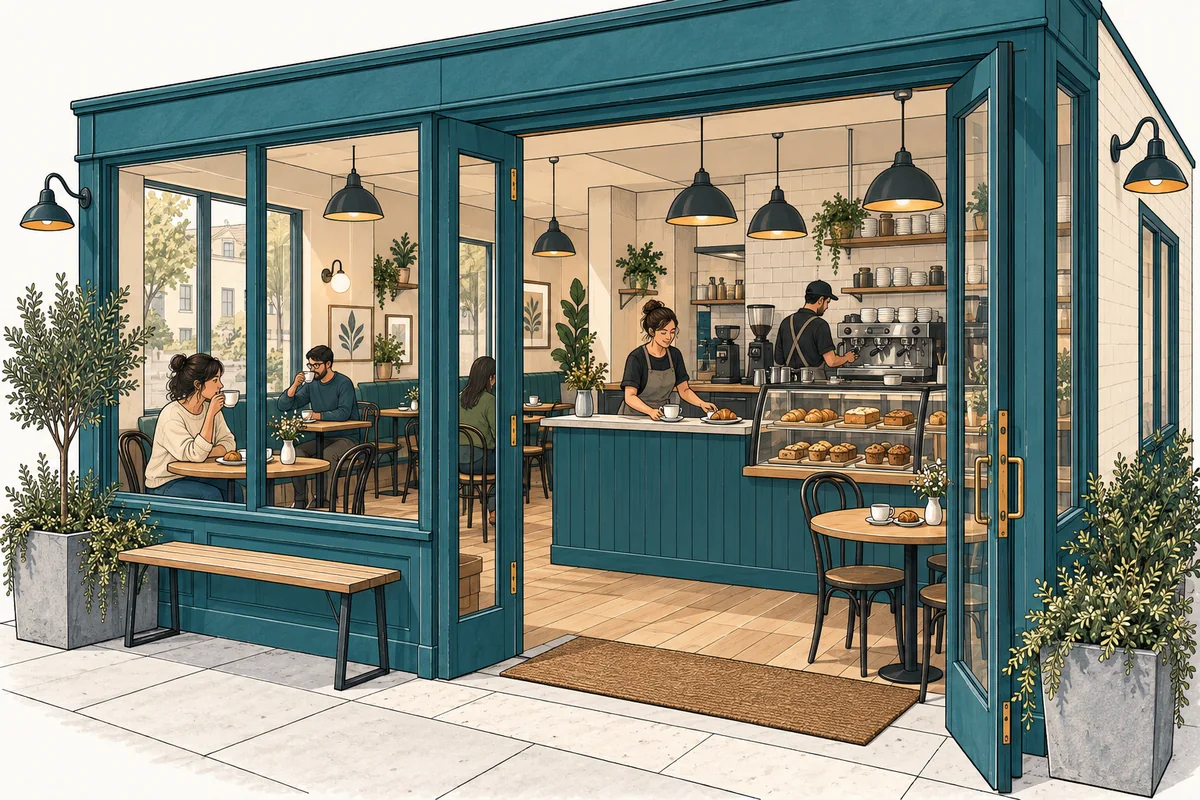
- A 1,600-square-foot cafe with espresso, drip and cold-brew guest groups.
- An owner planning paid staffing alongside seating and preparation capacity.
Check the boundary
A takeaway kiosk, drive-through, delivery operation or on-site bakery requires different demand and production assumptions.
Compare the other coffee shop typesHow this business makes money
Connect the unit sold to the resources required by this operating case.
Revenue logic
Revenue = served guests × their drink-and-pastry ticket.
Espresso, drip and cold-brew guest groups are calculated separately. Seating, baristas and espresso equipment constrain service.
Can a full cafe still leave baristas as the bottleneck?
Yes. Seating time is only one limit. Drink mix changes preparation work, and espresso equipment can constrain service even when seats are available. The workbook applies the tightest resource limit before assigning guests to ticket cohorts.
- Customer unit
- One seated guest, not one drink.
- Resource limits
- Seat time, funded barista minutes and espresso output.
- Physical costs
- Recipe purchases and bought-in pastries with usable yield.
What to establish for your own operation
- Observe actual dwell and drink preparation time.
- Validate the mix of drink cohorts and pastry purchases.
- Reprice the premises, staffing and supplier assumptions locally.
Follow the plan from demand to cash
Open each section for the assumptions, calculations, and limits of this workbook’s starting case.
Seats and preparation must both support the ticketRevenue
The Base case has 32 seats, ten open hours per day and 75-minute dwell. Seating alone allows 256 guests per day before labor or equipment constraints. Demand starts at 220 requests per open day, with a six-month ramp from 65% to full selected demand.
Espresso, drip and cold-brew cohorts receive 60%, 25% and 15% of served guests. Each buys 1.10 beverages and 0.55 pastries. Revenue volumes are guests; physical drink and pastry quantities are calculated separately.
- Three funded barista FTE contribute 75% productive time.
- The espresso station has a selected 60-drink hourly limit.
- No separate takeaway or delivery stream is included.
Keep recipe purchases separate from price assumptionsCOGS & OPEX
Ingredients and bought-in pastries use physical quantities and usable yields. Beans, milk and pastries start at 95% yield. The existing cost schedules receive per-guest cost-to-ticket ratios; positive monetary revenue multipliers preserve physical recipe costs.
The 5.25-FTE team includes a paid working owner/manager. Benefits equal 5% of gross pay, followed by a 10% on-cost on that total. Recurring overhead starts at $7,070 monthly, with $5,000 opening training and permits.
- Payment expense uses 90% card-paying guests, 2.6% plus $0.15 per payment.
- Only barista hours create preparation capacity; manager and service hours are not added again.
- Floor area does not automatically resize rent or seats.
Fund the opening cash trough and a separate reserveCAPEX
Initial capital is $161,000, followed by $6,000 replacement equipment in January 2030. The fit-out assumes a suitable existing site; installed allowances need local quotations.
January 2027 equity is $218,000, with no debt. The unfunded cash shortfall is $177,053; the selected contribution covers that shortfall and a $40,000 reserve after rounding. Receivable and payable days are zero, while inventory uses seven COGS days.
- All listed assets use the native seven-year book depreciation method.
- Land and lease deposits are excluded.
- Funding stays fixed when downside assumptions change.
Separate shop profitability from owner cash recoveryCF
Base 2027 sales are $595,089 and EBITDA is $56,309. Minimum funded cash is $40,947 in February 2027. These are outputs of the chosen U.S. planning case, not measured cafe results.
EBITDA first becomes nonnegative in March 2027 and remains so. Project payback occurs in January 2029, using cumulative undiscounted unlevered cash after startup outflows and replacement capital. No owner distributions are scheduled.
- Net income first becomes nonnegative in April 2027.
- Retained business cash is not a payment to the owner.
- Terminal valuation proceeds do not enter project payback.
Selected results from the starting case
Modeled results in USD unless stated otherwise. These describe the selected inputs, not an estimate for your location or a guaranteed outcome.
- First-year sales
- $595,089Base · USD · calendar 2027, including the launch ramp.
- First-year EBITDA
- $56,309Base · USD · calendar 2027 operating earnings before interest, tax and depreciation.
- Initial CAPEX
- $161,000Base · USD · January 2027 opening assets; replacement spending is separate.
- Minimum funded cash
- $40,947Base · USD · February 2027, after the selected $218,000 equity contribution.
- Project payback
- January 2029Base · month 25 from January 2027; cumulative undiscounted unlevered project cash, excluding terminal proceeds.
Make the case your own
Work from the operating plan toward the cash requirement.
Set the opening calendar, guest demand and seating assumptions.
Review drink mix, recipes, prices and barista staffing together.
Replace supplier, rent, payroll and installed-asset allowances.
Inspect monthly cash and resize fixed equity before comparing project payback.
Interpretation and scope
- This is a researched U.S. planning case, not a national average or local demand study.
- Demand, dwell, productivity and installed budgets remain selected assumptions.
- The 25% tax rate is a planning proxy using the native annual-loss-offset allocation.
- Use the Revenue switch for closure; exactly zero monetary revenue multiplier is outside the allowed positive domain.
- The model schedules no owner distributions or terminal proceeds in project payback.
The workbook is an Excel file for local planning. Learn how to interpret assumptions and evidence.
Other coffee shop types
Each operating type calls for its own financial structure.
Questions
Are the three revenue streams separate customer counts?
No. They are mutually exclusive espresso, drip and cold-brew guest cohorts. A guest and the pastry portion of the ticket are counted once.
Do ingredient costs rise automatically when menu prices rise?
The recipe quantities drive costs. For positive monetary revenue multipliers, the native cost interface preserves physical ingredient costs rather than simply scaling them with selling price.
Is the working owner paid?
Yes. The owner/manager salary is included in payroll; business profit is additional to that paid role.
Does the sales switch stop payroll?
No. Wages remain payable while their payroll dates are active. Revenue shutdown and staffing decisions are separate controls.
Does project payback mean the owner has received the cash?
No. It measures project cash recovery. The workbook schedules no owner distributions.
Can I buy this model now?
No. Purchasing and workbook downloads are not available on this site.
Which software does the workbook use?
The documented file is an Excel workbook (.xlsx). Compatibility with other spreadsheet applications is not established by the file extension.
Read the planning guides
Explore the relevant operating questions and how to interpret a workbook’s assumptions.
When do seats and barista time limit coffee shop sales?
Convert seats and guest dwell time into a capacity ceiling, then check drink preparation and espresso equipment before treating demand as coffee shop sales.
Read the guideWhich coffee business fits your customers and working day?
Compare a seated coffee shop, takeaway kiosk, mobile truck, and employer-paid service by customer, location, daily work, and the evidence each idea needs.
Read the guideHow to open a seated coffee shop around the guest visit
Define the seated cafe experience, check the bar and premises, confirm pastry supply, and test the paid operating schedule before committing to an opening date.
Read the guideEvidence and scope
A related category or operator is referenced. Do not interpret the link as independent proof of this exact configuration or its viability.
The links below provide operating-format context; they do not verify the workbook’s selected inputs or calculated returns.
The workbook guide and figures describe model PHY002-01, revision r01, for January 2027–December 2031. These are a documented planning case, not observed results for a particular business.