
Coffee Shop Financial Model: Coworking Coffee Shop
Plan a coworking cafe with memberships, day passes and retail sales. Test shared seats, drink preparation, paid staffing, startup funding and payback.
- Excel (.xlsx)
- Premises: 2,500 sq ft / 48 shared seats
- Opening: April 2027 after three preparation months
- Membership: $129/month; included drip coffee during visits
Planning several types? Compare 8 coffee shop formats
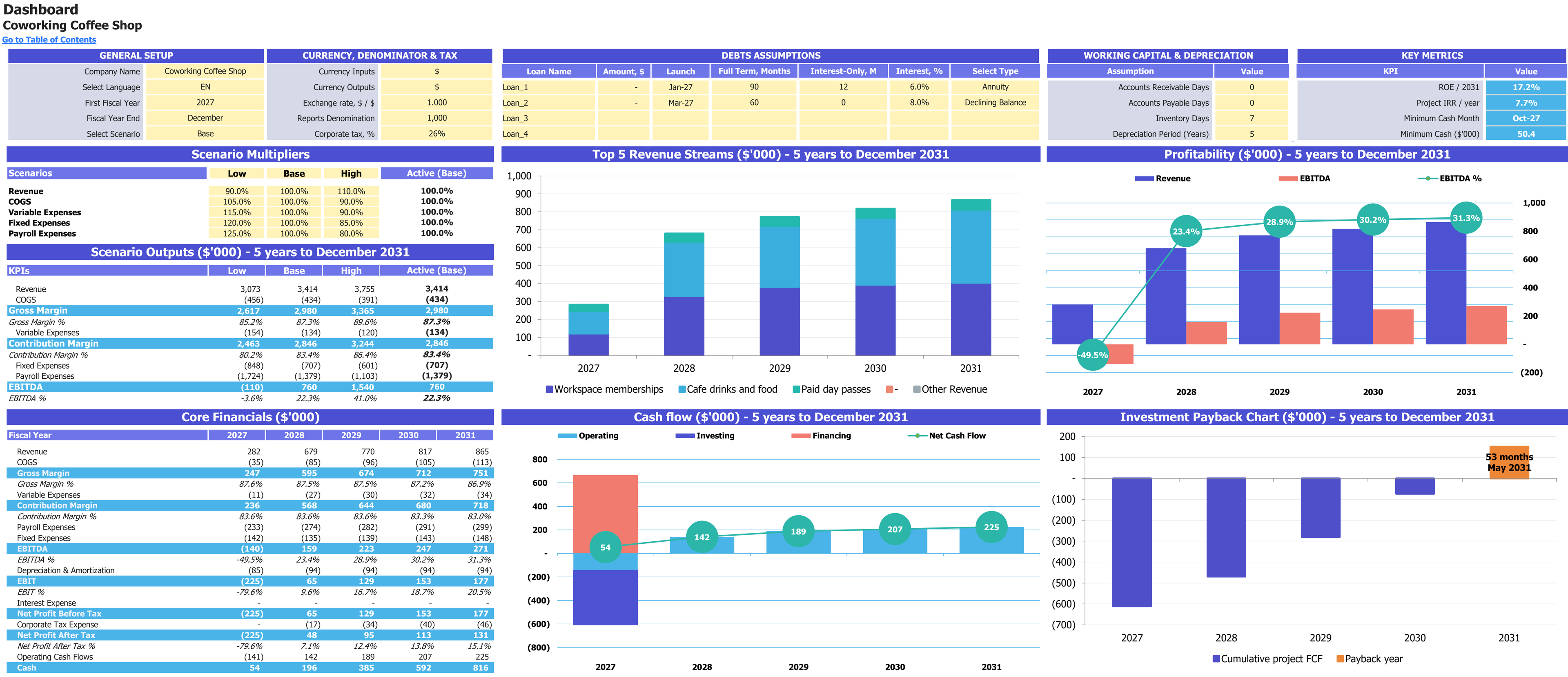
Saved Base scenario: annual financial results, profitability and project recovery for 2027–2031. Report amounts are in thousands of USD.
Enlarge image in a new tab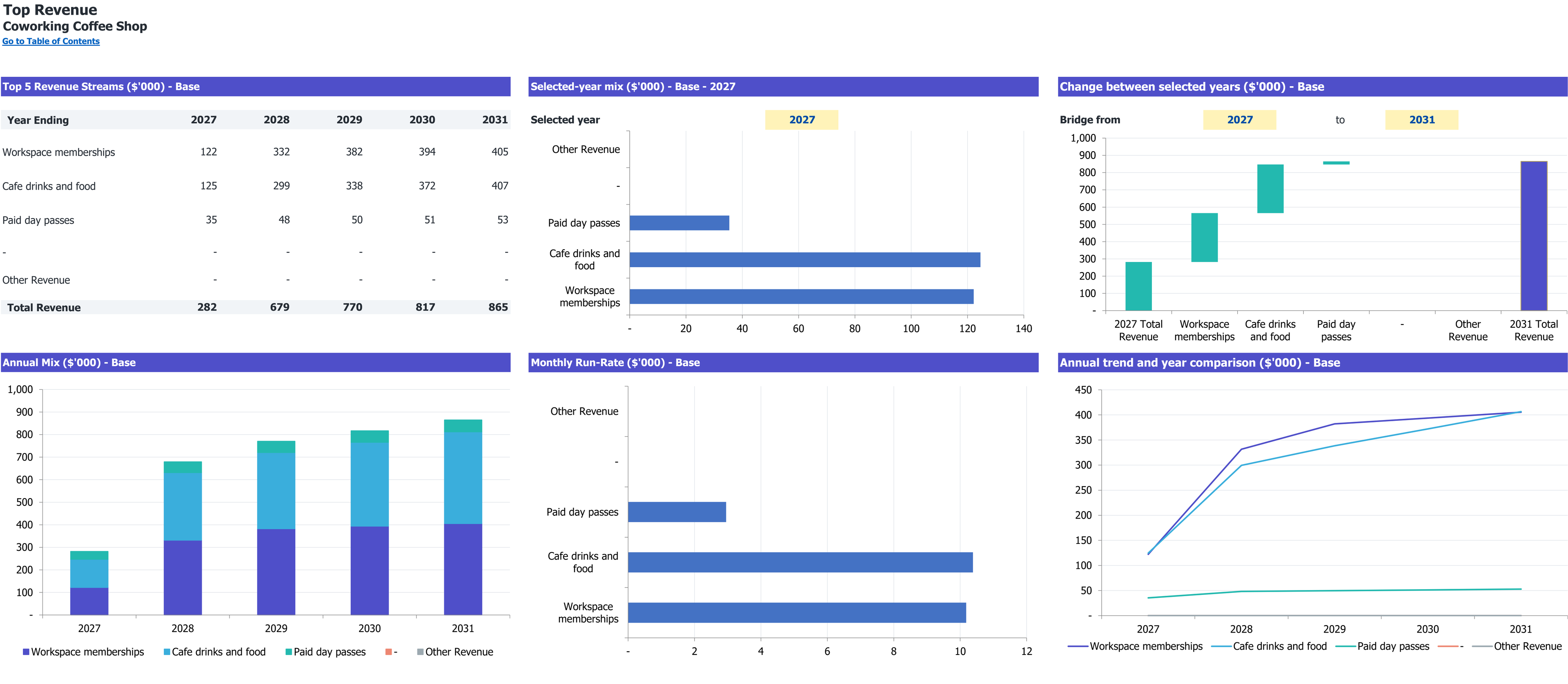
Actual Top Revenue sheet: annual revenue by stream, selected-year mix and comparison charts in thousands of USD. Base case 2027–2031.
Enlarge image in a new tab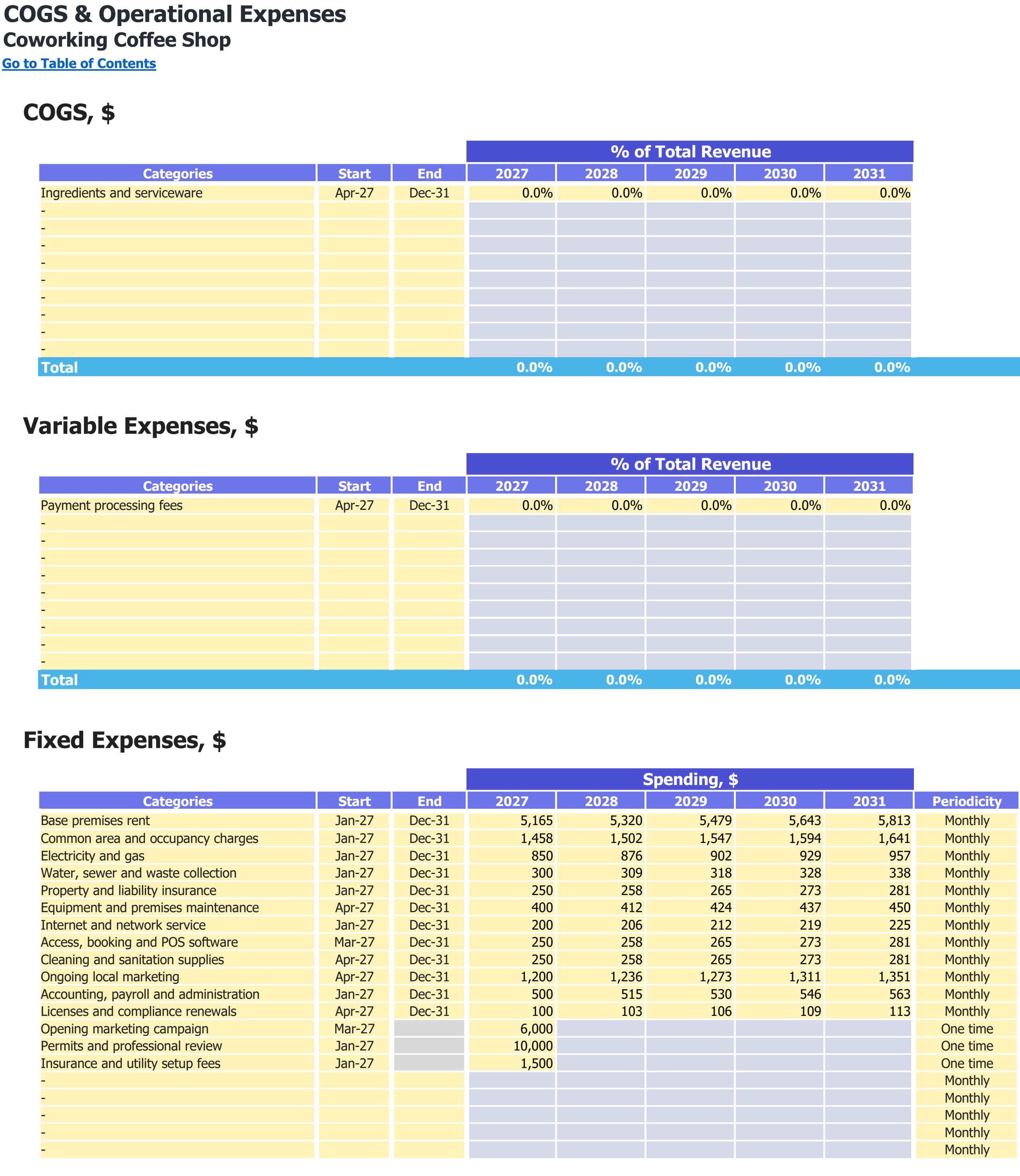
Operating-cost setup and recurring expense budgets in USD. Zero percentage inputs do not mean zero ingredient cost: the model calculates activity costs separately.
Enlarge image in a new tab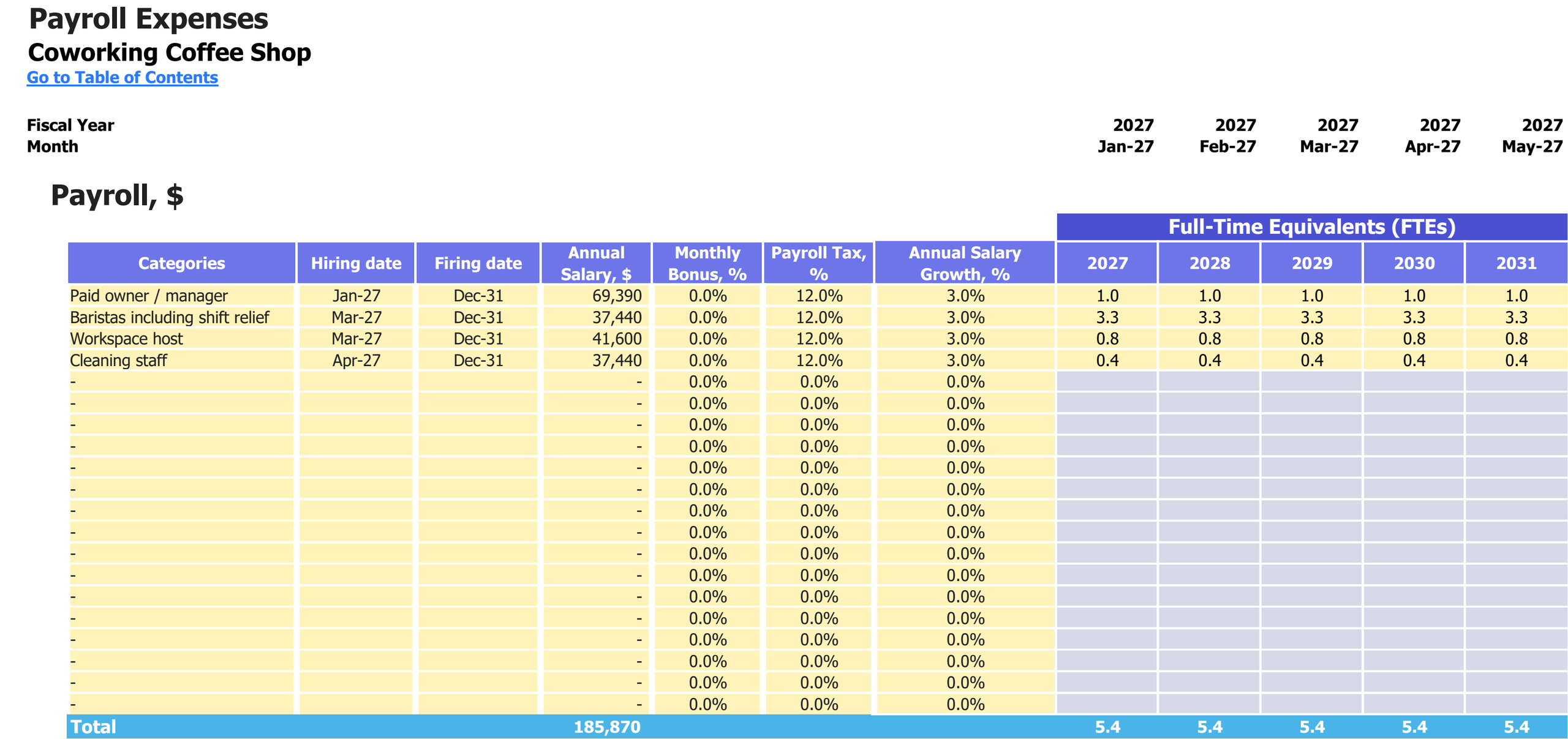
Paid roles, annual base salary per FTE, start dates, employer load and staffing for 2027–2031. Salary inputs are USD; payroll expense reflects timing and staffing.
Enlarge image in a new tab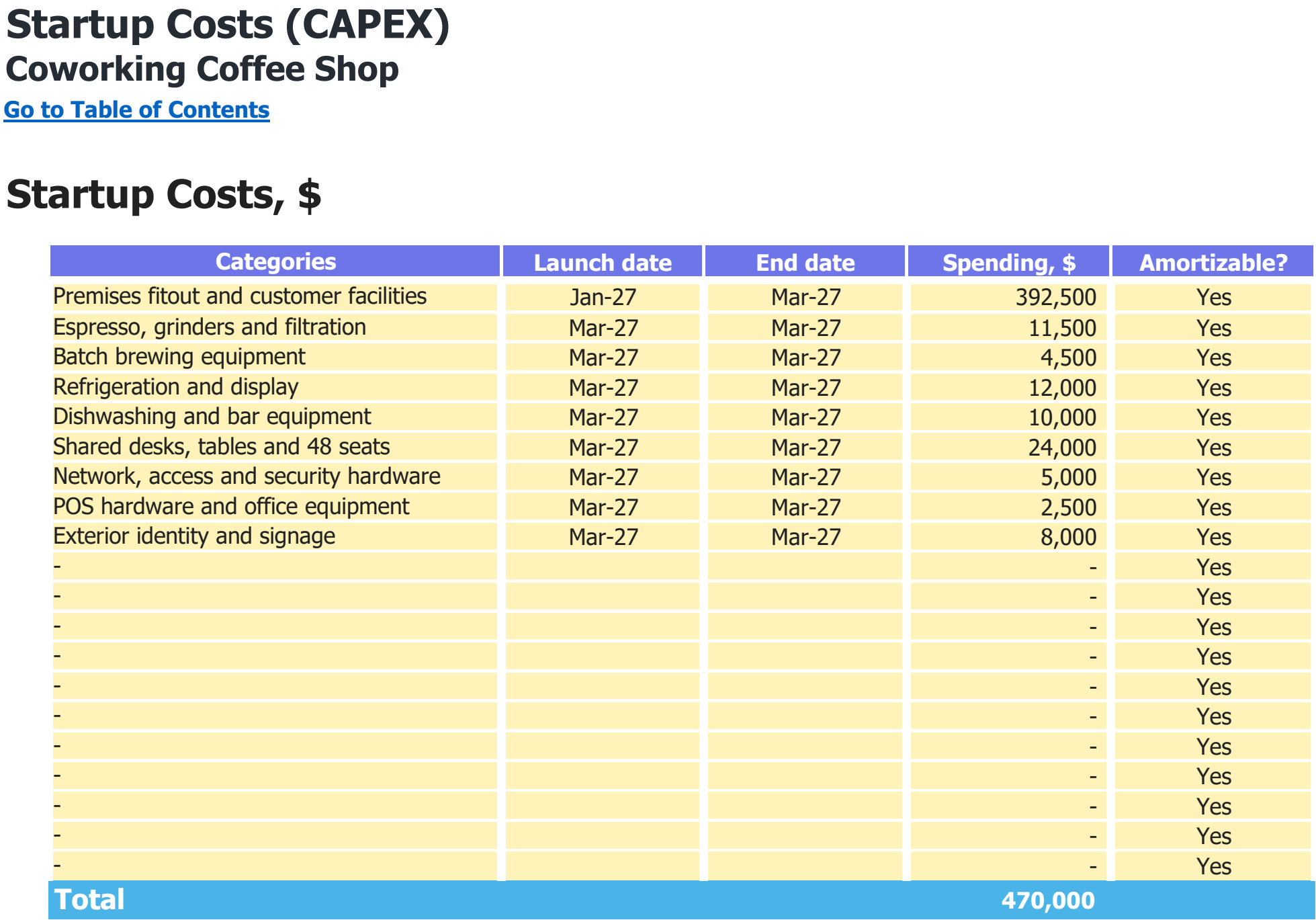
Initial installed-asset and fitout allowances in USD, with purchase dates and depreciation eligibility.
Enlarge image in a new tab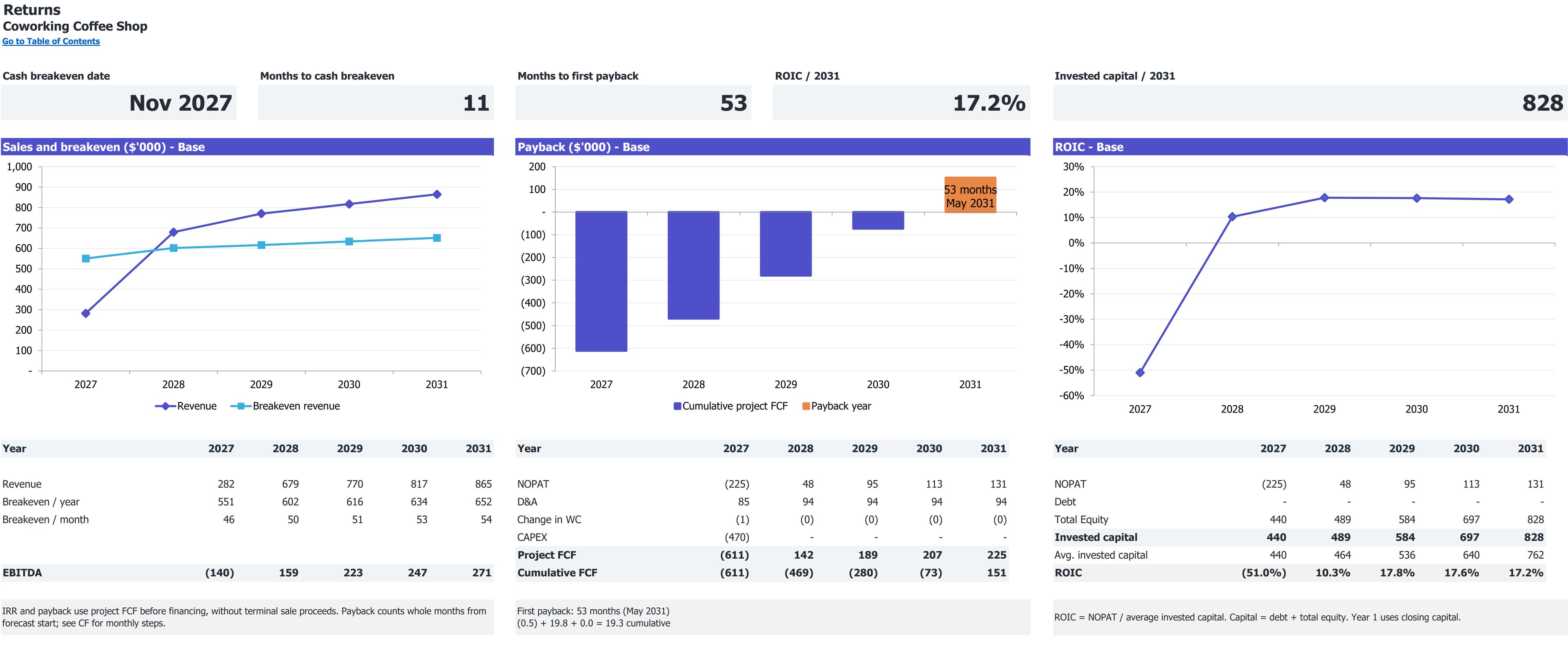
Excerpt from Returns: cumulative project free cash flow and payback. Base case 2027–2031; amounts in thousands of USD. First project recovery: 53 months, May 2031.
Open full Returns view in a new tabExcerpt from Returns: annual and monthly break-even revenue, sales and EBITDA. Base case 2027–2031; amounts in thousands of USD.
Open full Returns view in a new tab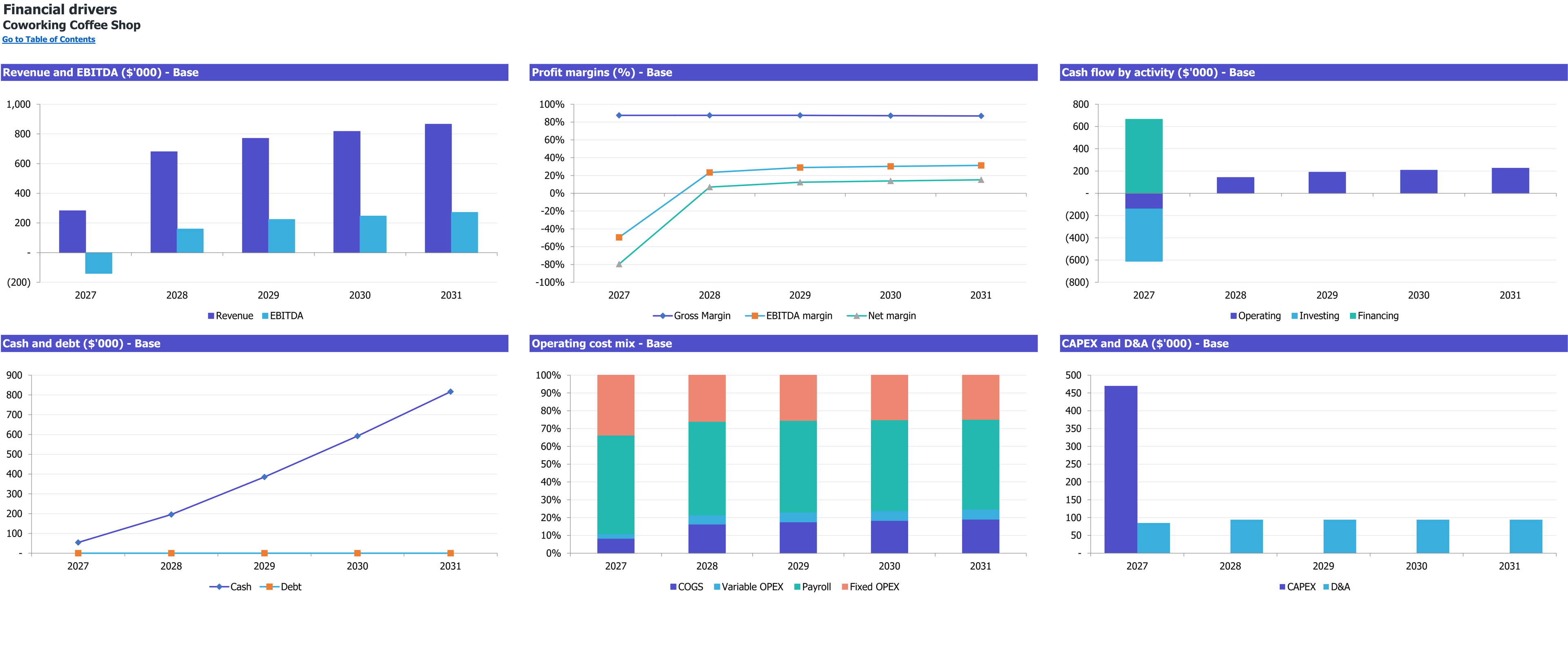
Financial-driver charts: revenue, margins, cash and debt, cost mix, investment and depreciation. Base case 2027–2031; chart units as labelled.
Enlarge image in a new tab8 selected worksheet views. Figures show this workbook’s starting case.
Workbook availability
What is inside the Excel model
See how workspace memberships and ordinary cafe orders compete for the same seats and baristas. Separate subscription fees from included drinks, then test whether the opening cash reserve covers the ramp.
Selected worksheets from the documented workbook. Forecast period: January 2027–December 2031. Model reference: PHY002-07.
Inputs you control. Results you can inspect.
On a small screen, scroll within the table to read every column.
| Planning area | Inputs you review | How they connect | Results to inspect |
|---|---|---|---|
| Membership | Active accounts, 5% monthly cancellations, pauses, resumptions and new joins. | Limit admission by the account ceiling and reserved member service capacity. | Service-weighted member-months and earned fees. |
| Seating and passes | Eight visits per member-month, three-hour member dwell, six-hour day passes. | Allocate shared seat-hours with member priority and a concurrency allowance. | Fulfilled visits, completed passes and remaining seated cafe capacity. |
| Cafe demand | Seated/takeaway mix, opening ramp, drink prices and food attachment. | Limit orders by remaining seats and barista preparation time. | Separately sold drinks and food; included benefits remain unbilled. |
| Materials and staffing | Drink recipes, usable bean yield, food waste and paid staffing. | Cost actual preparation and purchases independently of membership prices. | Materials expense, loaded payroll and operating margin. |
| Funding | $470,000 CAPEX, $665,000 initial equity and a $50,000 cash-floor policy. | Track preparation costs, opening losses and inventory through the monthly forecast. | Lowest funded cash and cumulative project investment recovery. |
Is this the right model for your business?
Check the starting case before changing the assumptions.
The starting operation
- A staffed coworking cafe sharing seats between members and visitors.
- A workspace operator adding day passes and a light-preparation cafe.
- An opening plan that needs to separate profit, project payback and funding.
Check the boundary
The saved case excludes private offices, events, alcohol, annual prepaid memberships, a full kitchen and owner distributions.
Compare the other coffee shop typesHow this business makes money
Connect the unit sold to the resources required by this operating case.
Revenue logic
Earned membership fees + completed day passes + separately sold cafe drinks and food.
Members receive priority. Included drinks consume ingredients and preparation time without creating another sale.
Can memberships crowd out cafe sales before the account ceiling is reached?
Yes. Visits, dwell time and included drinks use shared seats and barista time. A larger membership cohort can restrict passes and retail orders even while accounts remain below the nominal ceiling.
- Shared seating
- 48 seats
- Expected member use
- Eight visits/month at three hours/visit
- Included service
- One drip drink per member or pass visit
What to establish for your own operation
- Stress visit frequency and dwell time with member retention.
- Review peak staffing and preparation availability together.
- Confirm local demand, installed fitout scope and rent before relying on the case.
Follow the plan from demand to cash
Open each section for the assumptions, calculations, and limits of this workbook’s starting case.
Separate account growth from paid serviceRevenue
The case opens in April 2027. Both active and paused accounts count toward the 250-account ceiling. New joins receive half a month of paid service; cancellations, pauses and resumptions affect the service cohort.
Admission reserves a full member-month using the lowest open-day count in the forecast. One drip drink per visit has an ingredient cost but no additional selling price. Selling more memberships therefore changes both earned fees and service commitments.
- Test retention together with visit frequency and dwell time.
- Keep included benefits separate from paid cafe orders.
Keep labor, ingredients and fitout distinctCOGS & OPEX
The ingredient schedule counts every prepared drink, including membership and pass benefits. Espresso and drip recipes differ. Purchased food includes a 5% unsold-waste allowance.
The paid owner-manager, baristas, host and cleaner have separate start dates. Recurring rent and other premises costs begin before opening where specified. The $470,000 investment includes fitout, cafe equipment, furniture, technology and signage.
- Owner labor is an expense; modeled owner distributions are zero.
- Installed equipment allowances require local quotations and overlap checks.
Read opening funding separately from paybackReturns
The base case contributes $665,000 equity in January 2027. This covers the maximum unfunded deficit plus a $50,000 minimum cash policy, rounded to the next $1,000. Lowest funded month-end cash is $50,448 in October 2027.
Project payback first occurs in month 53, May 2031. It is undiscounted recovery of operating and capital outflows before financing and terminal proceeds, measured from January 2027. It is not repayment or distribution of all owner equity.
- Re-size contributed capital after material operating changes.
- The first profitable operating month and investment recovery are different dates.
Selected results from the starting case
Modeled results in USD unless stated otherwise. These describe the selected inputs, not an estimate for your location or a guaranteed outcome.
- 2027 revenue
- $282,172USD, Base; calendar 2027 includes three preparation months.
- 2027 EBITDA
- −$139,639USD, Base; includes paid owner and staff, before depreciation.
- Minimum cash
- $50,448USD, Base; October 2027 after $665,000 initial equity.
- Project payback
- 53 monthsBase; May 2031, counted from January 2027; undiscounted, before financing and terminal proceeds.
Make the case your own
Work from the operating plan toward the cash requirement.
Set opening timing, prices, membership retention and expected visit patterns.
Review seats, staffed hours and preparation availability before raising demand.
Replace recipes, payroll, occupancy and fitout assumptions with local evidence.
Recalculate the monthly cash curve, re-size funding and compare break-even with project payback.
Interpretation and scope
- All results are modeled assumptions for a US planning case, not observed operating results or a return guarantee.
- Concurrency is a monthly approximation; it does not validate bookings, daily staffing coverage or service levels.
- No refundable lease deposit, customer advances or unsettled processor receivables are modeled; required deposits need separate supported treatment.
- The native planning tax and common five-year depreciation methods are not jurisdiction-specific tax advice.
- Existing sheet images are user-supplied exports; inline views are summaries and full-sheet zoom provides context.
The workbook is an Excel file for local planning. Learn how to interpret assumptions and evidence.
Other coffee shop types
Each operating type calls for its own financial structure.
Questions
Are the included drinks counted as extra revenue?
No. Membership and pass fees earn workspace access with included drip coffee. The drinks use ingredients and preparation time but are not sold a second time.
Does the account ceiling guarantee enough seats?
No. Member visits, dwell time, staffing and peak concurrency also restrict capacity. The model reserves member service before admitting passes and retail demand.
Is the $665,000 funding requirement a general startup estimate?
No. It funds this saved scenario, including its fitout, opening losses and $50,000 cash floor. Your local costs and operating assumptions can change the requirement.
Is the first profitable month the payback month?
No. In the Base case, EBITDA first becomes positive in November 2027; cumulative project cash flow first recovers in May 2031. Payback excludes financing and terminal proceeds.
Can I buy this model now?
No. Purchasing and workbook downloads are not available on this site.
Which software does the workbook use?
The documented file is an Excel workbook (.xlsx). Compatibility with other spreadsheet applications is not established by the file extension.
Read the planning guides
Explore the relevant operating questions and how to interpret a workbook’s assumptions.
Evidence and scope
Switchyards confirms paid workspace membership with included coffee and tea. It does not validate separate public cafe sales, day-pass offerings or this proposed combined configuration.
The links below provide operating-format context; they do not verify the workbook’s selected inputs or calculated returns.
The workbook guide and figures describe model PHY002-07, revision r01, for January 2027–December 2031. These are a documented planning case, not observed results for a particular business.