
Coffee Shop Financial Model: Takeaway Coffee Kiosk
Plan a takeaway coffee kiosk with walk-in and preorder drinks, shared paid preparation and handover, recipe costs and startup cash.
- Excel (.xlsx)
- Footprint: 250 sq ft indoor kiosk
- Offer: One takeaway drink per order
- Opening: February 2027 / Monday–Saturday
Planning several types? Compare 8 coffee shop formats
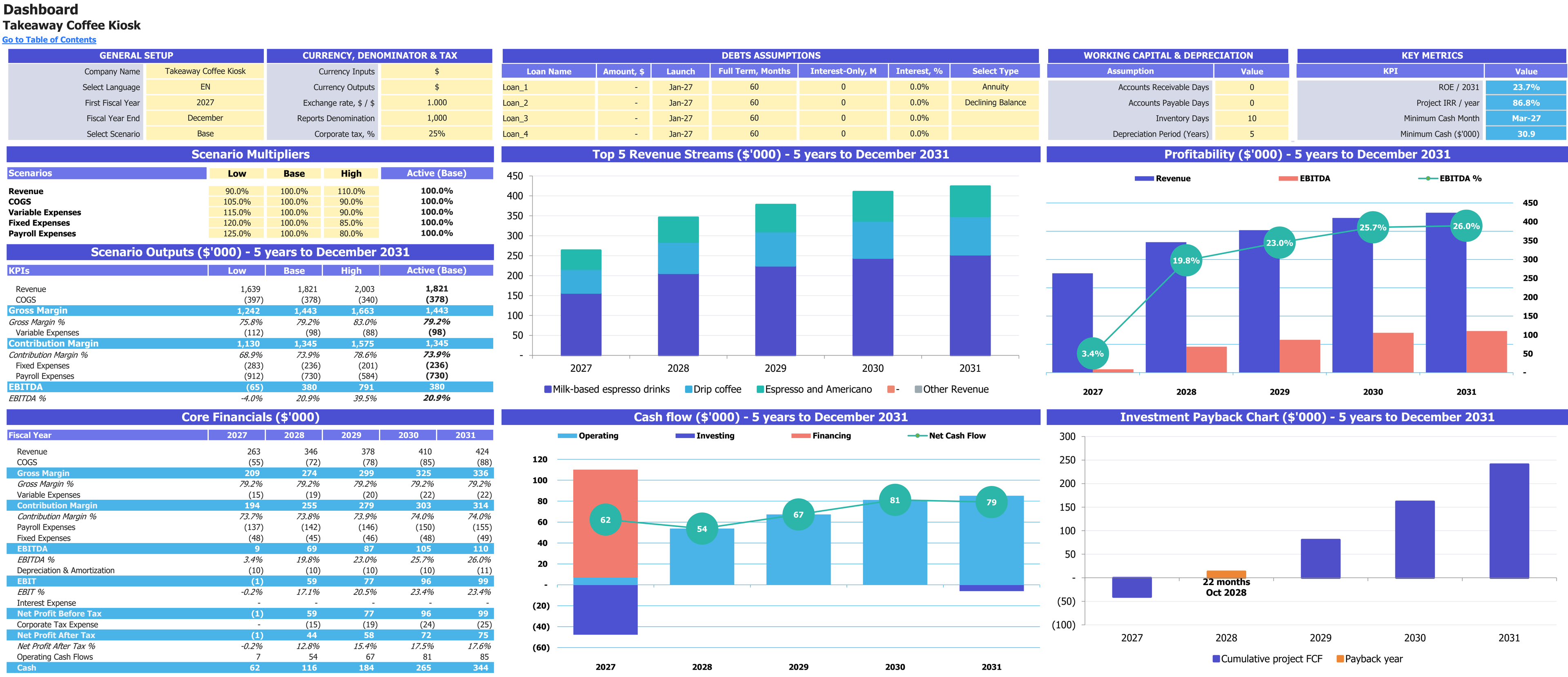
Base-case scenario controls, annual financial results and charts for 2027–2031. Financial report amounts are shown in thousands of USD; percentage measures retain their own units.
Enlarge image in a new tab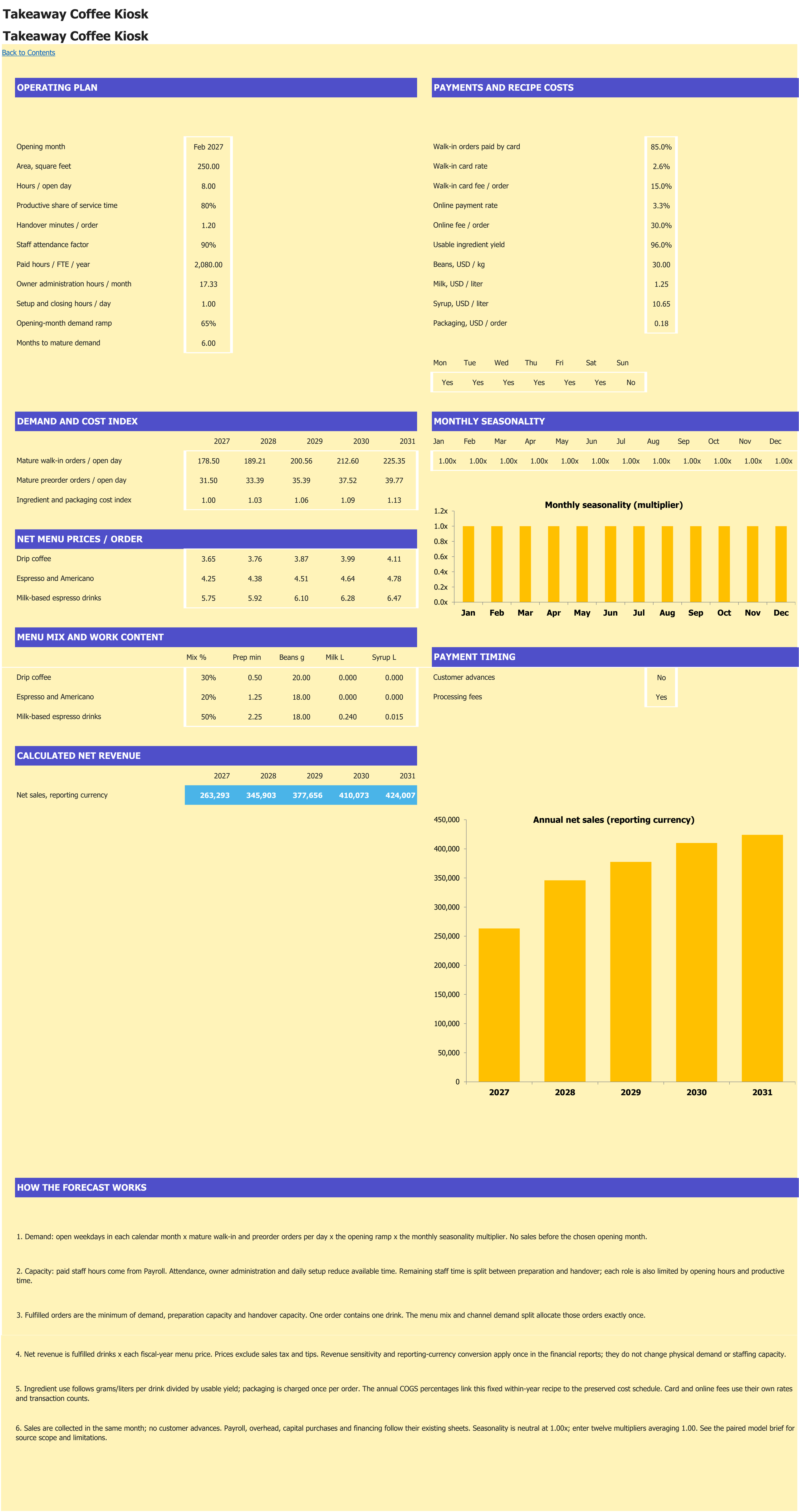
Walk-in and preorder drink demand, kiosk equipment and paid barista capacity. Monetary inputs and sales use USD; operating volumes retain their labelled units. Forecast years are 2027–2031.
Enlarge image in a new tab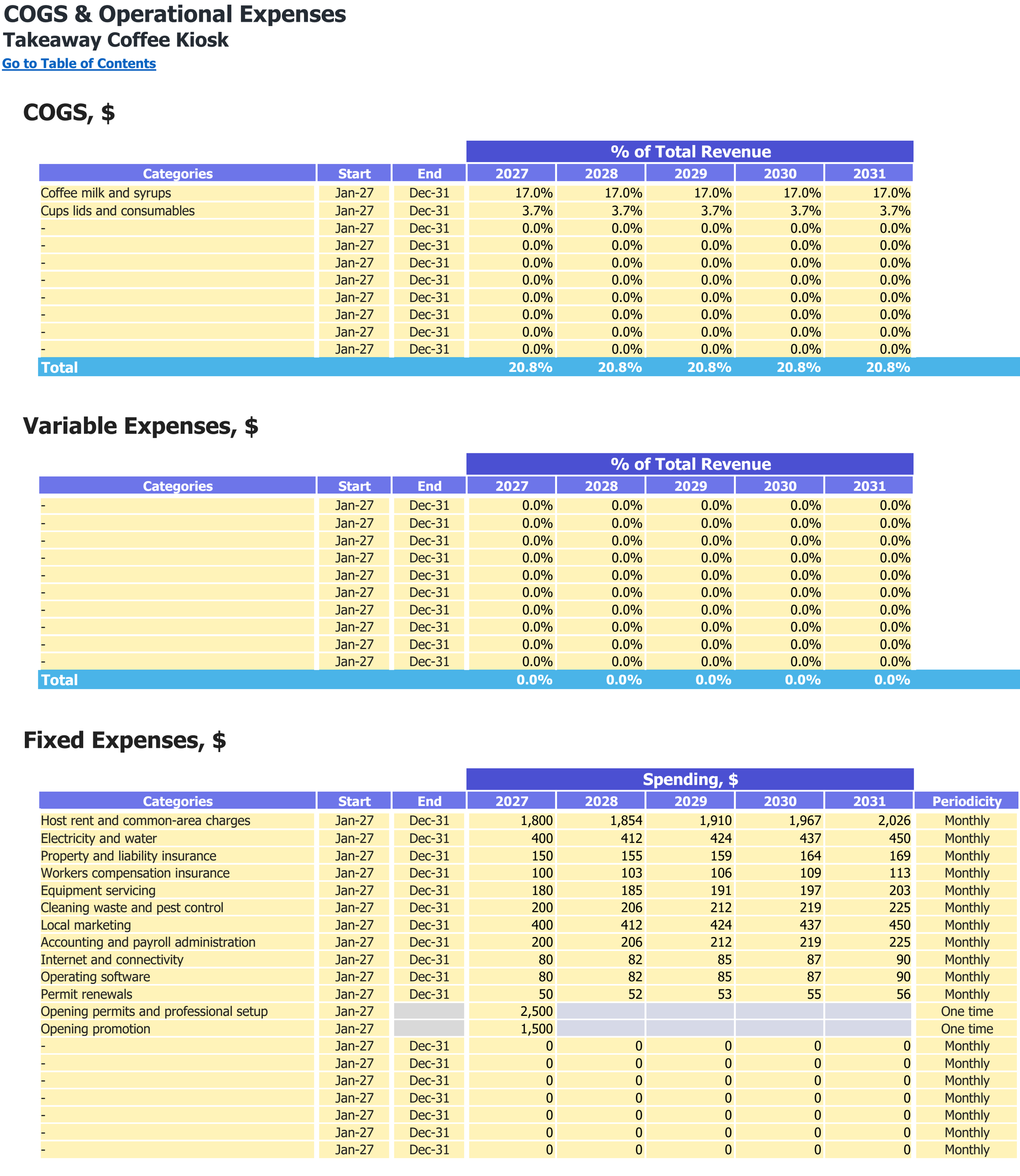
Food and other direct-cost categories, variable expense shares and fixed operating expenses. Monetary inputs are USD; the annual percentage columns are cost shares of revenue.
Enlarge image in a new tab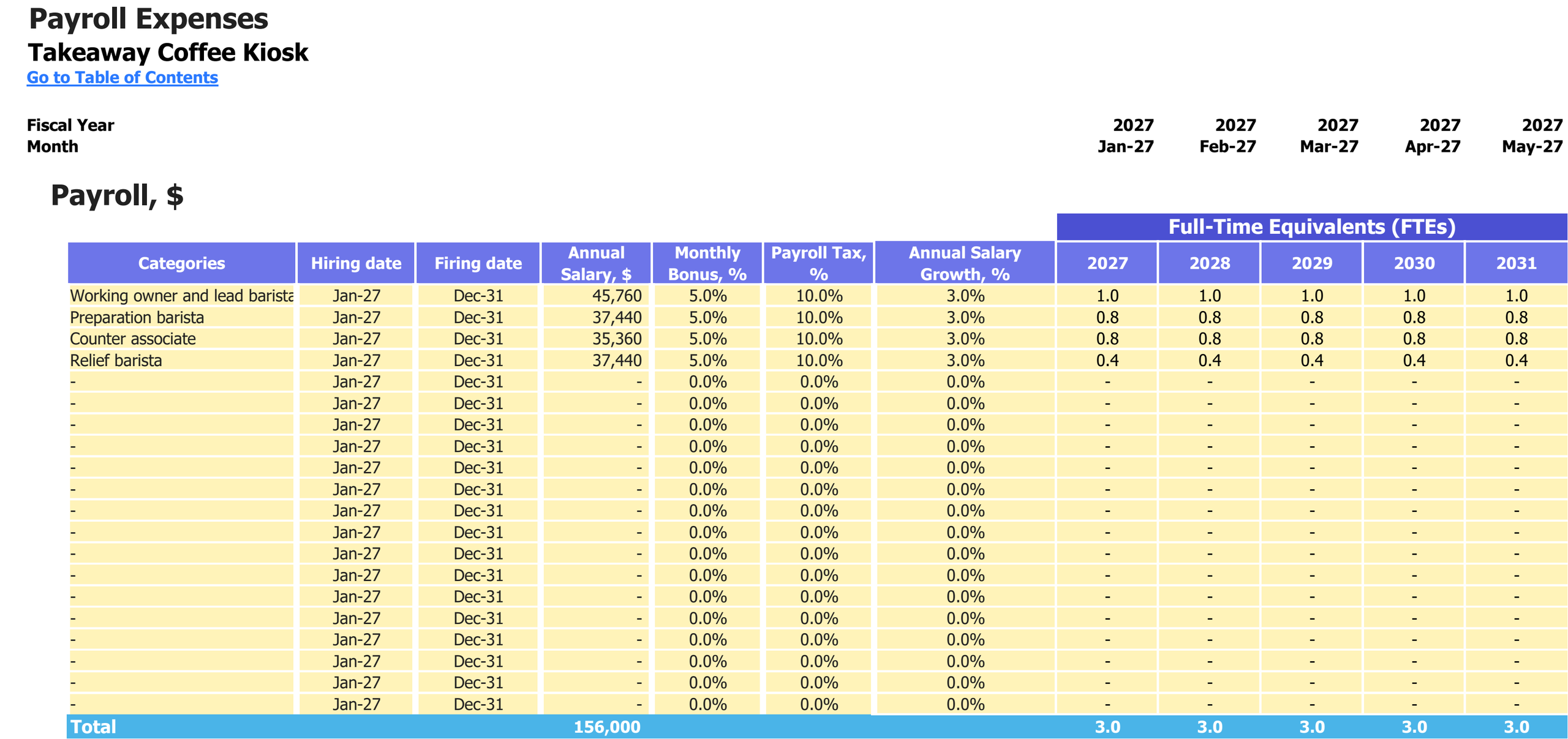
Paid roles, annual salary and employer-load assumptions, with staffing in full-time equivalents for 2027–2031. Salary amounts are USD; percentages and FTEs are labelled separately.
Enlarge image in a new tab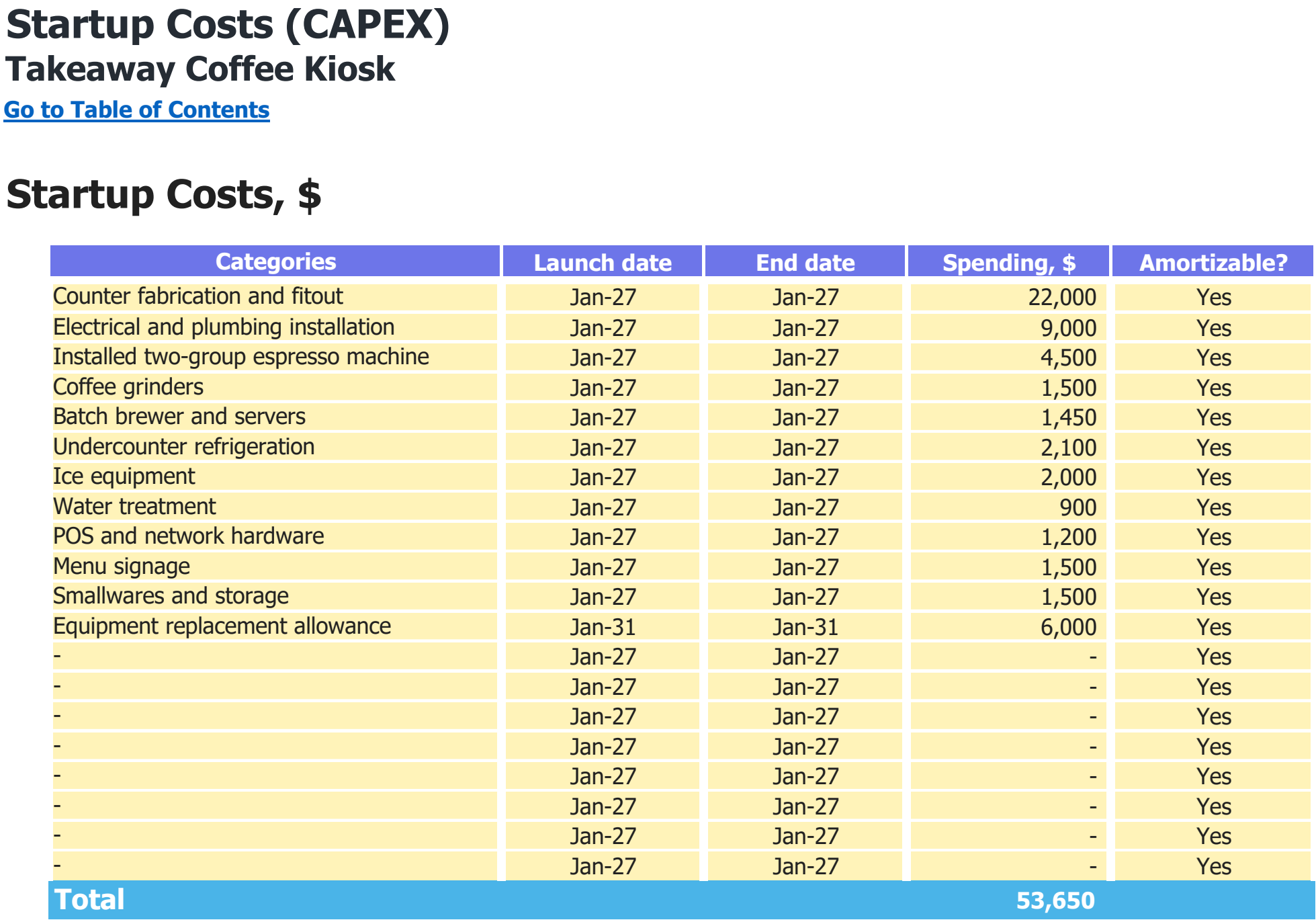
Asset categories, purchase dates and spending assumptions in USD. The total includes every scheduled purchase shown, including later replacements where present.
Enlarge image in a new tab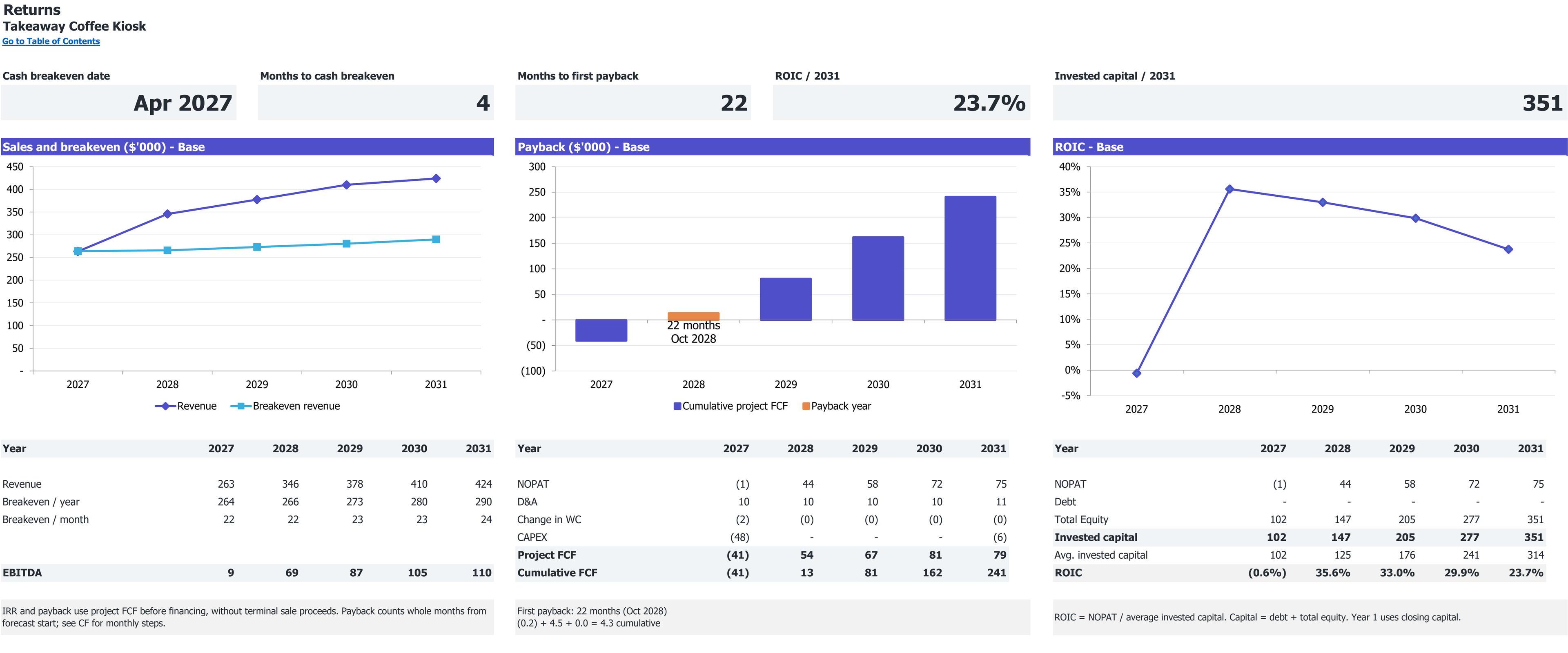
Excerpt from Returns: cumulative project free cash flow and first payback, if reached. 2027–2031 base case; dollar amounts in thousands.
Open full Returns view in a new tabExcerpt from Returns: revenue, annual and monthly break-even revenue, and EBITDA. 2027–2031 base case; dollar amounts in thousands.
Open full Returns view in a new tab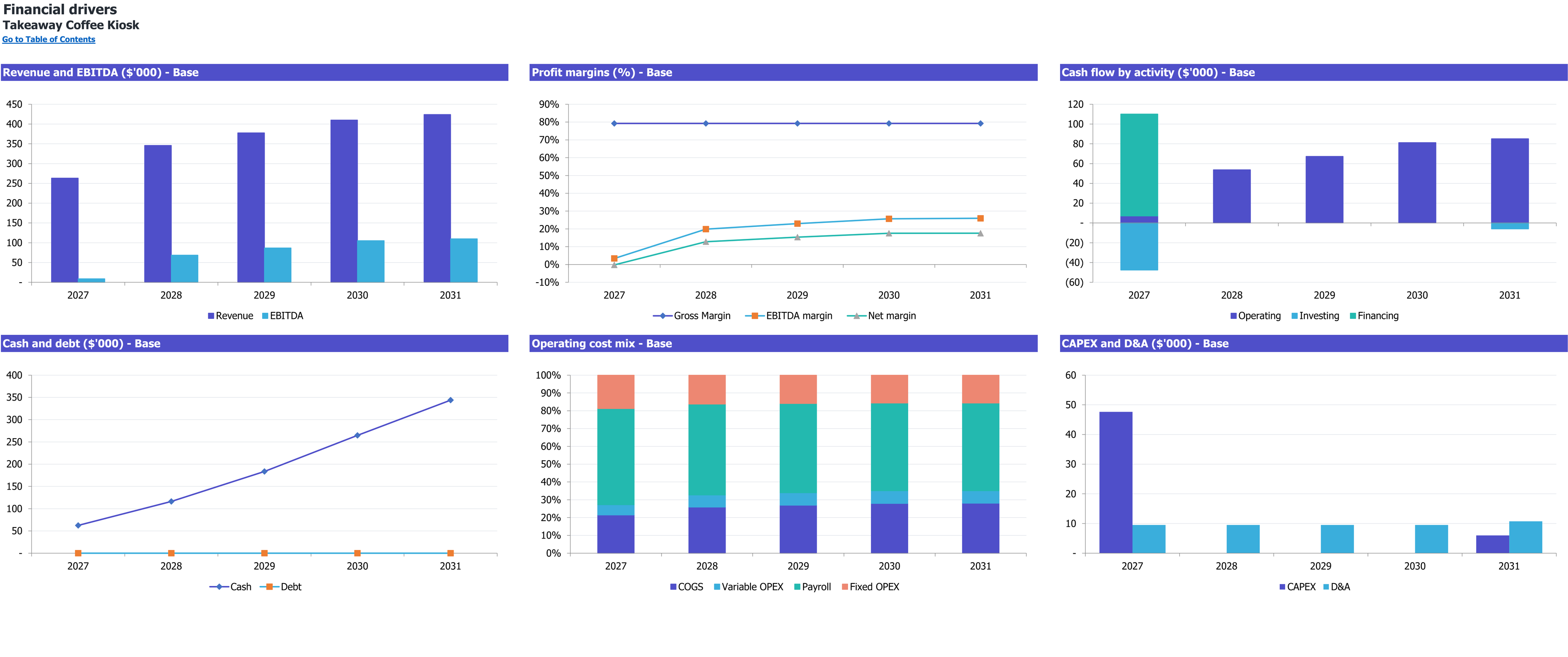
Six annual financial-driver charts for Takeaway Coffee Kiosk, 2027–2031 (Base scenario). Dollar amounts are in thousands; margins and cost mix are percentages.
Enlarge image in a new tab8 selected worksheet views. Figures show this workbook’s starting case.
Workbook availability
What is inside the Excel model
Connect a drinks-only kiosk’s walk-in and preorder demand to paid preparation and handover time. Follow ingredient yields, channel fees and opening investment through monthly cash and project recovery.
Selected worksheets from the documented workbook. Forecast period: January 2027–December 2031. Model reference: PHY002-02.
Inputs you control. Results you can inspect.
On a small screen, scroll within the table to read every column.
| Planning area | Inputs you review | How they connect | Results to inspect |
|---|---|---|---|
| Demand | 178.5 walk-in and 31.5 preorder mature orders/day initially. | Apply actual weekdays, seasonality and the 65% opening ramp. | Requested orders before paid capacity. |
| Staffed time | 3.0 FTE; 90% attendance; owner administration and setup. | Split remaining hours between preparation and handover with 80% productivity. | Fulfilled orders constrained by both roles. |
| Drink basket | 30% drip, 20% espresso/Americano, 50% milk espresso. | Weight prices and preparation minutes by the shared mix. | Revenue and drink-production workload. |
| Unit costs | Beans, milk, syrup; 96% usable yield; $0.18 packaging. | Charge ingredients by recipe and packaging once per order. | COGS and distinct channel processing fees. |
| Funding | $47,650 initial CAPEX; $103,000 equity; $30,000 reserve. | Include startup losses and stock in the monthly cash trough. | Funded minimum cash and project payback. |
Is this the right model for your business?
Check the starting case before changing the assumptions.
The starting operation
- A small indoor kiosk selling takeaway coffee without seating.
- An operator combining counter orders with online preorders.
- A founder budgeting paid owner time and a compact drink-only menu.
Check the boundary
The saved case excludes seating, food, franchise royalties, delivery marketplaces and customer advances.
Compare the other coffee shop typesHow this business makes money
Connect the unit sold to the resources required by this operating case.
Revenue logic
Fulfilled takeaway drinks multiplied by the selected drip, espresso and milk-drink prices.
Each order contains one drink. Walk-in and preorder channels share the same staffed capacity.
Can preorders increase sales without adding staffed capacity?
Only while the common preparation and handover budgets have room. The kiosk allocates the same fulfilled order count between channels; preordering changes processing costs but does not supply more barista minutes.
- Preparation
- Drink-mix weighted minutes
- Handover
- 1.2 minutes/order
- Paid time
- Administration, attendance and setup deducted first
What to establish for your own operation
- Measure the proposed drink mix and complete service times.
- Validate paid coverage at busy periods.
- Compare online fees and incremental demand within shared capacity.
Follow the plan from demand to cash
Open each section for the assumptions, calculations, and limits of this workbook’s starting case.
Calculate ingredients and channel fees separatelyPayroll
The initial menu is $3.65 drip, $4.25 espresso/Americano and $5.75 milk espresso. Bean doses, milk and syrup quantities are adjusted by 96% usable yield. Each completed order uses one $0.18 packaging allowance.
Three paid FTE include the owner/lead, preparation, counter and relief roles from January. Walk-in card transactions and online preorders use separate percentage and fixed fees. Workers compensation is a separate overhead line included in the combined labor KPI.
- Prices, ingredient budgets, wages and recurring overhead rise 3% annually.
- The food/packaging relationship is exact for the saved constant annual mix.
- Pass-through tax and tip processing fees are outside the selected fee base.
Fund the kiosk before February tradingCAPEX
January CAPEX totals $47,650 for counter fitout, connections, coffee equipment, refrigeration, water treatment and supporting assets. A $6,000 replacement follows in January 2031. Installed budgets require actual supplier and host quotes.
January equity is $103,000 with no debt. It covers the $72,108.88 peak unfunded need plus a $30,000 retained reserve, rounded upward. Minimum funded cash is $30,891.12 in March 2027.
- Recurring overhead starts before opening.
- Assets use five-year book depreciation.
- Ten inventory days are modeled; receivables and payables are zero.
Compare early trading profit with project recoveryCF
Base 2027 revenue is $263,293 and EBITDA is $8,904, including January preparation. EBITDA and operating cash first turn positive in April 2027 and remain positive; pretax profit first turns positive in May.
Project payback is October 2028, month 22. Cumulative undiscounted unlevered cash includes startup losses, stock movements and capital purchases. No owner payout policy or terminal equipment sale is modeled.
- Five-year revenue totals $1,820,932.70.
- Total operating expenses already include payroll and processing.
- The result depends on site demand, the drink mix and sustained paid productivity.
Selected results from the starting case
Modeled results in USD unless stated otherwise. These describe the selected inputs, not an estimate for your location or a guaranteed outcome.
- 2027 revenue
- $263,293USD, Base; eleven trading months after February opening.
- 2027 EBITDA
- $8,904USD, Base; includes January preparation.
- Initial CAPEX
- $47,650USD in January 2027, before the later $6,000 replacement.
- Minimum cash
- $30,891.12USD, funded Base balance in March 2027.
- Project payback
- October 2028 / month 22Cumulative undiscounted project cash recovery; owner distributions are not modeled.
Make the case your own
Work from the operating plan toward the cash requirement.
Set channel demand, opening date and drink mix.
Validate attendance, administration, setup and productive minutes.
Replace recipes, rent and installed equipment allowances.
Review funding, physical demand stresses and monetary scenarios separately.
Interpretation and scope
- The national case does not establish local demand or a host agreement.
- No peak queue or outage simulation is included.
- Same-month cash settlement omits processor float and customer advances.
- The 25% tax allowance has no selected jurisdiction or interyear loss carryforward.
- Lease deposits, revenue-share rent and owner distributions are outside the saved assumptions.
The workbook is an Excel file for local planning. Learn how to interpret assumptions and evidence.
Other coffee shop types
Each operating type calls for its own financial structure.
Questions
Is food included?
No. Every order contains one takeaway drink.
Are preorders additional capacity?
No. They share the same preparation and handover team.
Is owner time free?
No. Owner pay and monthly administration time are included.
Do the two channels use identical processing fees?
No. Walk-in card and online preorder fees have separate rates and fixed amounts.
Does project payback mean a dividend?
No. It measures project cash recovery; no owner payout schedule is modeled.
Can I buy this model now?
No. Purchasing and workbook downloads are not available on this site.
Which software does the workbook use?
The documented file is an Excel workbook (.xlsx). Compatibility with other spreadsheet applications is not established by the file extension.
Read the planning guides
Explore the relevant operating questions and how to interpret a workbook’s assumptions.
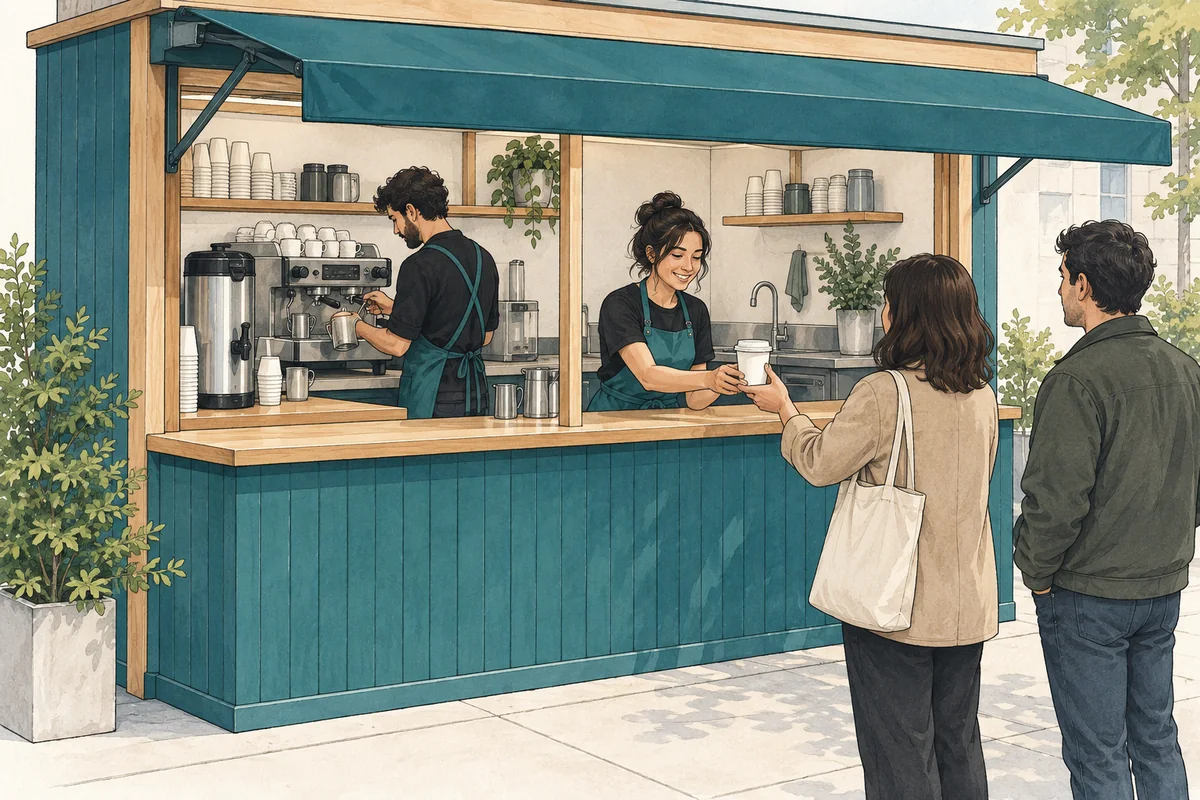
How do drink mix and paid staffing limit a takeaway coffee kiosk?
Turn funded staff hours into preparation and handover capacity, then test how a takeaway kiosk's drink mix limits monthly orders without assuming a peak-hour queue forecast.
Read the guide
Which coffee business fits your customers and working day?
Compare a seated coffee shop, takeaway kiosk, mobile truck, and employer-paid service by customer, location, daily work, and the evidence each idea needs.
Read the guide
How to read financial assumptions before editing an Excel model
Follow the chain from operating assumptions to calculated results, check units and timing, and keep a useful record of changes to a financial workbook.
Read the guideEvidence and scope
A related category or operator is referenced. Do not interpret the link as independent proof of this exact configuration or its viability.
The links below provide operating-format context; they do not verify the workbook’s selected inputs or calculated returns.
The workbook guide and figures describe model PHY002-02, revision r01, for January 2027–December 2031. These are a documented planning case, not observed results for a particular business.