
Wedding and Banquet Venue Financial Model: Full-Service Own-Venue Events
Plan a staffed banquet venue with inclusive guest packages, constrained bookings, refundable deposits, payroll, startup funding and cash flow.
- Excel (.xlsx)
- Forecast: 60 months · March 2027 service launch
- Reservation: One exclusive ten-hour block per available day
- Case: U.S. · USD · Base
Planning several types? Compare 4 wedding and banquet venue formats
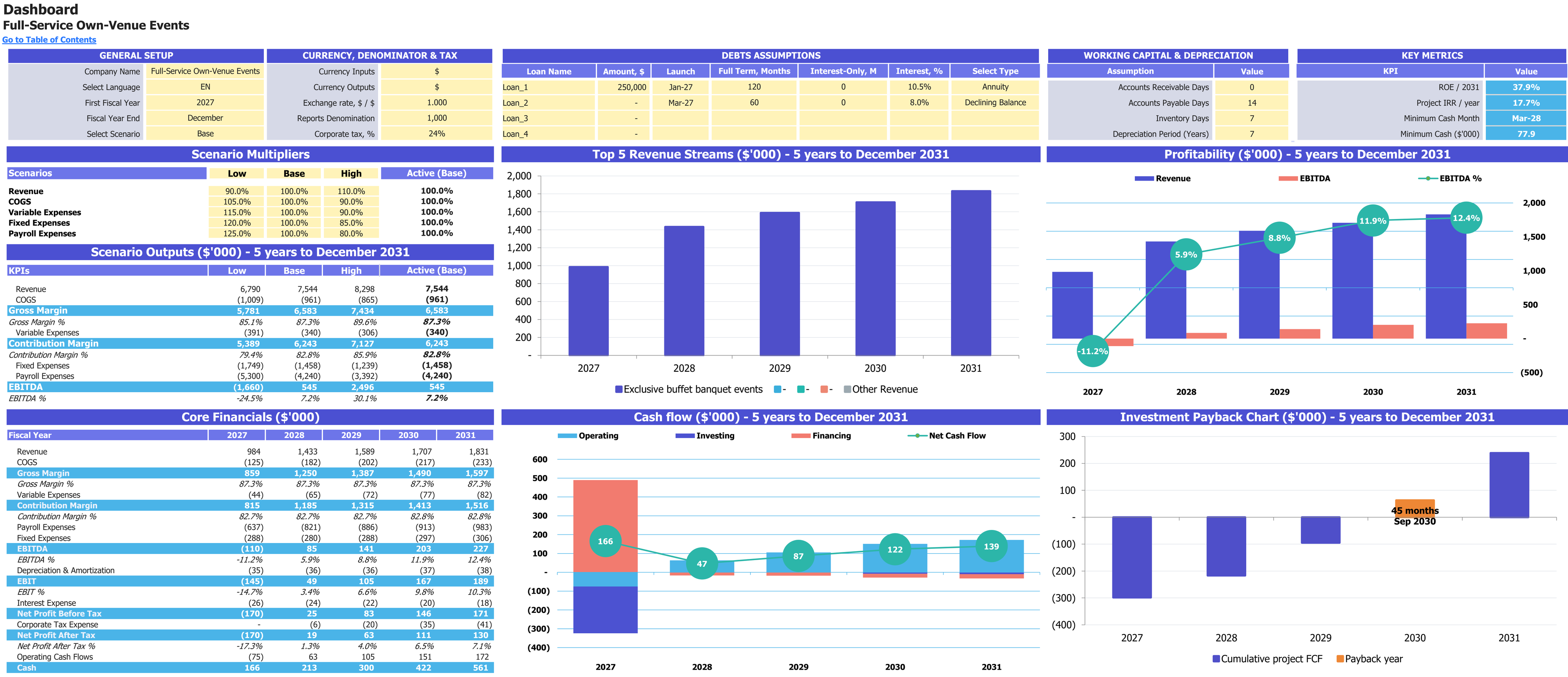
Base-case scenario controls, annual financial results and charts for 2027–2031. Financial report amounts are shown in thousands of USD; percentage measures retain their own units.
Enlarge image in a new tab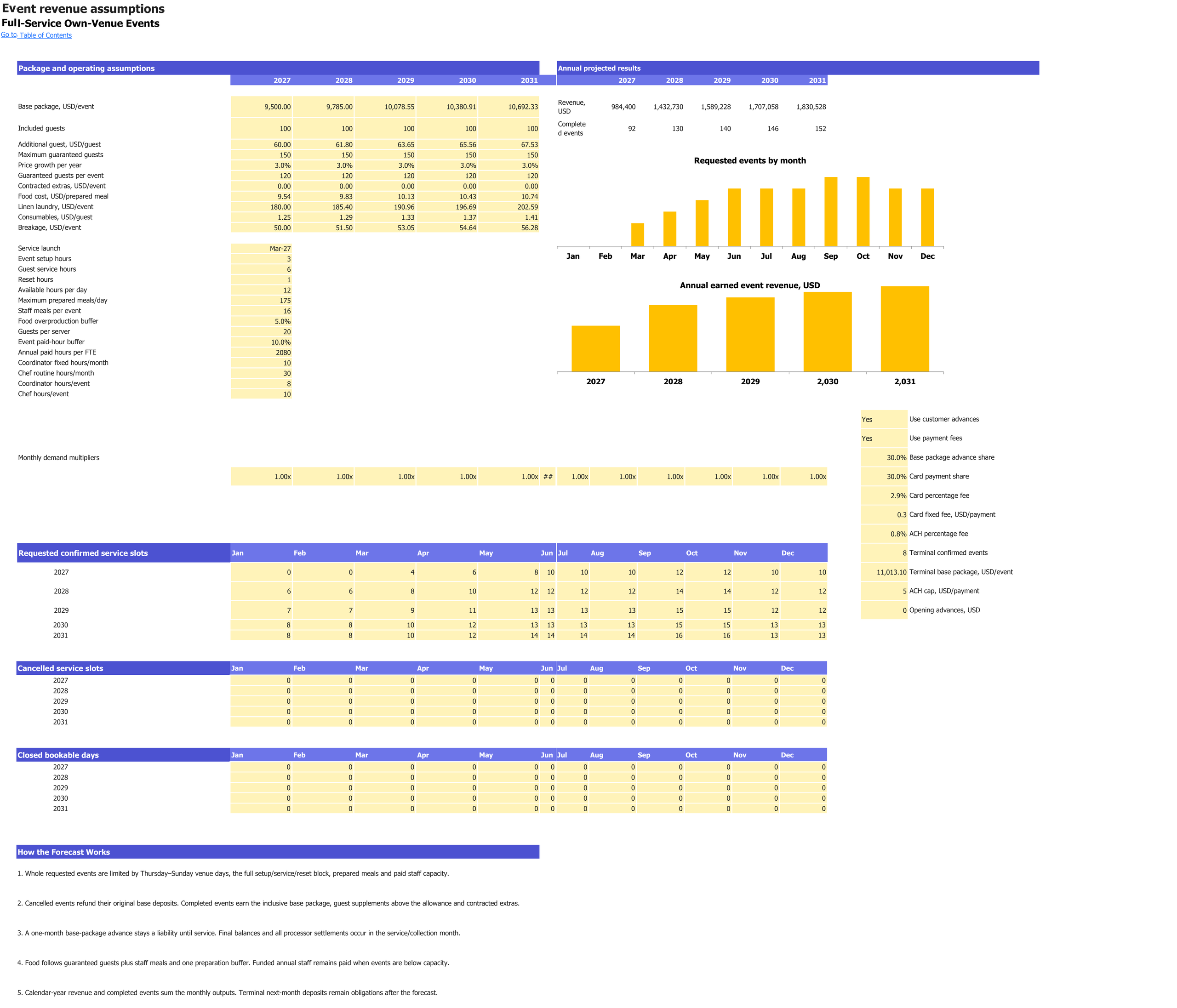
Event packages, venue capacity, bookings and payment assumptions with monthly and annual operating results. Monetary inputs and sales use USD; operating volumes retain their labelled units. Forecast years are 2027–2031.
Enlarge image in a new tab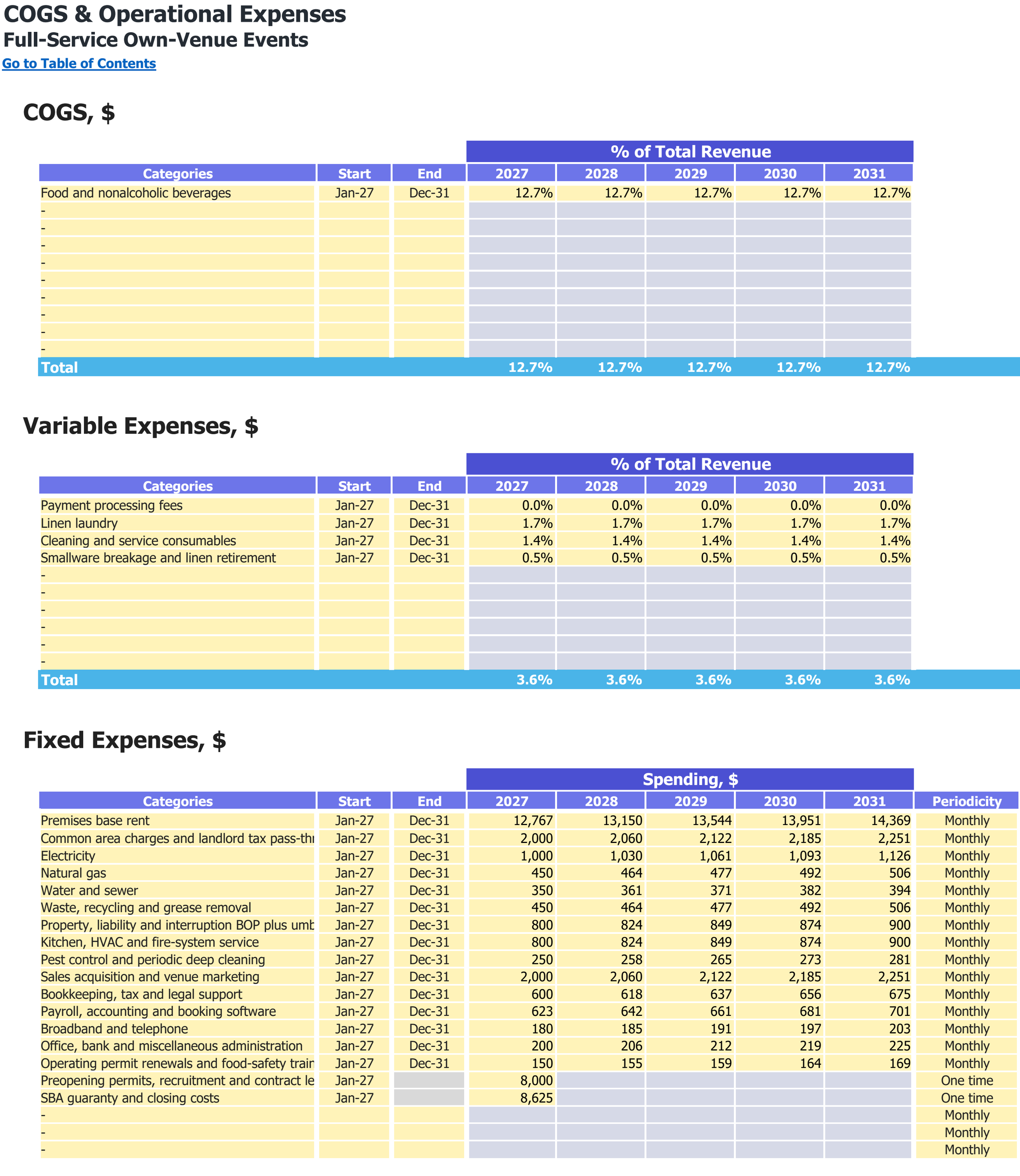
Food and other direct-cost categories, variable expense shares and fixed operating expenses. Monetary inputs are USD; the annual percentage columns are cost shares of revenue.
Enlarge image in a new tab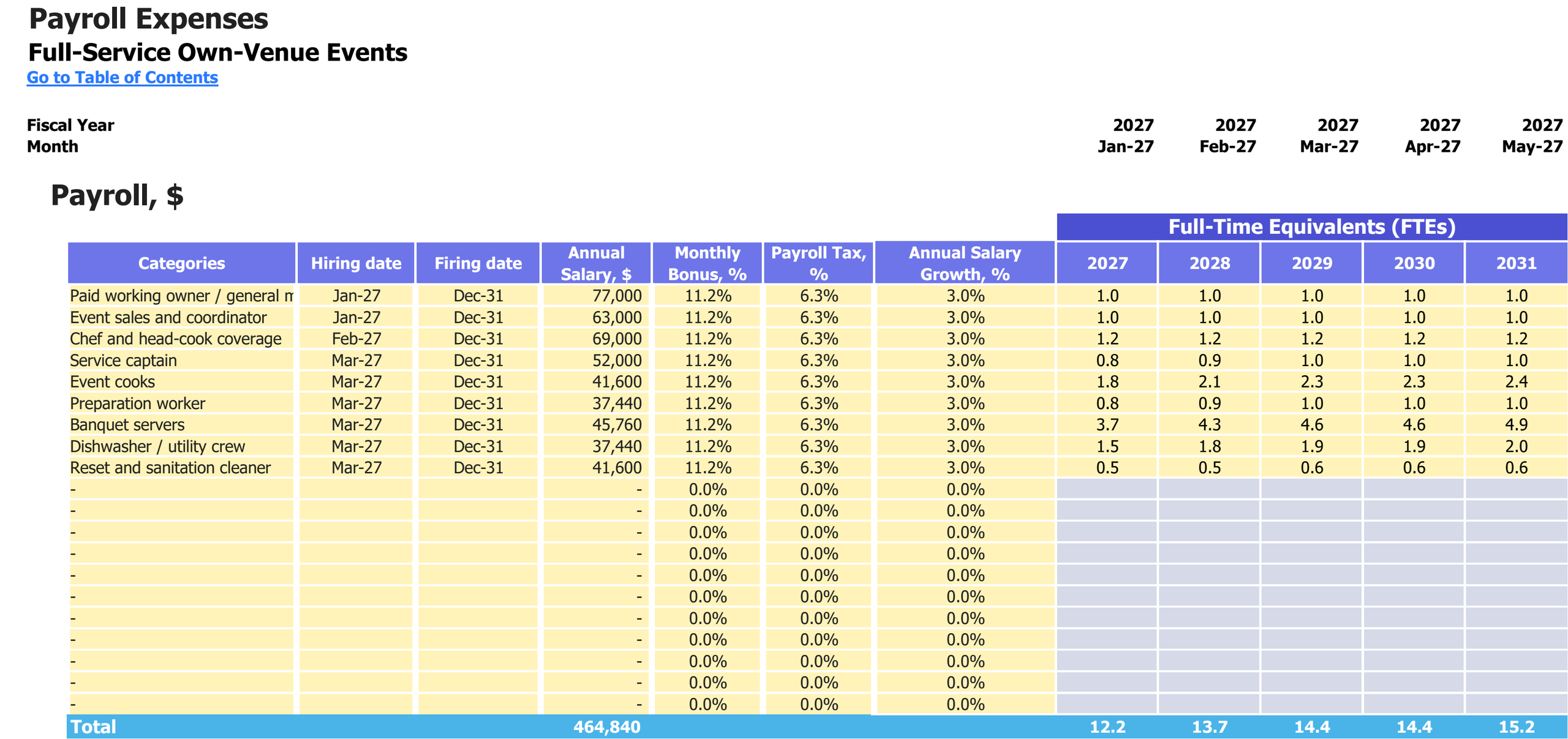
Paid roles, annual salary and employer-load assumptions, with staffing in full-time equivalents for 2027–2031. Salary amounts are USD; percentages and FTEs are labelled separately.
Enlarge image in a new tab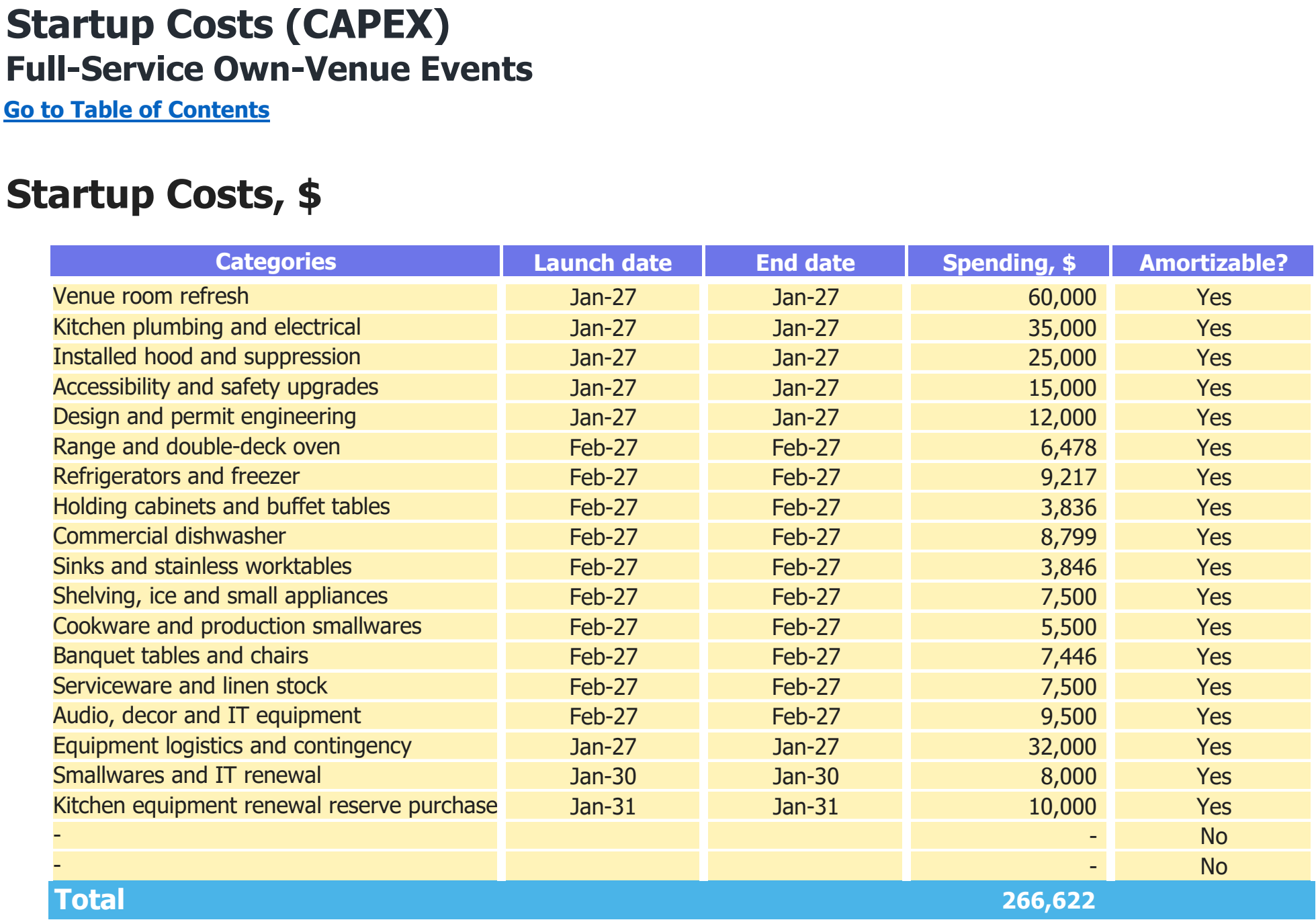
Asset categories, purchase dates and spending assumptions in USD. The total includes every scheduled purchase shown, including later replacements where present.
Enlarge image in a new tab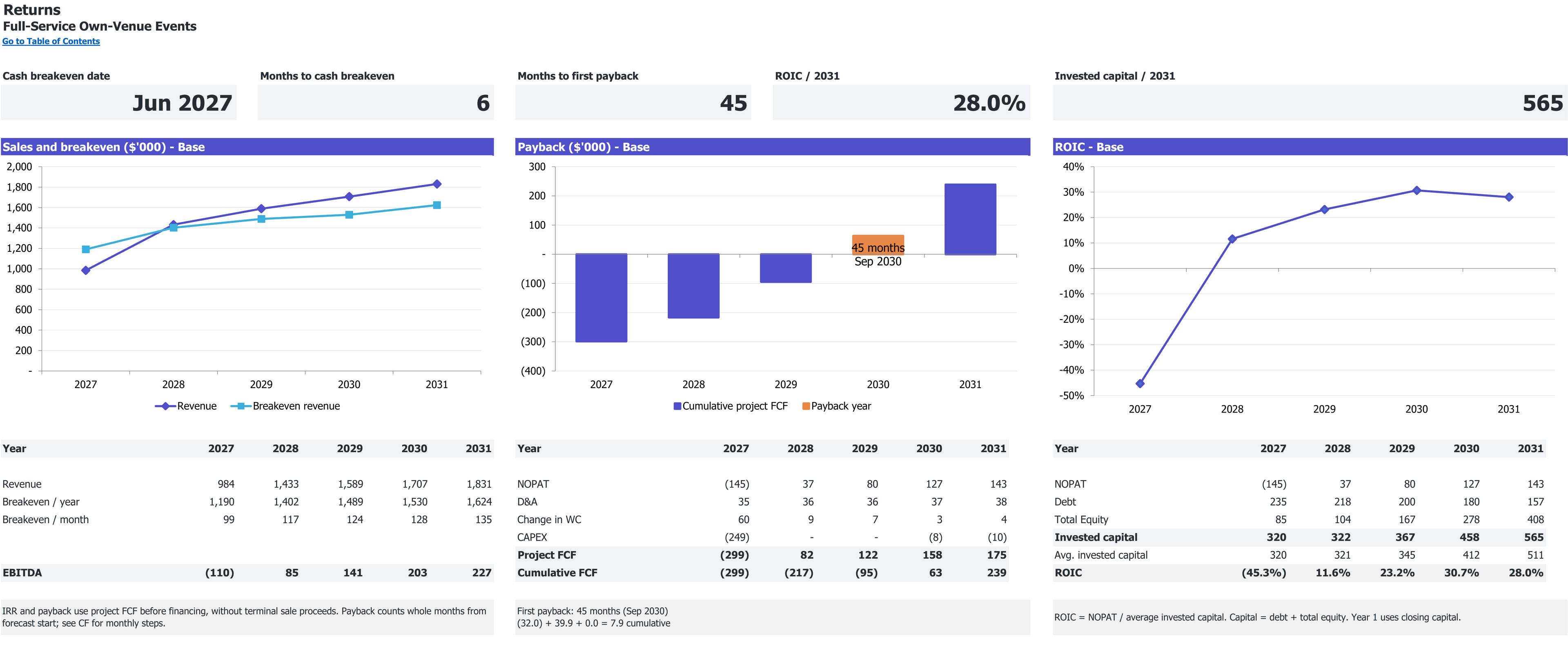
Excerpt from Returns: cumulative project free cash flow and first payback, if reached. 2027–2031 base case; dollar amounts in thousands.
Open full Returns view in a new tabExcerpt from Returns: revenue, annual and monthly break-even revenue, and EBITDA. 2027–2031 base case; dollar amounts in thousands.
Open full Returns view in a new tab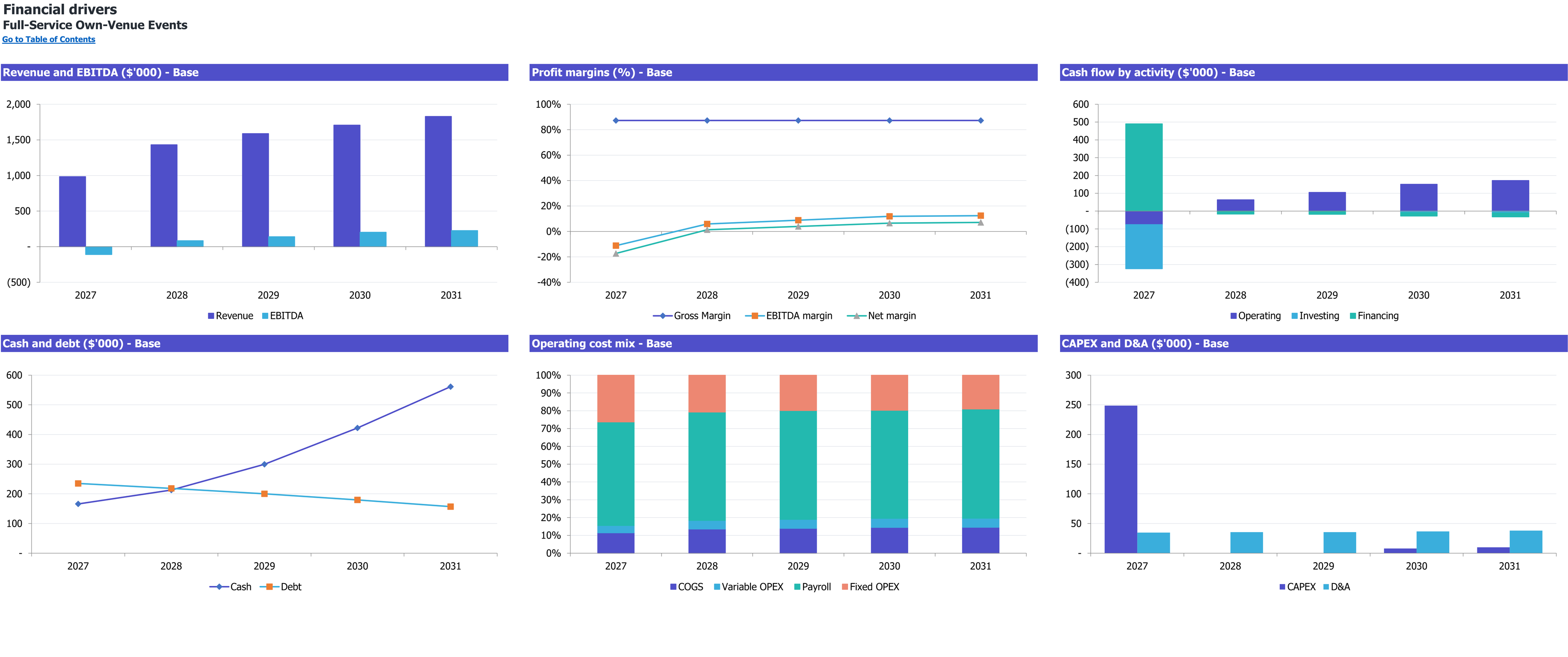
Six annual financial-driver charts for Full-Service Own-Venue Events, 2027–2031 (Base scenario). Dollar amounts are in thousands; margins and cost mix are percentages.
Enlarge image in a new tab8 selected worksheet views. Figures show this workbook’s starting case.
Workbook availability
What is inside the Excel model
Keep booking cash separate from earned event revenue. This workbook connects exclusive venue dates and paid crew capacity to package pricing, cancellations and the monthly funding requirement.
Selected worksheets from the documented workbook. Forecast period: January 2027–December 2031. Model reference: PHY199-02.
Inputs you control. Results you can inspect.
On a small screen, scroll within the table to read every column.
| Planning area | Inputs you review | How they connect | Results to inspect |
|---|---|---|---|
| Bookings and availability | Monthly whole-event requests, cancellations and open weekdays. | Calendar and funded capacity constrain confirmations before cancellations. | Completed events and earned revenue. |
| Inclusive package | Base price, included and guaranteed guests, supplements and extras. | Only guaranteed guests above the included count earn a supplement. | Contract price without double-counted guests. |
| Crew and food capacity | Role hours, paid start dates, guest count and meal throughput. | Management overhead and event work consume funded capacity. | Feasible event count and meal purchases. |
| Deposits and payments | Advance share, payment mix and card/ACH terms. | Deposits precede service; cancellations refund deposits; processing is charged once. | Advance liabilities, refunds and collections. |
| Investment and finance | Fit-out, replacement assets, working capital, debt and equity. | Monthly cash includes advance liabilities and financing schedules. | Cash reserve and project investment recovery. |
Is this the right model for your business?
Check the starting case before changing the assumptions.
The starting operation
- One leased 6,000-square-foot second-generation banquet venue.
- Exclusive Thursday–Sunday events with a conditional 150-guest ceiling.
- A staffed inclusive package with refundable advance deposits and a March 2027 launch.
Check the boundary
A room-only rental, off-site caterer, alcohol-led package, lodging operation or automated booking-rescheduling system needs a different scope.
Compare the other wedding and banquet venue typesHow this business makes money
Connect the unit sold to the resources required by this operating case.
Revenue logic
Revenue = completed events × inclusive package price, plus additional guaranteed guests and contracted extras.
Included guests are counted once. Deposits remain liabilities until service; canceled events earn no sale.
Why can event deposits improve cash without increasing earned sales?
A deposit funds the period before the event but remains refundable under the modeled cancellation rule. Revenue arises when the event is completed. Capacity, advance liabilities and refunds therefore need separate treatment from the package sales forecast.
- Earned sale
- One completed inclusive event.
- Advance
- A base-package deposit collected one month before service.
- Capacity
- Exclusive dates, guests, kitchen and funded role hours.
What to establish for your own operation
- Confirm local occupancy and actual kitchen capacity.
- Validate booking demand, cancellation terms and payment timing.
- Review role coverage at the largest guaranteed guest count.
Follow the plan from demand to cash
Open each section for the assumptions, calculations, and limits of this workbook’s starting case.
Price the package once and constrain the calendarRevenue
The initial $9,500 package includes 100 guests. A $60 supplement applies above that count; the 120-guest guarantee produces an initial $10,700 earned event price. Contracted extras start at zero.
Each date reserves ten hours: three for setup, six for service and one for reset. The case allows one exclusive event on an available Thursday–Sunday date. Paid role hours and kitchen capacity also constrain confirmations.
- The conditional 150-guest ceiling is not proof of legal occupancy.
- Food includes guaranteed guests and staff meals; included guests are not another sale.
- The rotating roster is not equivalent to the same number of full-time employees.
A deposit is cash received before revenue is earnedCF
The client pays 30% of the base package one month before service. The deposit remains a liability until completion. Cancellations refund the original deposit and earn no event sale; supplements and extras enter the service-month balance.
Card processing and capped ACH fees apply to separate deposit and balance payments. Original processing fees are not refunded on cancellation. Successful collection and settlement occur in the same month.
- Opening advance liabilities are zero.
- The one-month lead is a selected planning assumption.
- The workbook does not automatically move a prepaid cohort to a rescheduled date.
Pay for available capacity even when dates are quietPayroll
The model funds management, chef and event crews through fixed annual FTEs. Unused event capacity remains paid. Chef and coordinator capacity deduct routine overhead; event crew time includes the training and relief buffer once.
Food follows prepared meals, including staff meals and the selected buffer. Event materials include laundry, guest consumables and breakage. Annual cost ratios connect this event budget to the existing schedules without making purchases rise solely because package prices rise.
- A paid owner/general manager is included.
- Recurring overhead starts at $22,619.85 monthly, including occupancy.
- Guaranteed guest count can reduce the number of events supported by fixed staff.
Separate spent assets, retained cash and project recoveryCAPEX
Initial CAPEX is $248,622, with $8,000 replacement spending in January 2030 and $10,000 in January 2031. The native method uses purchase dates and one seven-year depreciation life.
January financing includes $250,000 debt and $255,000 cash equity. Debt assumes 10.5% over 120 months with no grace period. Minimum funded cash is $77,912 in March 2028 against a $75,000 reserve target.
Project payback first occurs in September 2030, month 45 from January 2027. It uses cumulative undiscounted unlevered project cash, including working-capital changes and advance liabilities, with no owner distributions.
- Base 2027 EBITDA is negative $110,109.
- June 2027 is the first nonnegative EBITDA and operating-cash month; later seasonal losses recur.
- Some stress cases have multiple admissible IRR roots; assess cash flow and NPV alongside the warning.
Selected results from the starting case
Modeled results in USD unless stated otherwise. These describe the selected inputs, not an estimate for your location or a guaranteed outcome.
- First-year earned revenue
- $984,400Base · USD · calendar 2027, from 92 completed events after a March launch.
- First-year EBITDA
- −$110,109Base · USD · calendar 2027, including pre-opening payroll and expenses.
- Initial CAPEX
- $248,622Base · USD · January–February 2027 purchases; later replacements are separate.
- Minimum funded cash
- $77,912Base · USD · March 2028, including selected debt, equity and advance collections.
- Project payback
- September 2030Base · month 45 from January 2027; first cumulative undiscounted unlevered project recovery.
Make the case your own
Work from the operating plan toward the cash requirement.
Set available dates, event requests, cancellations and guest guarantees.
Review package inclusions, supplements and crew capacity together.
Replace food, venue, payroll, asset and financing allowances.
Inspect advance liabilities, refunds and monthly cash through seasonal losses.
Interpretation and scope
- This national planning case is not a venue lease quote, occupancy approval or lender commitment.
- Monthly bookings and paid-capacity assumptions are not an automated scheduling system.
- Rescheduling is not implemented; settlement across months is outside the selected case.
- The 14-day payable assumption applies to native operating-expense aggregates; it is not a separate negotiated term for every supplier.
- Seasonal losses recur after the first operating break-even month. IRR sign-pattern warnings remain meaningful.
- Project payback is not a distribution or repayment to shareholders.
The workbook is an Excel file for local planning. Learn how to interpret assumptions and evidence.
Other wedding and banquet venue types
Each operating type calls for its own financial structure.
Questions
Does the package earn revenue for all guaranteed guests again?
No. The base package includes its first 100 guests. Only guaranteed guests above that allowance receive the supplement.
Is a booking deposit revenue?
No. It is an advance liability until the event is completed. Canceled events refund the original deposit and earn no event sale.
Are crews paid only when an event takes place?
No. Funded fixed FTEs provide capacity, and unused capacity remains paid while the roles are active.
Does June 2027 establish permanent profitability?
No. EBITDA and operating cash first become nonnegative then, but seasonal losses recur.
Can I move a prepaid booking to another date automatically?
No. Rescheduling a prepaid cohort is not an implemented user control.
Can I buy this model now?
No. Purchasing and workbook downloads are not available on this site.
Which software does the workbook use?
The documented file is an Excel workbook (.xlsx). Compatibility with other spreadsheet applications is not established by the file extension.
Read the planning guides
Explore the relevant operating questions and how to interpret a workbook’s assumptions.
How do event bookings and deposits affect revenue and cash?
Trace one venue booking from its advance deposit to the completed event, separating package revenue, guest supplements, refunds, and available cash.
Read the guideIs a full-service event venue the right business idea for you?
Assess a full-service event venue through its customer promise, package boundaries, reserved dates, paid team and premises commitment.
Read the guideHow to open a full-service event venue before taking bookings
Define the venue package, confirm usable capacity and event hours, prove the crew and kitchen, and connect booking commitments to the opening cash plan.
Read the guideEvidence and scope
Operationally specified by the analyst. An active local operator, commercial demand and legal permission require separate validation.
The links below provide operating-format context; they do not verify the workbook’s selected inputs or calculated returns.
The workbook guide and figures describe model PHY199-02, revision r02, for January 2027–December 2031. These are a documented planning case, not observed results for a particular business.