The private-label bakery case models one U.S. contract bread manufacturer in a leased 4,000-square-foot plant. It owns its ingredients and production inventory and has no retail sales or customer advances. Its Base forecast spans January 2027–December 2031 in USD; the terms and volumes discussed here are planning assumptions, not signed customer contracts.
When does production become a sale?
Revenue is earned when accepted loaves are delivered to external private-label customers. Mixing dough, moving a batch into the oven, and transferring finished loaves to storage are internal production steps. They do not create a second customer sale in this model.
Requested contract orders are compared with deliverable stock. Mixing, proofing, baking, and packing constrain production, and existing work in process uses completion capacity before new dough starts. Producing more is therefore not the same as having more accepted, billable loaves.
Where can cash remain tied up?
The case carries separate raw-material, work-in-process, and finished-goods balances. It also tracks trade receivables and supplier payables. Keeping those stages separate makes it possible to explain why a paid purchase may still be inventory, or why a recorded sale may still be awaiting payment.
On a narrow screen, scroll within the table to read all columns.
| Stage | Case treatment | Cash-planning implication |
|---|---|---|
| Raw materials | Buffer of seven operating days of current usage. | Purchases can precede production and delivery. |
| Work in process | 2% of new starts remain unfinished; material content is complete and conversion is 50% complete. | Some incurred production cost remains in stock. |
| Finished goods | 8% of current output is held awaiting acceptance. | Finished output is not automatically an accepted sale. |
| Customer payment | Receivables use 15 calendar days; no advances. | Earned sales and cash receipts can fall in different periods. |
| Supplier payment | 50% of purchases paid currently; 50% the next month. | Trade credit delays part of the purchase payment. |
Do not add these inputs into a single number of cash-cycle days. Seven operating days and 15 calendar days use different clocks, while the WIP and acceptance assumptions are shares of production. The monthly ledgers determine how they interact; the table is a map of the mechanism, not a calculated funding requirement.
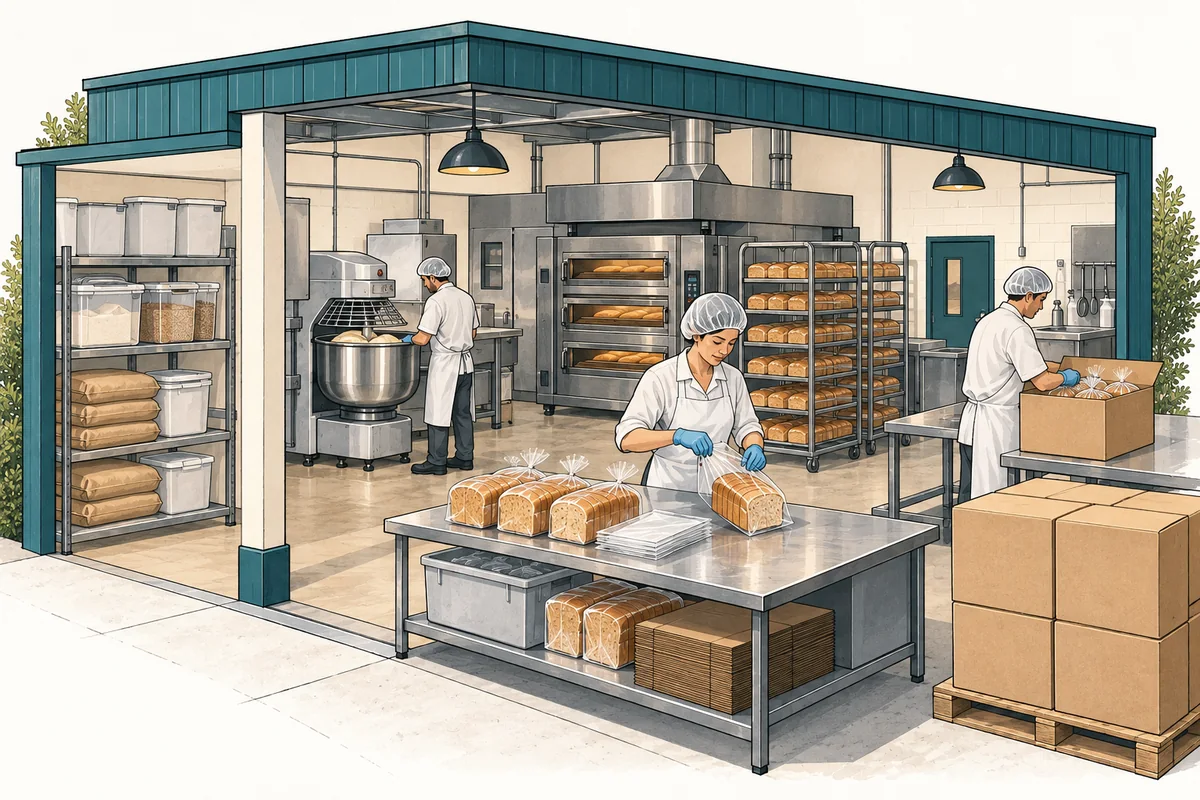
Does holding labor cost in inventory conserve cash?
No cash is created by classifying an incurred cost as inventory. This case allocates eligible production wages, factory overhead, and depreciation to production under its normal-capacity policy. Wages and factory bills still follow their cash-payment schedules even when part of the cost has not yet reached the income statement.
The owner/manager’s labor is paid and expensed. Idle production costs, abnormal rejection, spoilage, and finished-goods write-downs receive separate treatment. The model’s monthly inventory method is an approximation; it does not replace a daily expiry, quality-release, or customer-level schedule.
There is also a presentation boundary to preserve. The workbook’s gross-profit subtotal deducts materials and packaging, while production payroll, factory overhead, and depreciation appear in their respective expense sections after inventory deferral. That subtotal is not a fully absorbed manufacturing margin; use the model’s separate full-production-cost information when asking that question.
How does this affect the startup cash requirement?
The saved Base case requires more cash than its equipment and fit-out budget. Initial capital expenditure is $269,141, while the peak cumulative cash requirement before financing reaches $399,404 in November 2027. The $130,263 difference includes cumulative operating and working-capital cash absorption; it is not an inventory-only balance.
The selected funding adds a $100,000 retained reserve and rounds upward to the next $1,000: $399,404 + $100,000 = $499,404, rounded to $500,000 of equity. At the stated cash trough, that leaves $100,596. These whole-dollar case figures illustrate the reconciliation, not a funding recommendation for another bakery.
The cash requirement already includes the modeled inventory and payment effects. Adding the inventory buffers again as a separate startup expense would count the same cash need twice. Funding is fixed in the source case, so slower collections or a larger acceptance hold requires a fresh cash review.
What evidence should replace the selected terms?
Before adapting the case, obtain the commercial terms that determine when goods become billable and when cash is due. Confirm the accepted product specification, rejection process, shelf life, supplier payment schedule, and customer settlement terms rather than assuming a retail cash-sale pattern.
Use the assumptions review guide to record changes and their basis. The private-label bakery model links the production and trade balances to the cash forecast; its selected terms remain assumptions until the intended customer and supplier arrangements support them.