
Bakery Financial Model: Private-Label Bakery
Plan private-label bread contracts with production bottlenecks, acceptance holds, owned inventory, manufacturing costs and monthly funding needs.
- Excel (.xlsx)
- Forecast: 60 months · January 2027 opening
- Starting plant: 4,000 sq ft · seven FTE
- Case: U.S. · USD · Base
Planning several types? Compare 8 bakery formats
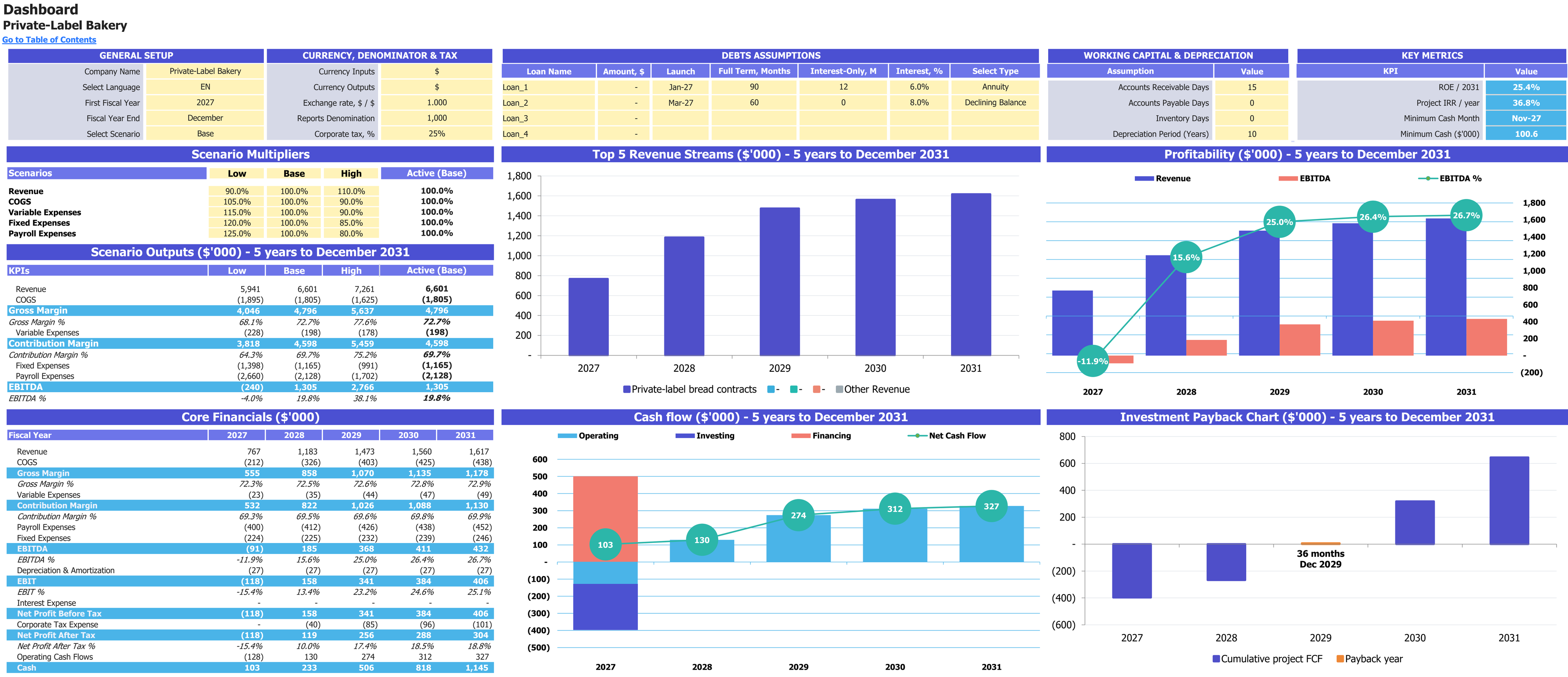
Base-case scenario controls, annual financial results and charts for 2027–2031. Financial report amounts are shown in thousands of USD; percentage measures retain their own units.
Enlarge image in a new tab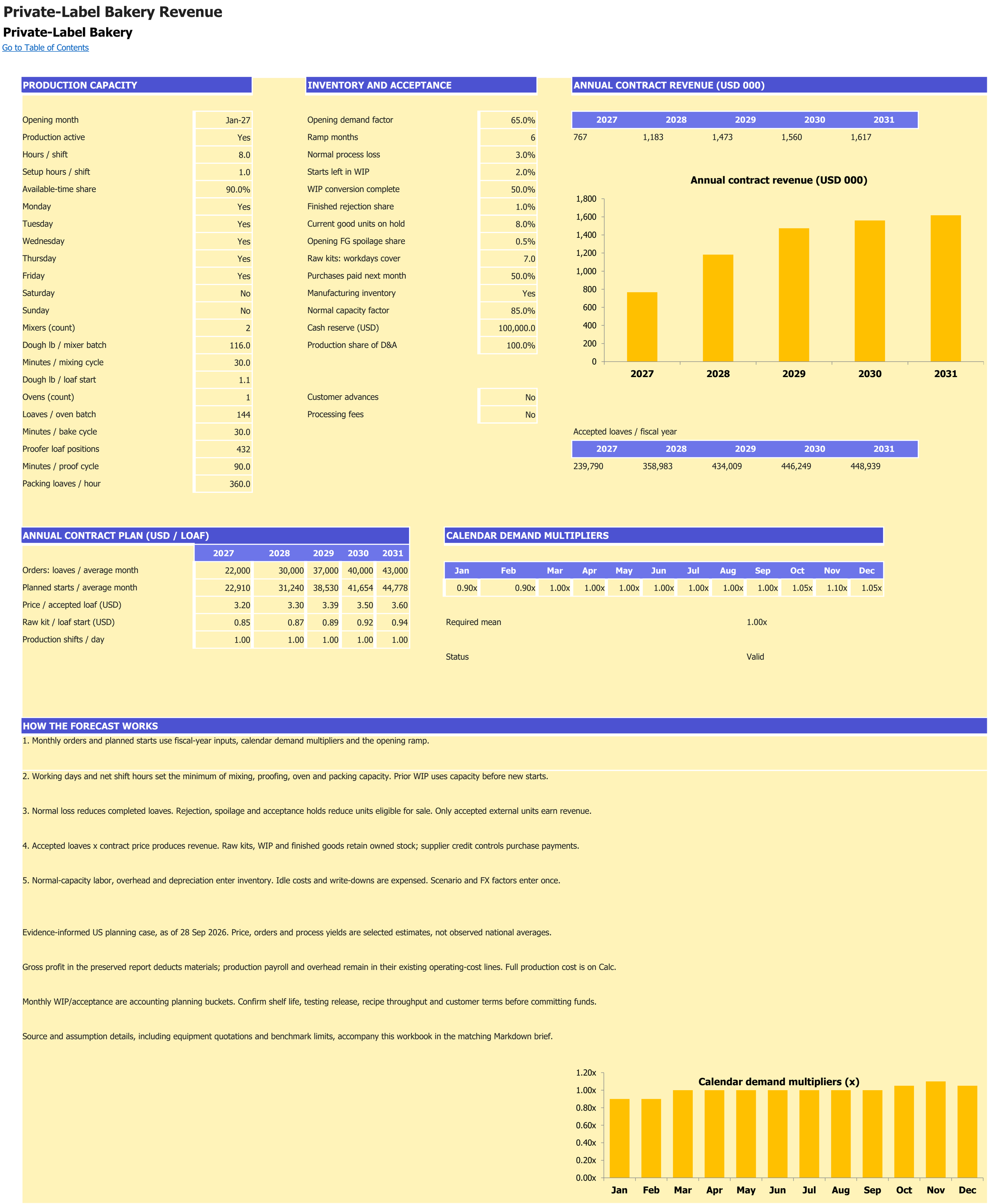
Private-label bread production, contract demand, inventory and costing assumptions with output and revenue charts. Monetary inputs and sales use USD; operating volumes retain their labelled units. Forecast years are 2027–2031.
Enlarge image in a new tab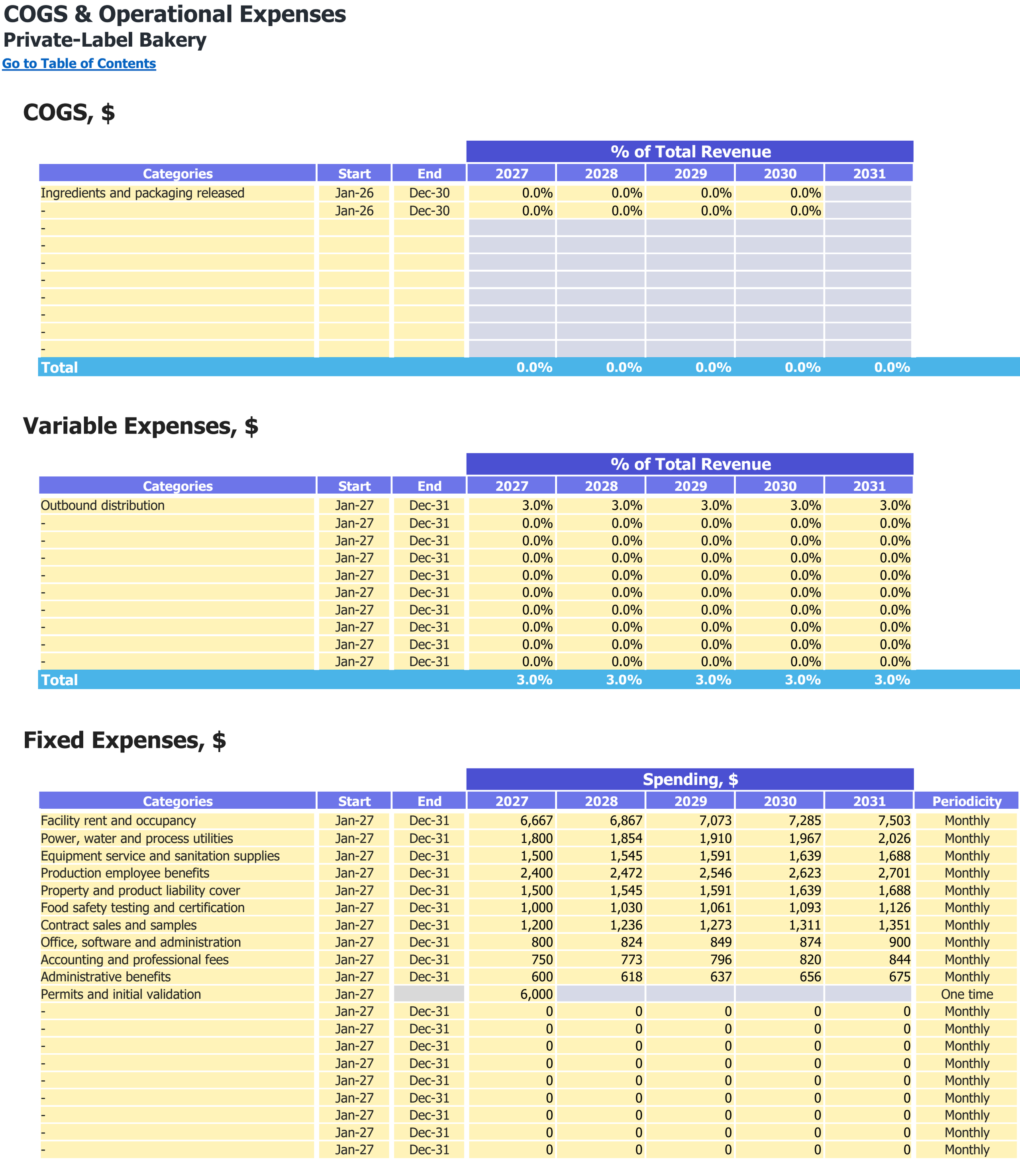
Food and other direct-cost categories, variable expense shares and fixed operating expenses. Monetary inputs are USD; the annual percentage columns are cost shares of revenue.
Enlarge image in a new tab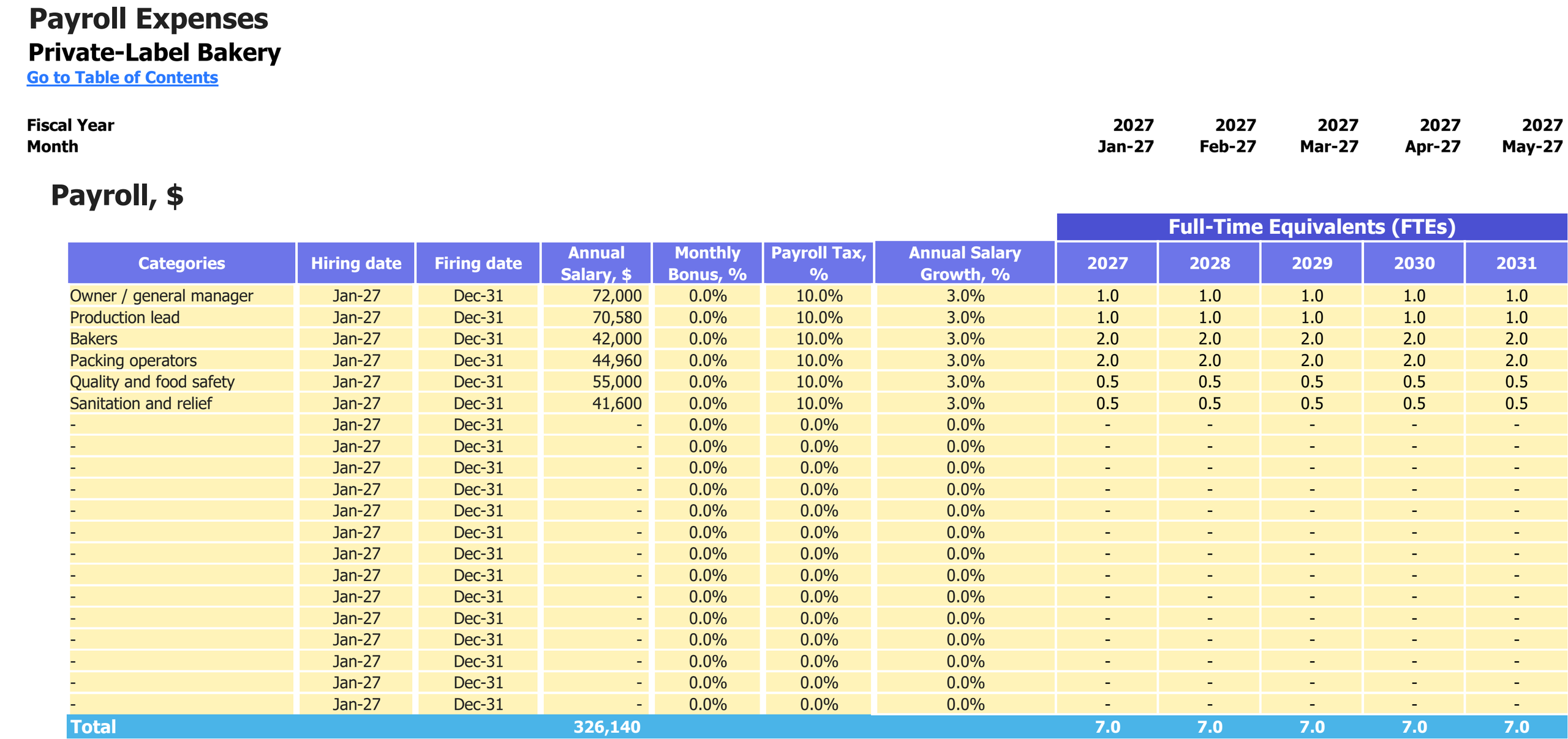
Paid roles, annual salary and employer-load assumptions, with staffing in full-time equivalents for 2027–2031. Salary amounts are USD; percentages and FTEs are labelled separately.
Enlarge image in a new tab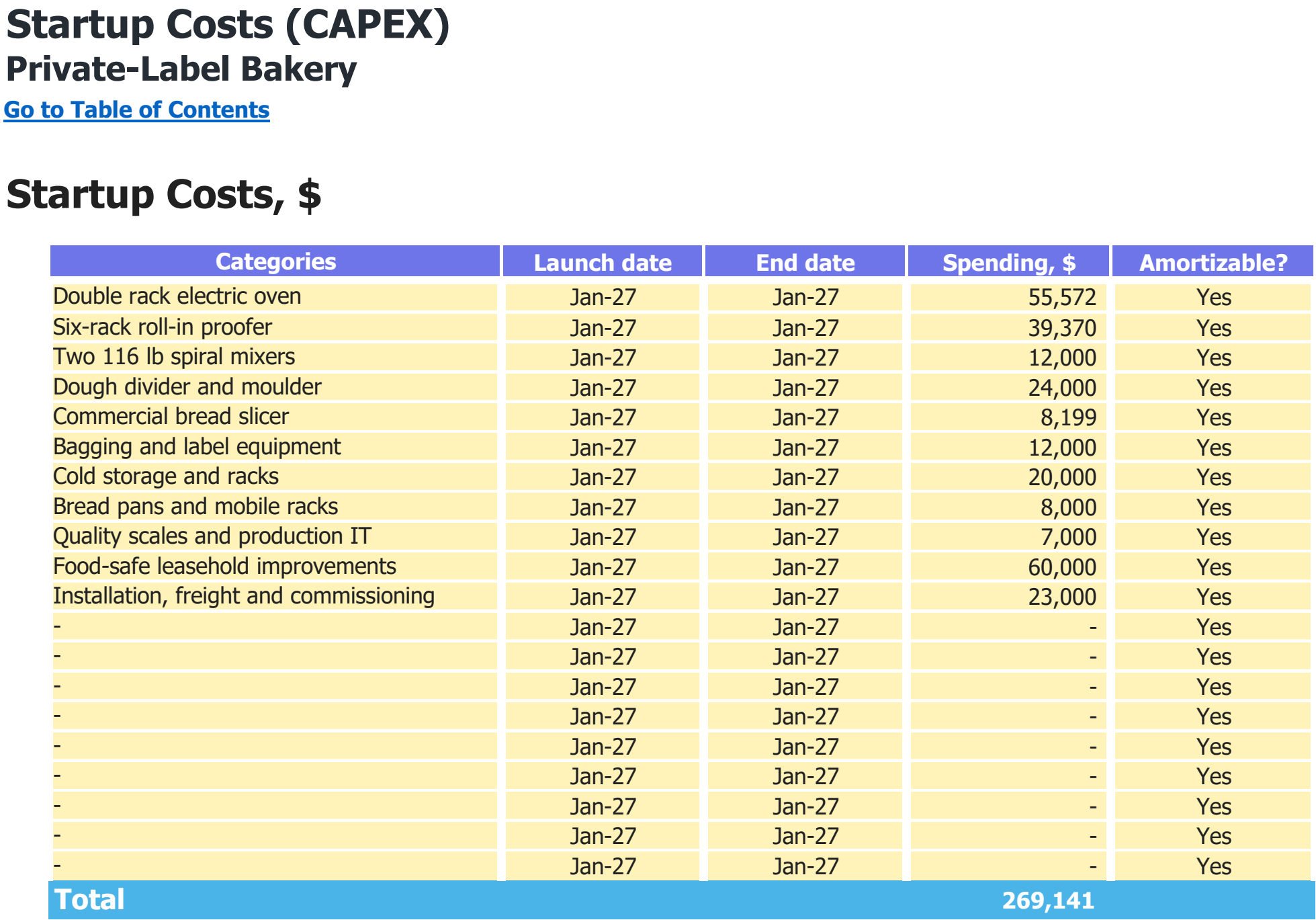
Asset categories, purchase dates and spending assumptions in USD. The total includes every scheduled purchase shown, including later replacements where present.
Enlarge image in a new tab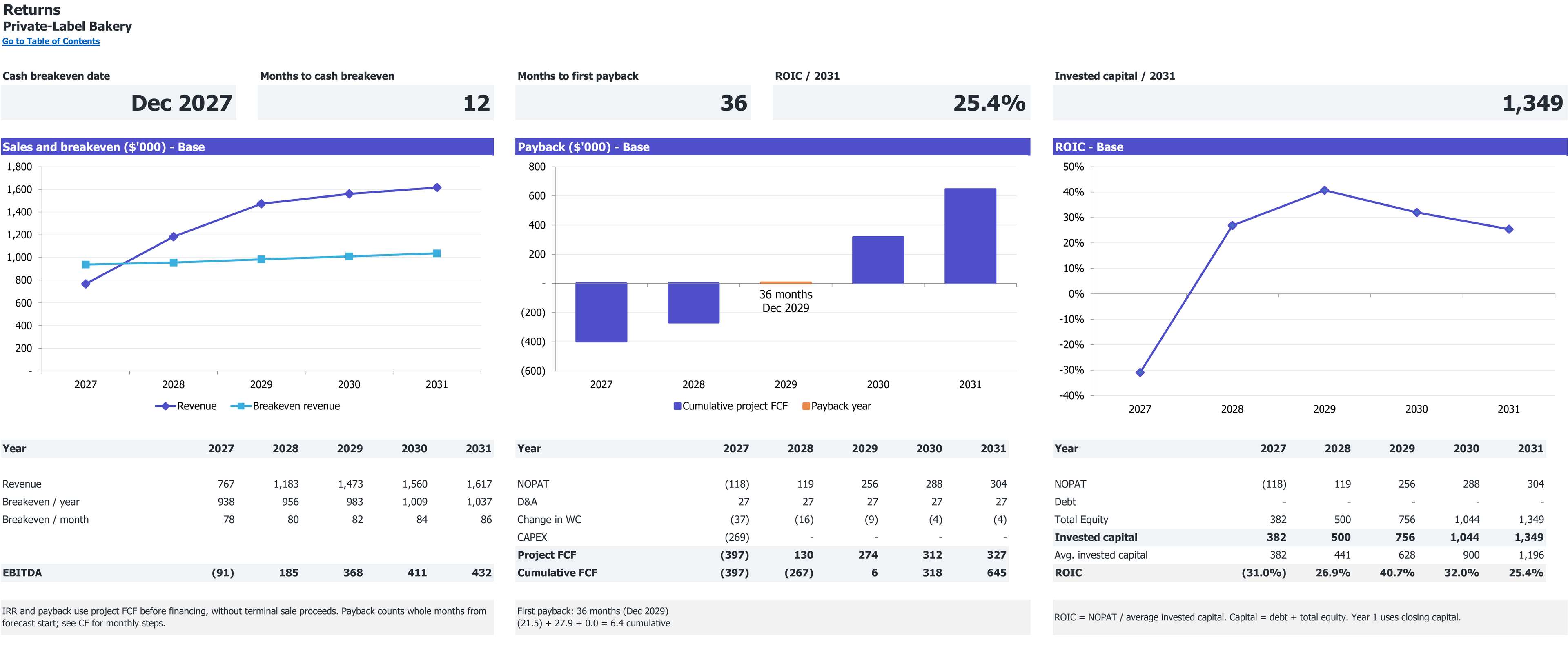
Excerpt from Returns: cumulative project free cash flow and first payback, if reached. 2027–2031 base case; dollar amounts in thousands.
Open full Returns view in a new tabExcerpt from Returns: revenue, annual and monthly break-even revenue, and EBITDA. 2027–2031 base case; dollar amounts in thousands.
Open full Returns view in a new tab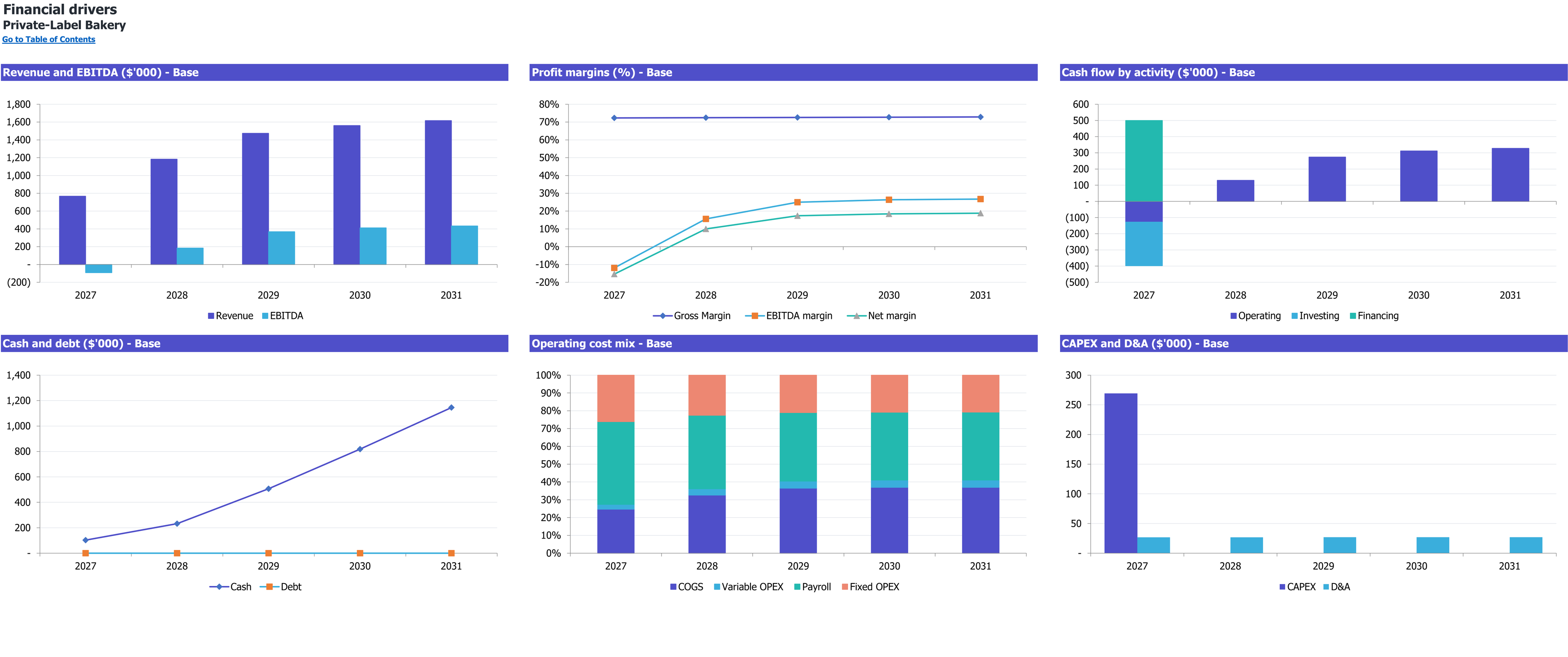
Six annual financial-driver charts for Private-Label Bakery, 2027–2031 (Base scenario). Dollar amounts are in thousands; margins and cost mix are percentages.
Enlarge image in a new tab8 selected worksheet views. Figures show this workbook’s starting case.
Workbook availability
What is inside the Excel model
Follow accepted loaves from contract demand to cash collection. This workbook connects the production line, owned inventory and customer acceptance to payroll, working capital and project cash.
Selected worksheets from the documented workbook. Forecast period: January 2027–December 2031. Model reference: PHY003-04.
Inputs you control. Results you can inspect.
On a small screen, scroll within the table to read every column.
| Planning area | Inputs you review | How they connect | Results to inspect |
|---|---|---|---|
| Contract demand | Monthly orders, loaf price, ramp and seasonality. | Accepted deliveries are limited by demand and available stock. | Contract revenue and sold loaves. |
| Production line | Mixing, proofing, baking, packing, shift hours and availability. | The slowest process caps monthly output; existing WIP is completed first. | Starts, completions and bottleneck utilization. |
| Loss and acceptance | Normal loss, rejection, WIP share, acceptance hold and spoilage. | Good output moves through owned inventory before qualifying for sale. | Deliverable stock and losses. |
| Manufacturing costs | Material kit, production pay, factory costs and normal capacity. | Weighted-average ledgers allocate eligible conversion costs; idle costs are expensed. | Recognized costs and inventory values. |
| Working capital and funding | Raw buffer, supplier payment split, receivable days, equipment and equity. | Physical purchases and payment timing flow through monthly cash. | Cash trough, reserve coverage and project payback. |
Is this the right model for your business?
Check the starting case before changing the assumptions.
The starting operation
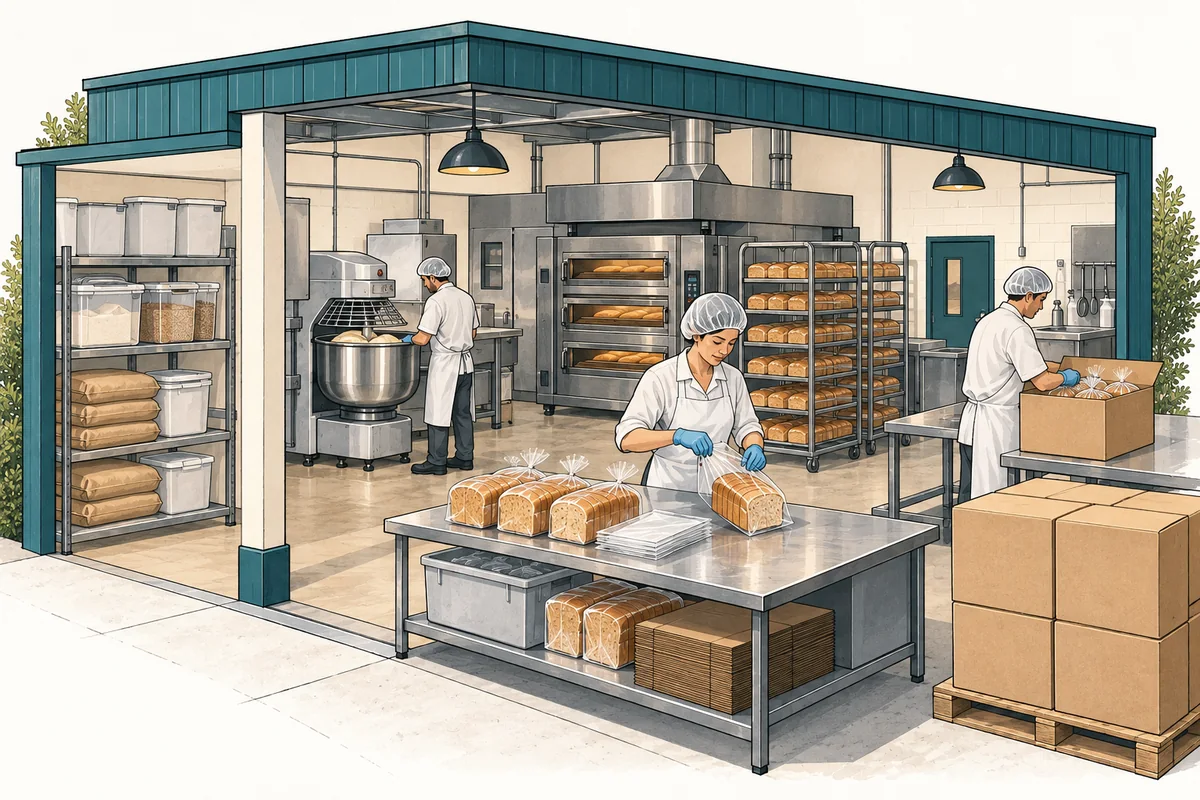
- A 4,000-square-foot leased plant making private-label bread.
- An operator owning raw materials, work in process and finished goods.
- One funded shift with seven FTE and a paid owner/manager.
Check the boundary
Retail bakery traffic, customer-owned ingredients, a second shift or detailed customer/SKU scheduling require a different operating case.
Compare the other bakery typesHow this business makes money
Connect the unit sold to the resources required by this operating case.
Revenue logic
Revenue = accepted loaves delivered × contract price per loaf.
Sales require both customer demand and deliverable stock. Internal production and acceptance-held output are not sales.
Why can a bakery produce loaves before it earns revenue?
The operator owns unfinished and completed stock until the delivery meets the acceptance conditions. Production consumes materials, capacity and cash before every loaf can be sold. The model tracks that gap through WIP, finished stock, acceptance holds and customer collection timing.
- Revenue unit
- An accepted loaf delivered to an external customer.
- Physical limit
- The slowest production step and deliverable inventory.
- Cash timing
- Owned stock, supplier terms and customer receivables.
What to establish for your own operation
- Confirm contract volumes, prices and acceptance terms.
- Validate the actual recipe and line cycle times.
- Check shelf life and storage against monthly hold and spoilage assumptions.
Follow the plan from demand to cash
Open each section for the assumptions, calculations, and limits of this workbook’s starting case.
Production does not become revenue until acceptanceRevenue
The selected contract price starts at $3.20 per accepted loaf. Monthly orders rise from 22,000 in 2027 to 43,000 in 2031 before calendar adjustments. These are negotiated-price and customer-volume assumptions, not signed contracts.
The line is capped by its slowest process. Existing work in process consumes completion capacity first. The case includes 3% normal process loss, 1% rejection of good output and an 8% acceptance hold on current output.
- One funded shift uses weekday working time after setup and availability allowances.
- Output awaiting acceptance stays in owned inventory.
- Finished-goods spoilage and customer acceptance need shelf-life validation.
Read the gross-profit subtotal with its accounting boundaryCOGS & OPEX
Raw materials, WIP and finished goods use pooled weighted-average cost. WIP is fully supplied with materials and packaging and is 50% converted. Eligible production wages, factory overhead and depreciation are capitalized up to normal capacity; idle costs are expensed.
The retained income statement places materials and packaging in COGS, while production payroll, overhead and depreciation remain in their expense sections after inventory deferral. Its gross margin is therefore not a fully absorbed manufacturing margin. Full recognized manufacturing cost is separately calculated.
- Cash payroll and factory payments continue despite accounting capitalization.
- The owner/manager is paid and expensed.
- Rejection, spoilage and finished-stock NRV write-downs are expenses; raw/WIP impairment needs separate review.
Cover factory investment and cash tied up before collectionCAPEX
January 2027 capital spending totals $269,141 for production equipment, fit-out and commissioning. Seven FTE generate $401,280 of initial annual cash payroll including burden, before separate benefits.
The peak funding need before financing is $399,404 in November 2027. The $500,000 equity contribution covers that shortfall and a $100,000 reserve after rounding. Supplier purchases are paid half currently and half the next month; customer receivables use 15 calendar days.
- Raw inventory uses a seven-operating-day buffer.
- Legacy inventory and payable day inputs are zero to avoid duplicate ledgers.
- No debt or subsequent equity is scheduled.
Distinguish a first profitable month from sustained coverageCF
Base 2027 revenue is $767,328 and EBITDA is negative $91,421. EBITDA first becomes nonnegative in November 2027, but reverses in December. EBIT first becomes nonnegative in January 2028 and remains so.
Project payback occurs in December 2029, month 36 from January 2027. It measures cumulative undiscounted unlevered cash after capital spending, excluding financing and exit proceeds. No owner distributions are scheduled.
- Operating cash first becomes nonnegative in December 2027 and remains so.
- Minimum funded cash is $100,596 in November 2027.
- Forecast improvements depend on contract growth and fixed-cost absorption.
Selected results from the starting case
Modeled results in USD unless stated otherwise. These describe the selected inputs, not an estimate for your location or a guaranteed outcome.
- First-year revenue
- $767,328Base · USD · calendar 2027 accepted deliveries.
- First-year EBITDA
- −$91,421Base · USD · calendar 2027 operating loss before interest, tax and depreciation.
- Initial CAPEX
- $269,141Base · USD · January 2027 production and premises investment.
- Minimum funded cash
- $100,596Base · USD · November 2027 after $500,000 equity.
- Project payback
- December 2029Base · month 36 from January 2027; cumulative undiscounted unlevered project cash.
Make the case your own
Work from the operating plan toward the cash requirement.
Set contract orders, price and customer acceptance terms.
Validate each production step and the single-shift staffing plan.
Update material, conversion-cost and inventory assumptions together.
Replace installed budgets and examine cash under slower orders or acceptance.
Interpretation and scope
- This is a modeled U.S. startup; order volumes and contract prices are analytical assumptions.
- Monthly inventory ledgers are not daily expiry, cold-chain or food-safety schedules.
- Raw-material and WIP impairment, individual customers/SKUs and a second shift are not automated.
- The reported gross margin excludes parts of manufacturing cost shown elsewhere in the income statement.
- Base funding does not automatically cover stress cases; no loss carryforward, owner distributions or exit value is modeled.
The workbook is an Excel file for local planning. Learn how to interpret assumptions and evidence.
Other bakery types
Each operating type calls for its own financial structure.
Questions
Is every loaf produced a sale?
No. Revenue requires an accepted external delivery. Output on hold and internal production transfers remain outside revenue.
Is the income-statement gross margin a fully absorbed manufacturing margin?
No. Materials and packaging enter its COGS subtotal, while production payroll, overhead and depreciation retain their own presentation after inventory deferral.
Does inventory capitalization reduce the payroll payment?
No. It changes expense recognition and inventory value; the underlying cash payroll and factory payments still occur.
Can I simply add a second shift?
No. The current funded labor plan supports one shift. A second shift requires a new staffing and capacity design.
Is November 2027 a sustained EBITDA break-even date?
No. It is the first nonnegative EBITDA month, followed by a reversal in December. EBIT becomes nonnegative in January 2028 and stays so.
Can I buy this model now?
No. Purchasing and workbook downloads are not available on this site.
Which software does the workbook use?
The documented file is an Excel workbook (.xlsx). Compatibility with other spreadsheet applications is not established by the file extension.
Read the planning guides
Explore the relevant operating questions and how to interpret a workbook’s assumptions.
Why can a private-label bakery need cash before it records a sale?
Follow owned materials, work in process, finished loaves, customer acceptance, and payment terms through one private-label bakery planning case.
Read the guideShould your bakery sell cafe visits, branded orders, or private-label production?
Choose a bakery format by its buyer, production promise, route to market, inventory responsibility, and the work you want to manage.
Read the guide
How to read financial assumptions before editing an Excel model
Follow the chain from operating assumptions to calculated results, check units and timing, and keep a useful record of changes to a financial workbook.
Read the guideEvidence and scope
Operationally specified by the analyst. An active local operator, commercial demand and legal permission require separate validation.
The links below provide operating-format context; they do not verify the workbook’s selected inputs or calculated returns.
The workbook guide and figures describe model PHY003-04, revision r01, for January 2027–December 2031. These are a documented planning case, not observed results for a particular business.