
Bakery Financial Model: Wholesale Production Bakery
Plan wholesale bread production with shared mixer, proofing, oven and labor limits. Follow recipes, stock, customer credit, startup cash and payback.
- Excel (.xlsx)
- Plant: 3,500 sq ft / one mixer / two oven-proofer combinations
- Production: White and seeded wholesale bread
- Staffing: 8.5 paid FTE at full staffing, including owner
Planning several types? Compare 8 bakery formats
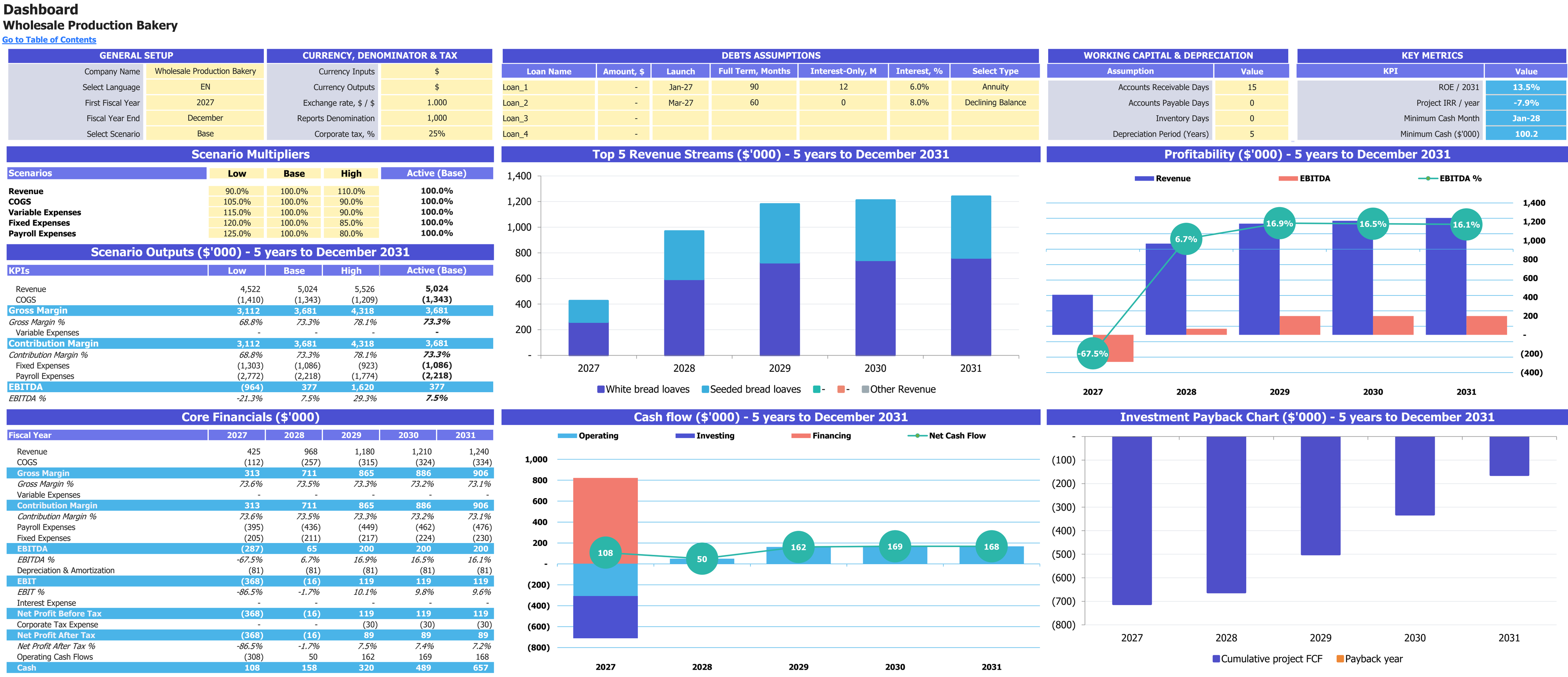
Saved Base scenario: annual financial results, profitability and project recovery for 2027–2031. Report amounts are in thousands of USD.
Enlarge image in a new tab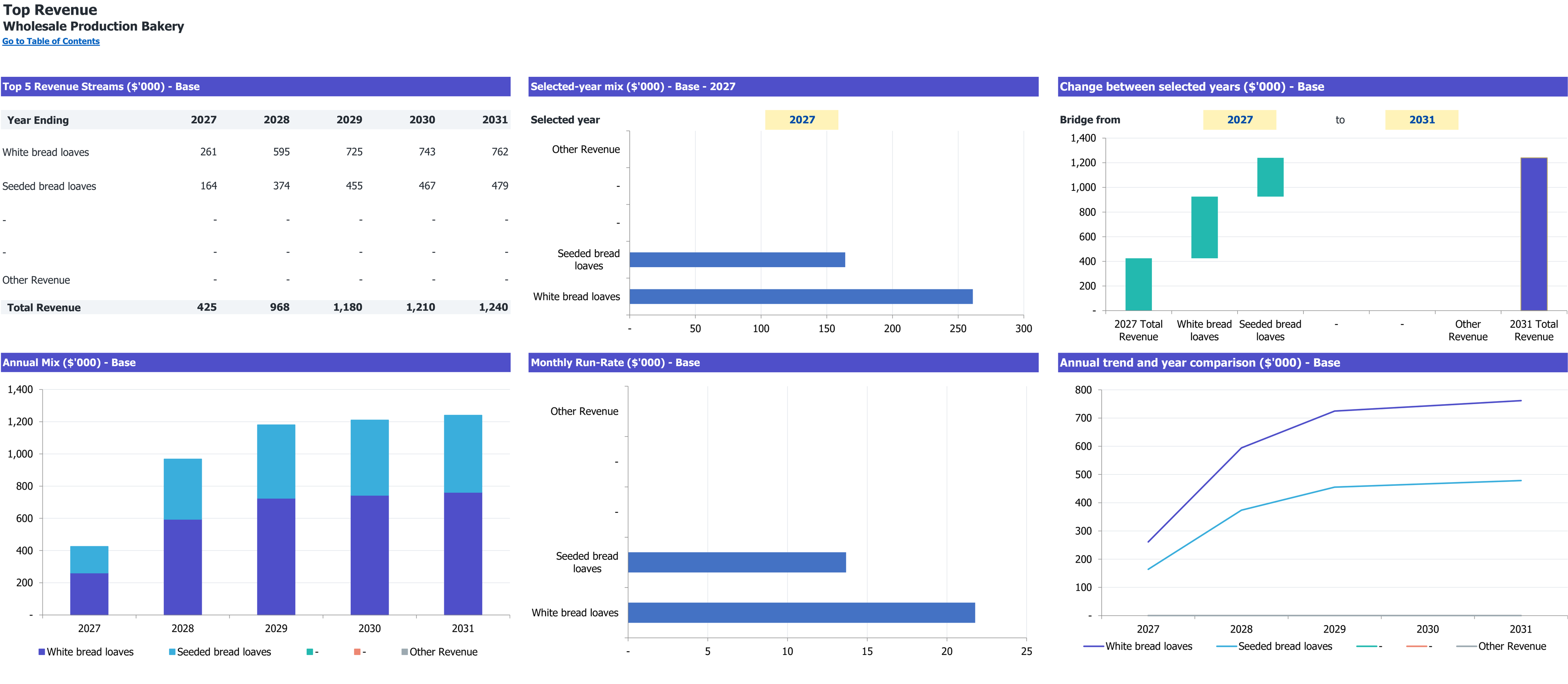
Actual Top Revenue sheet: annual revenue by stream, selected-year mix and comparison charts in thousands of USD. Base case 2027–2031.
Enlarge image in a new tab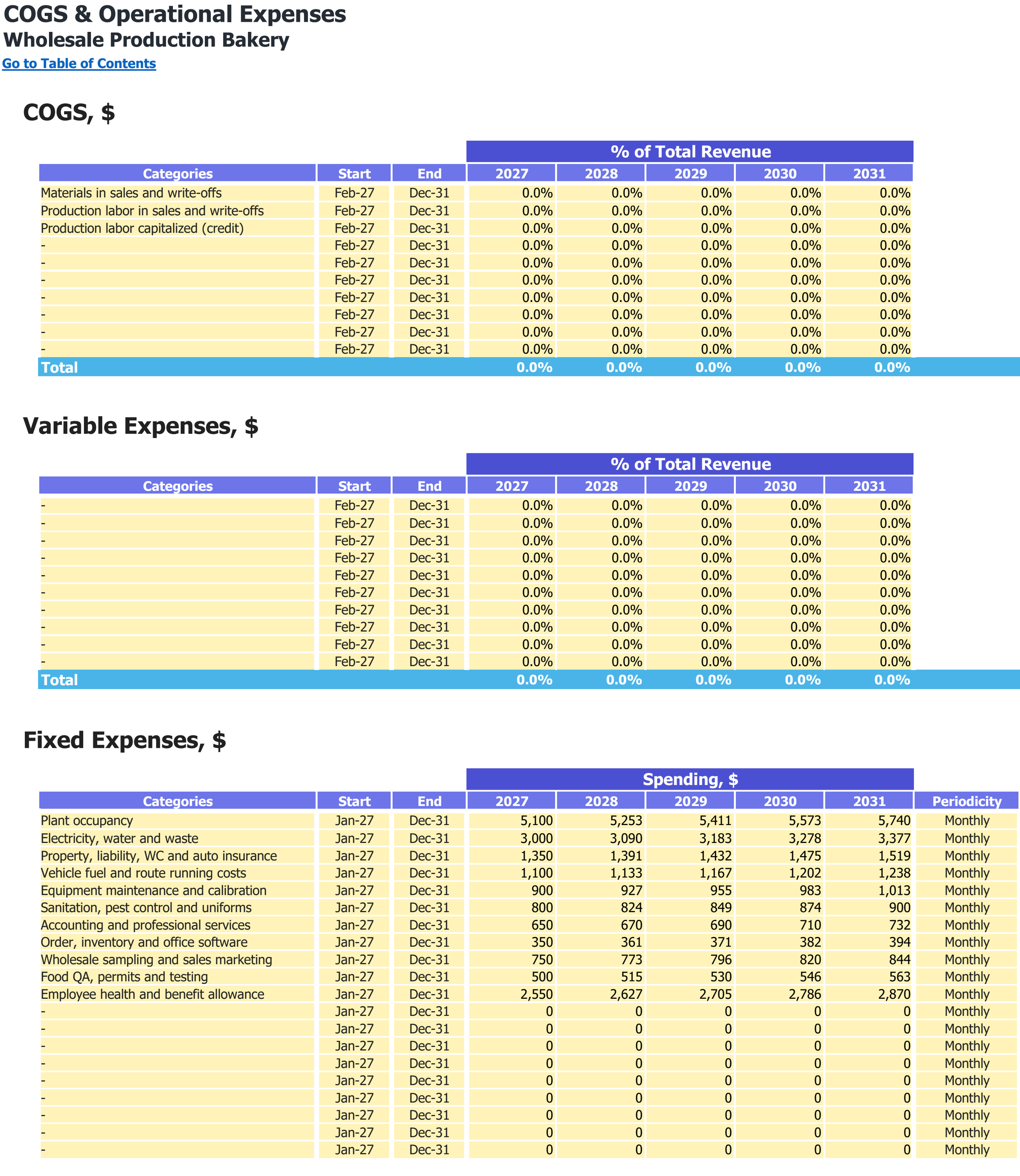
Operating-cost setup and recurring expense budgets in USD. Zero percentage inputs do not mean zero ingredient cost: the model calculates activity costs separately.
Enlarge image in a new tab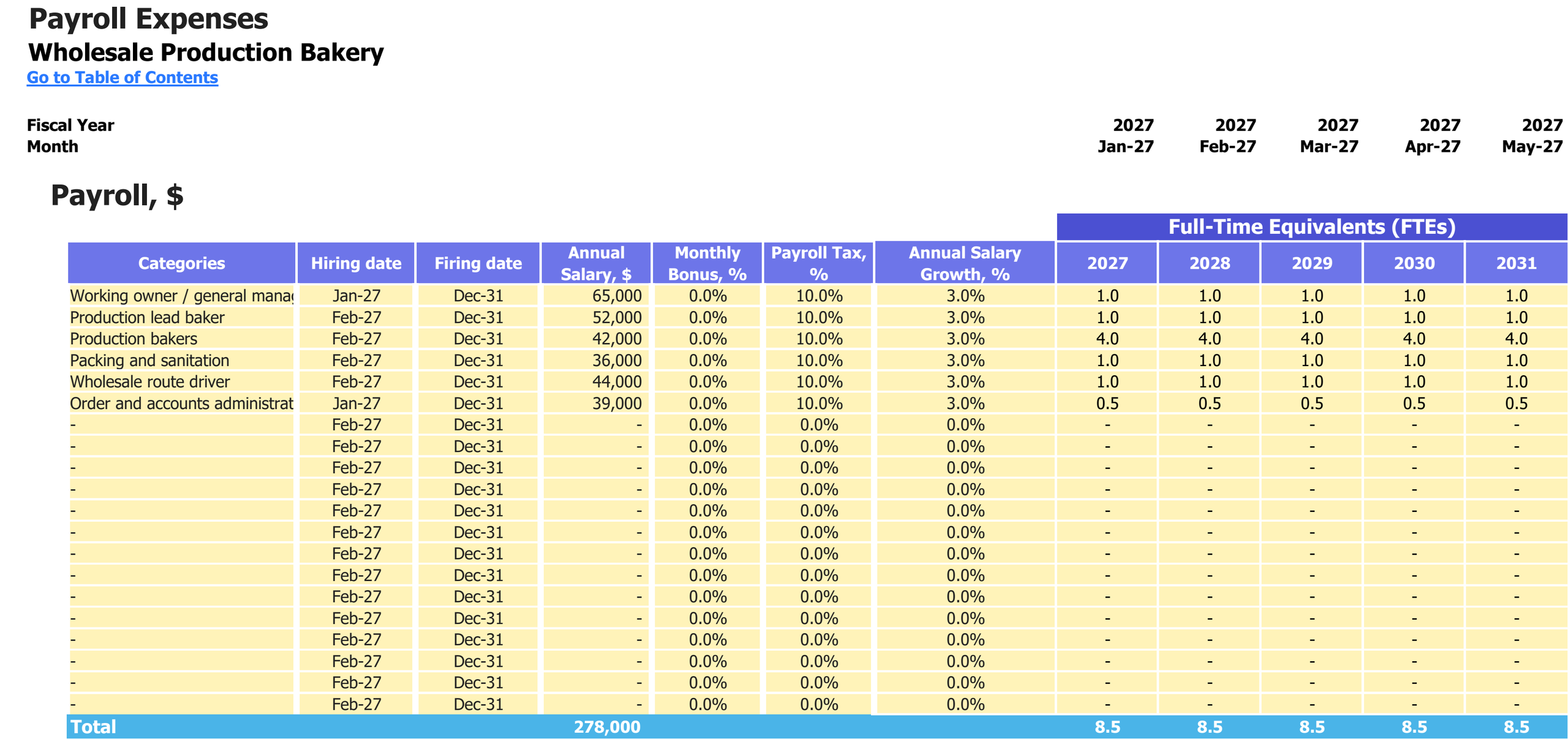
Paid roles, annual base salary per FTE, start dates, employer load and staffing for 2027–2031. Salary inputs are USD; payroll expense reflects timing and staffing.
Enlarge image in a new tab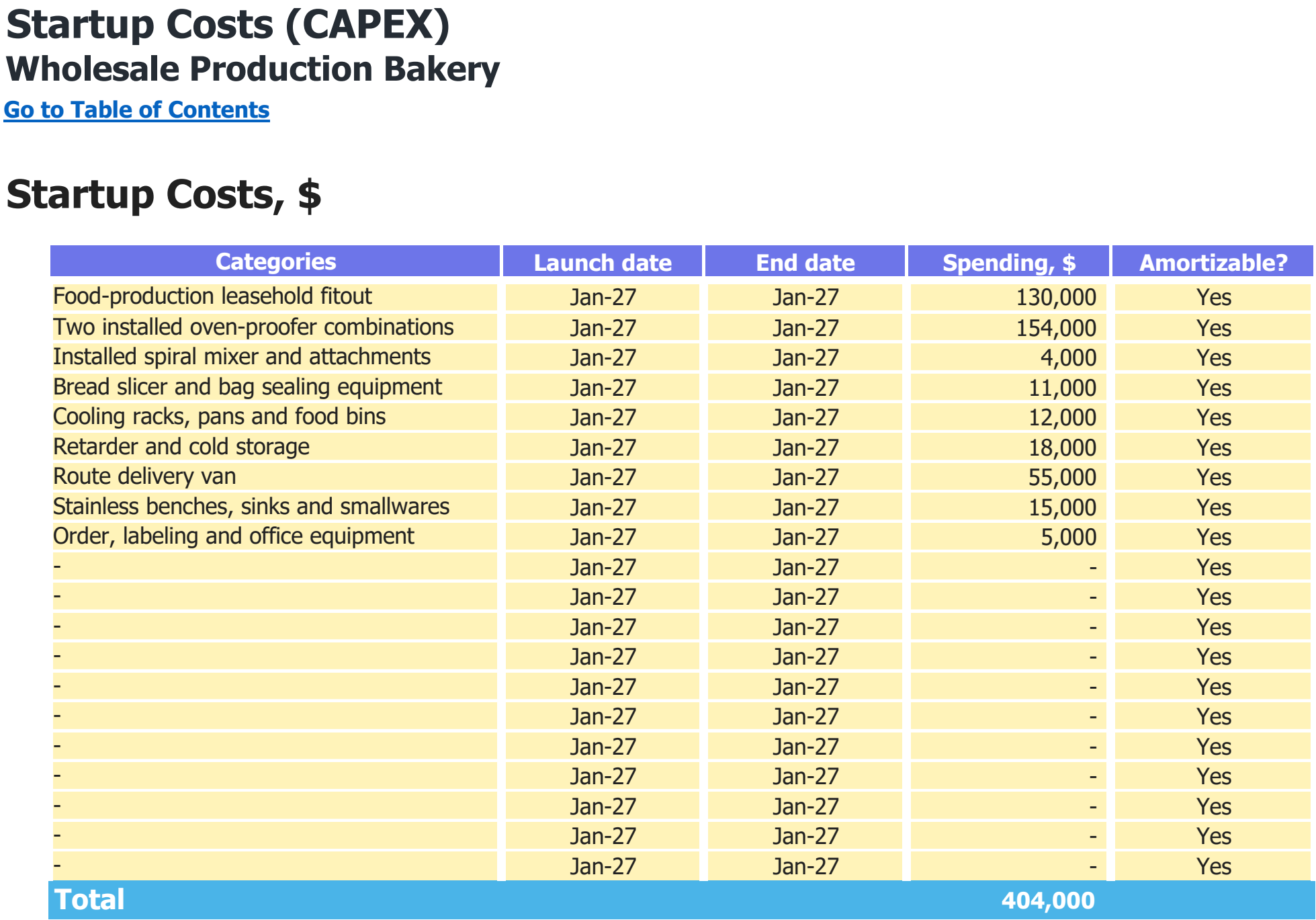
Initial installed-asset and fitout allowances in USD, with purchase dates and depreciation eligibility.
Enlarge image in a new tab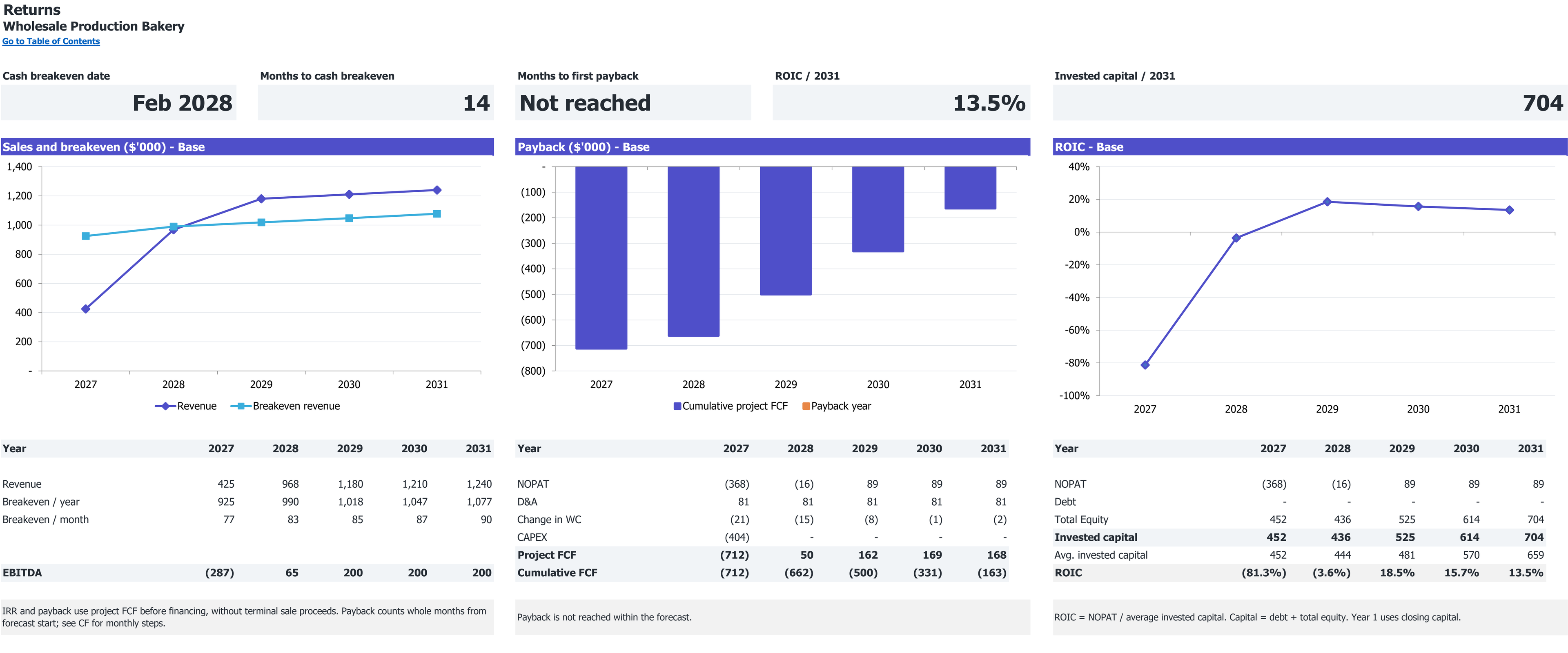
Excerpt from Returns: cumulative project free cash flow and payback. Base case 2027–2031; amounts in thousands of USD. Project payback is not reached within the 60-month forecast.
Open full Returns view in a new tabExcerpt from Returns: annual and monthly break-even revenue, sales and EBITDA. Base case 2027–2031; amounts in thousands of USD.
Open full Returns view in a new tab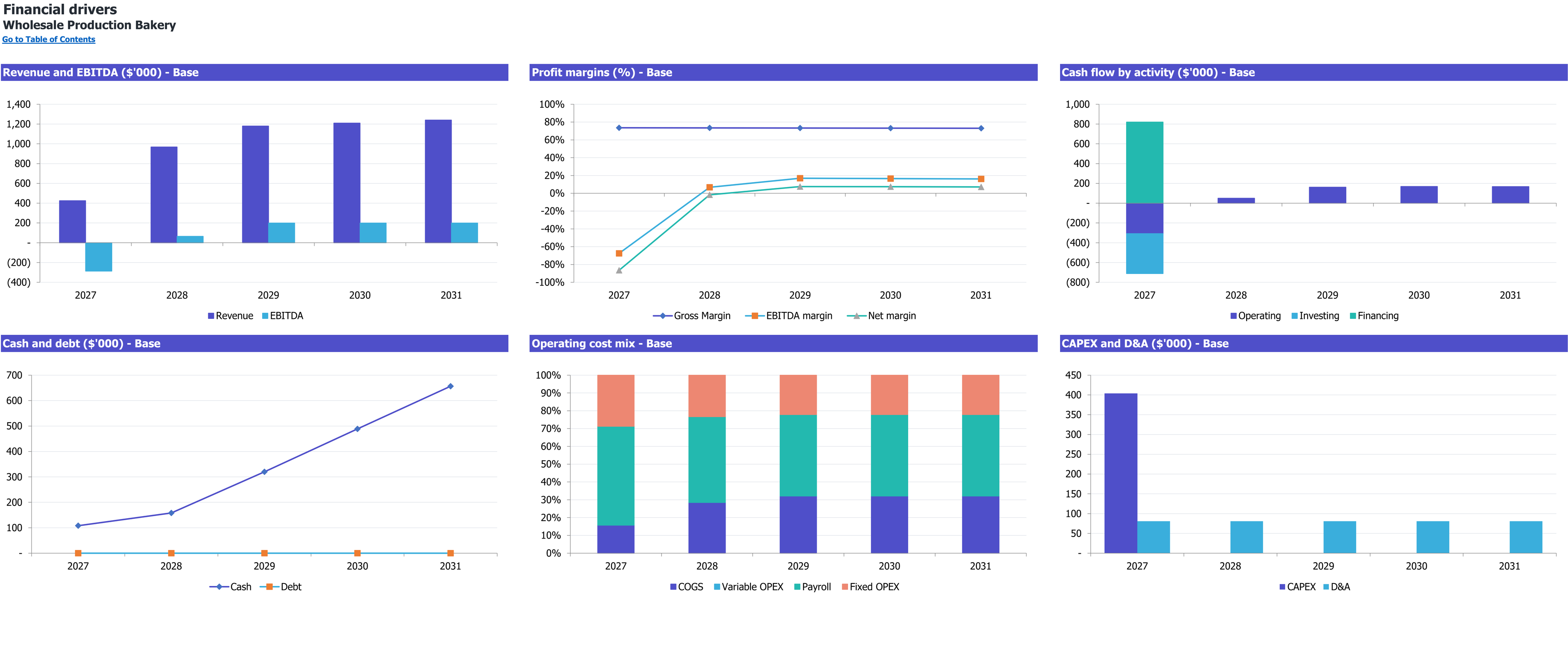
Financial-driver charts: revenue, margins, cash and debt, cost mix, investment and depreciation. Base case 2027–2031; chart units as labelled.
Enlarge image in a new tab8 selected worksheet views. Figures show this workbook’s starting case.
Workbook availability
What is inside the Excel model
Connect wholesale account demand to the loaves the plant can actually ship. Track raw materials, finished stock and payment timing, then test whether later profits recover the initial investment.
Selected worksheets from the documented workbook. Forecast period: January 2027–December 2031. Model reference: PHY003-03.
Inputs you control. Results you can inspect.
On a small screen, scroll within the table to read every column.
| Planning area | Inputs you review | How they connect | Results to inspect |
|---|---|---|---|
| Accounts and orders | Accounts, daily loaves per account, dispatch days, opening ramp and product mix. | Create external orders, then apply common capacity-constrained fulfillment. | Shipped loaves and recognized wholesale revenue. |
| Shared production | Mixer dough capacity, proofing/oven positions, cycle times and productive paid hours. | Allocate the tightest shared constraint across both product orders. | Attempted production, good output and bottleneck utilization. |
| Recipes and stock | Flour-based recipes, 3% rejection, raw cover and a finished-stock reserve. | Carry raw and finished stock at moving weighted-average direct cost. | Purchases, stock balances, write-offs and recognized product cost. |
| Credit and collections | 15-day customer collection and supplier-payment assumptions. | Link collection to shipments and supplier payables to raw purchases. | Receivables, supplier balances and monthly operating cash. |
| Launch funding | $404,000 CAPEX, $820,000 equity and a $100,000 cash-floor policy. | Fund investment, ramp losses and working capital through the lowest cash month. | Cash reserve, profitability dates and project investment recovery. |
Is this the right model for your business?
Check the starting case before changing the assumptions.
The starting operation
- A wholesale bread bakery serving recurring business accounts.
- A production plan sharing equipment between white and seeded loaves.
- A team testing the cash cost of stock, credit terms and a slow sales ramp.
Check the boundary
This case excludes retail walk-in sales, a third product, frozen stock, consignment, month-end work in process and customer advances. Inventory uses direct-cost management valuation, not full-absorption GAAP costing.
Compare the other bakery typesHow this business makes money
Connect the unit sold to the resources required by this operating case.
Revenue logic
Externally shipped white and seeded loaves × their wholesale selling prices.
Production is limited by shared equipment and paid productive labor. Unsold output becomes stock, never revenue.
Why can profitable later years still leave the investment unrecovered?
The model pays for plant investment and opening losses before reaching mature shipments. Later operating cash improves, but the Base case still ends the five-year period with negative cumulative project free cash flow.
- Initial investment
- $404,000 CAPEX
- Funding
- $820,000 initial equity
- Five-year project cash flow
- −$163,391 before financing and terminal proceeds
What to establish for your own operation
- Validate contracted account demand and attainable wholesale prices.
- Measure actual batch cycles, yield and productive crew availability.
- Re-test cash after changing stock cover or collection terms.
Follow the plan from demand to cash
Open each section for the assumptions, calculations, and limits of this workbook’s starting case.
Recognize shipments rather than productionRevenue
Operations start in February 2027 after one preparation month. Accounts, basket size, dispatch days and ramp assumptions generate external orders, allocated 65% to white bread and 35% to seeded bread.
The shared plant must meet dough, proofing, oven and productive-labor constraints. A common fulfillment fraction allocates the bottleneck proportionately. The saved case approaches roughly 295,000 shipped loaves per year as oven capacity becomes binding.
- Unshipped production is stock, not an additional sale.
- Demand growth alone does not expand shared equipment capacity.
Follow raw materials, finished goods and laborCOGS & OPEX
Recipe kits and finished goods carry forward at moving weighted-average direct cost. Production replenishes current orders and the dispatch-day stock reserve. Opening finished stock above the planning shelf window is written off.
Productive labor is capitalized once and recognized on shipment or write-off. The P&L retains full payroll below gross profit and includes a labor-capitalization credit in cost rows. Plant overhead and depreciation remain period expenses, so reported gross margin is not a fully burdened manufacturing margin.
- The stock window is a planning proxy, not a food-safety recommendation.
- There is no month-end work in process or frozen-stock module.
Budget the production operation as a wholePayroll
Full staffing comprises the paid owner-manager, production lead, four bakers, packing/sanitation, route driver and a part-time accounts administrator. Only the lead and production bakers supply capitalizable labor.
January CAPEX totals $404,000 for fitout, installed baking equipment, cold storage, a delivery van and supporting assets. Initial fixed operating costs total $17,050 per month; employee benefits are separate from the payroll levy.
- Installed equipment and fitout values are planning allowances requiring quotations.
- The saved case uses no active debt, dividends or replacement-asset program.
Separate operating recovery from investment recoveryReturns
Initial equity is $820,000. The forecast's $719,846 unfunded deficit plus a $100,000 cash floor is rounded upward to a $5,000 funding step. Lowest funded month-end cash is $100,154 in January 2028.
EBITDA first turns nonnegative in January 2028. EBIT first does so in March 2028 but reverses in some later months; sustained monthly EBIT profitability begins in January 2029. Cumulative project free cash flow remains negative at December 2031, so payback is not reached within 60 months.
- Project cash flow excludes equity/debt receipts and terminal sale proceeds.
- Positive later-year profit does not establish five-year investment recovery.
Selected results from the starting case
Modeled results in USD unless stated otherwise. These describe the selected inputs, not an estimate for your location or a guaranteed outcome.
- 2027 revenue
- $425,304USD, Base; calendar 2027 includes January setup.
- 2027 EBITDA
- −$286,976USD, Base; includes paid owner and full payroll treatment.
- Minimum cash
- $100,154USD, Base; January 2028 after $820,000 initial equity.
- Project payback
- Not reachedBase; no recovery within January 2027–December 2031, before financing and terminal proceeds.
Make the case your own
Work from the operating plan toward the cash requirement.
Set the account plan, product mix, prices and dispatch calendar.
Replace recipe, equipment-cycle and productive-labor assumptions with plant-specific evidence.
Review stock cover, write-offs and supplier/customer payment delays.
Recalculate the monthly cash floor, re-size funding and inspect profitability and payback separately.
Interpretation and scope
- Outputs are modeled US planning assumptions, not observed bakery performance or guaranteed returns.
- Inventory uses direct-cost management valuation; it does not implement full-absorption GAAP inventory accounting.
- Monthly aggregation does not certify food safety, actual shelf life, delivery-route feasibility or daily staffing.
- The supplier-delay approximation is capped at each month's length and does not model multiple aged payable cohorts.
- The saved scenario has no debt or distributions; funding inputs require review after operating changes.
- The supplied Revenue PNG is unavailable; the gallery's Revenue summary shows the actual Top Revenue sheet instead.
The workbook is an Excel file for local planning. Learn how to interpret assumptions and evidence.
Other bakery types
Each operating type calls for its own financial structure.
Questions
Does produced bread immediately count as revenue?
No. Only externally shipped loaves earn revenue. Unsold good production becomes finished stock, subject to the model's reserve and write-off rules.
Is productive labor included twice?
No. The model capitalizes productive labor and recognizes it on shipment or write-off. A separate capitalization credit reconciles this with full payroll shown in the P&L.
Does this case reach payback?
No. The Base case remains below cumulative project cash recovery at December 2031. No payback beyond the 60-month forecast is extrapolated.
Can I increase revenue just by adding more wholesale accounts?
Only while spare production capacity remains. Shared mixer, proofing, oven and labor constraints limit fulfillment; the saved case eventually becomes oven-constrained.
Can I buy this model now?
No. Purchasing and workbook downloads are not available on this site.
Which software does the workbook use?
The documented file is an Excel workbook (.xlsx). Compatibility with other spreadsheet applications is not established by the file extension.
Read the planning guides
Explore the relevant operating questions and how to interpret a workbook’s assumptions.

Evidence and scope
Operationally specified by the analyst. An active local operator, commercial demand and legal permission require separate validation.
The links below provide operating-format context; they do not verify the workbook’s selected inputs or calculated returns.
The workbook guide and figures describe model PHY003-03, revision r01, for January 2027–December 2031. These are a documented planning case, not observed results for a particular business.