
Bakery Financial Model: Delivery-Focused Bakery
Plan direct online bakery orders with production losses, dispatch limits, retained delivery fees, contracted couriers and startup funding.
- Excel (.xlsx)
- Premises: 1,200 sq ft production kitchen
- Product: One six-piece breakfast box
- Opening: February 2027 / Monday–Saturday
Planning several types? Compare 8 bakery formats
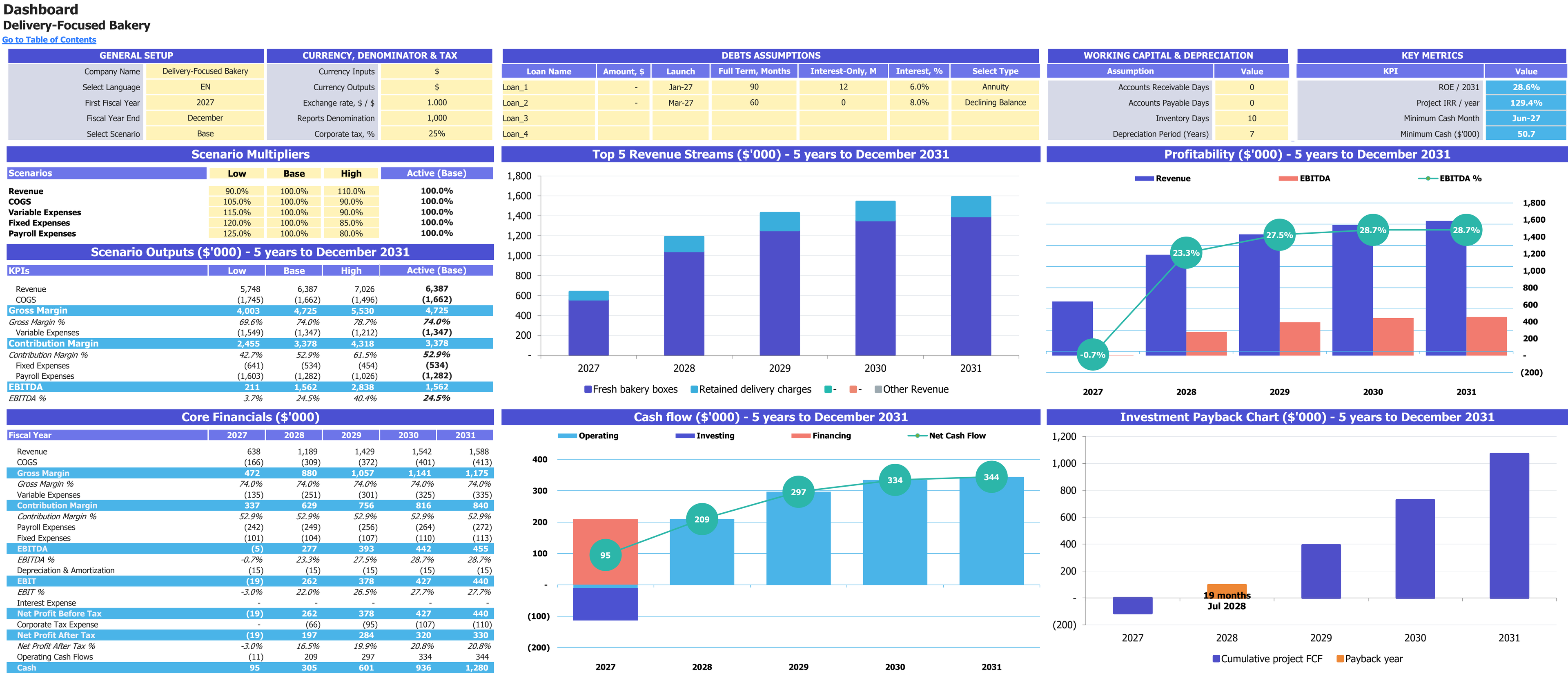
Base-case scenario controls, annual financial results and charts for 2027–2031. Financial report amounts are shown in thousands of USD; percentage measures retain their own units.
Enlarge image in a new tab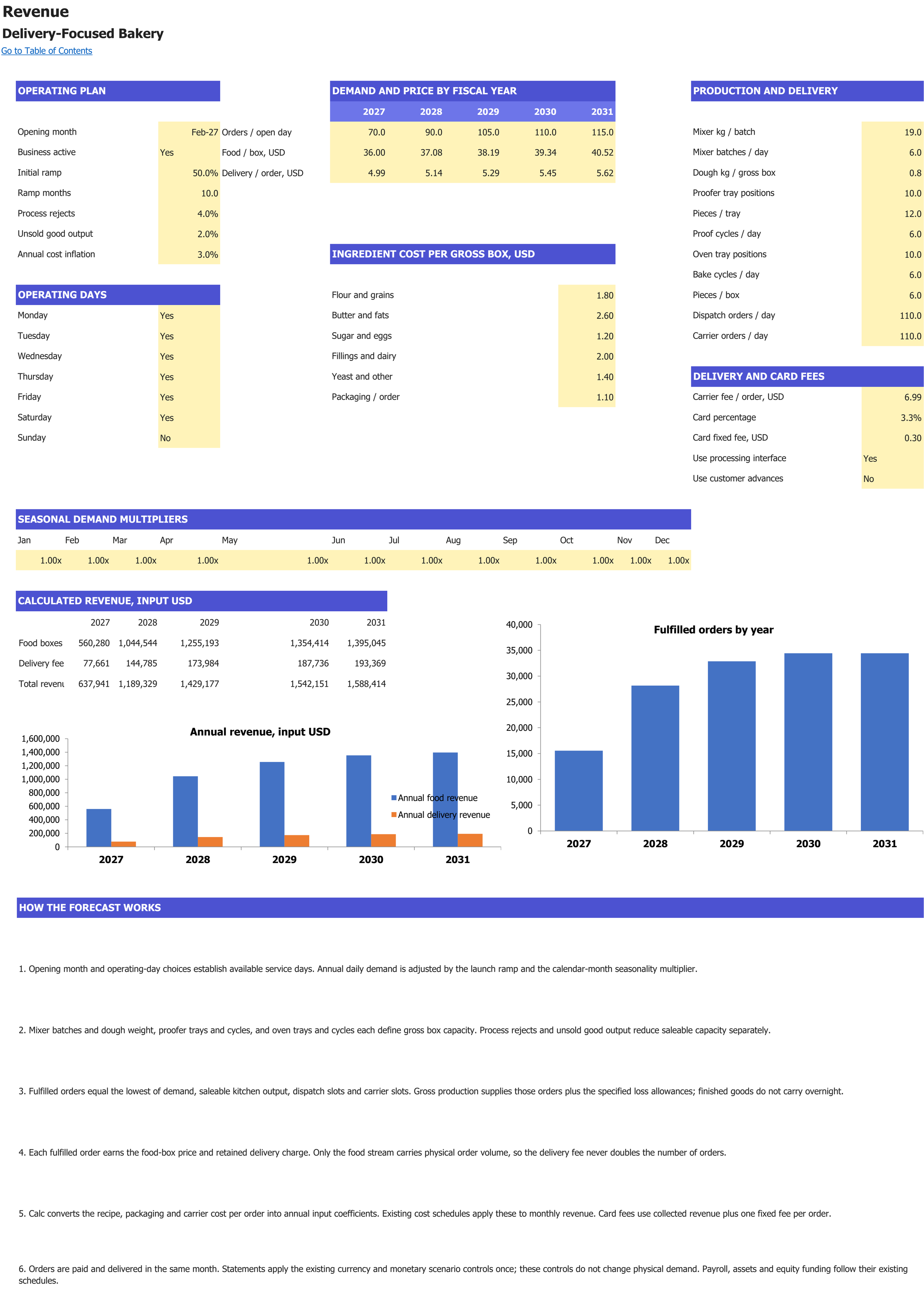
Breakfast-box orders, baking yield, dispatch and carrier capacity, with food and delivery sales. Monetary inputs and sales use USD; operating volumes retain their labelled units. Forecast years are 2027–2031.
Enlarge image in a new tab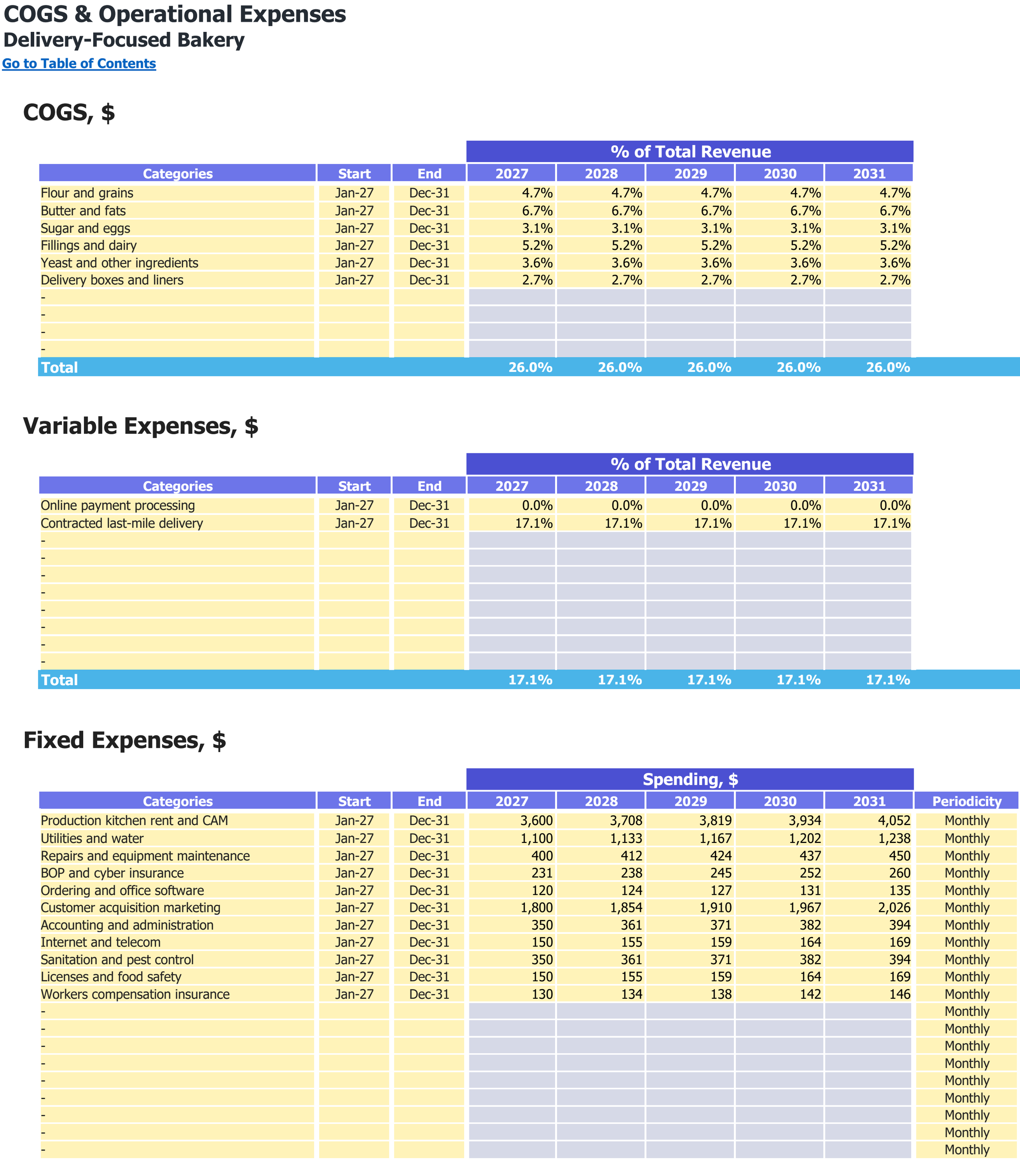
Food and other direct-cost categories, variable expense shares and fixed operating expenses. Monetary inputs are USD; the annual percentage columns are cost shares of revenue.
Enlarge image in a new tab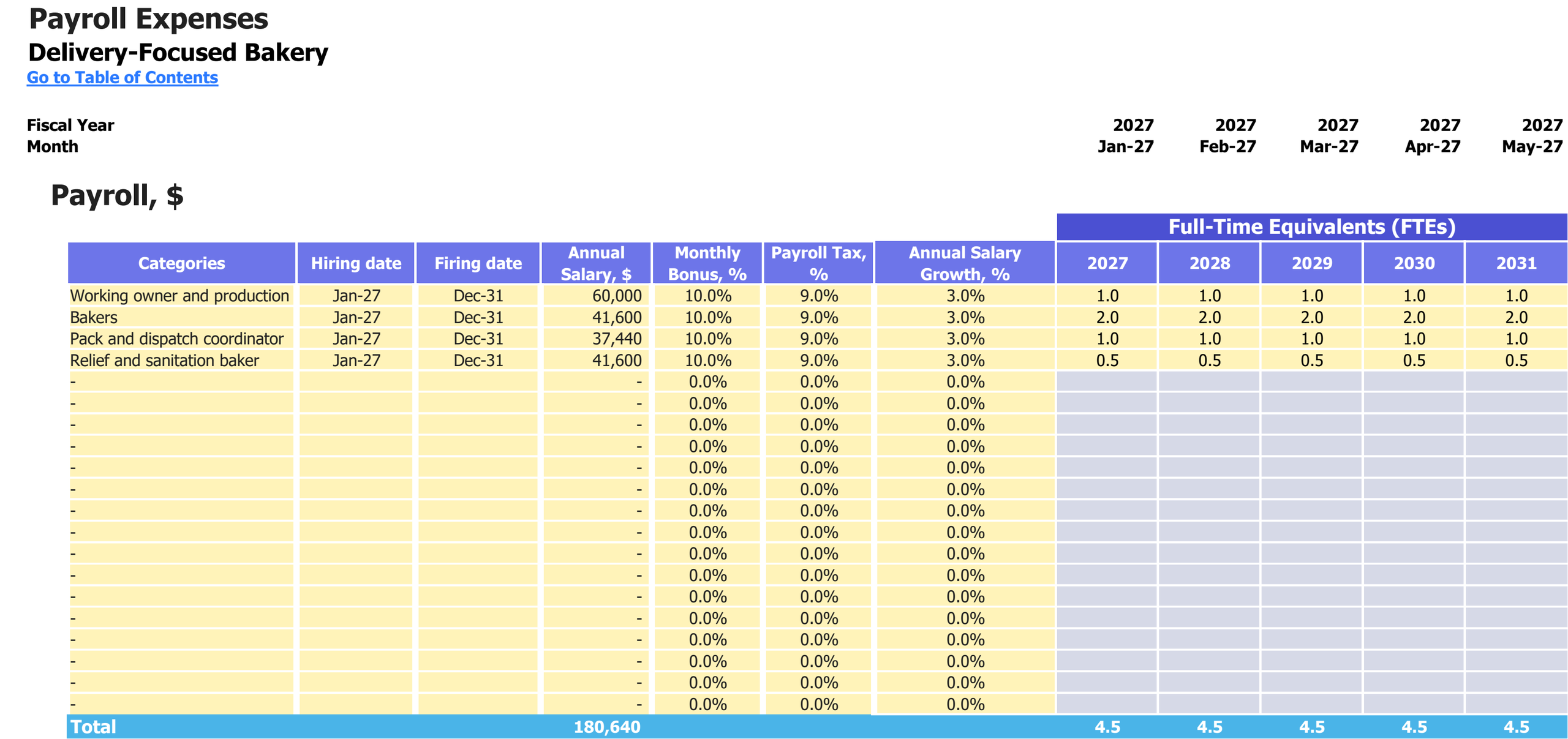
Paid roles, annual salary and employer-load assumptions, with staffing in full-time equivalents for 2027–2031. Salary amounts are USD; percentages and FTEs are labelled separately.
Enlarge image in a new tab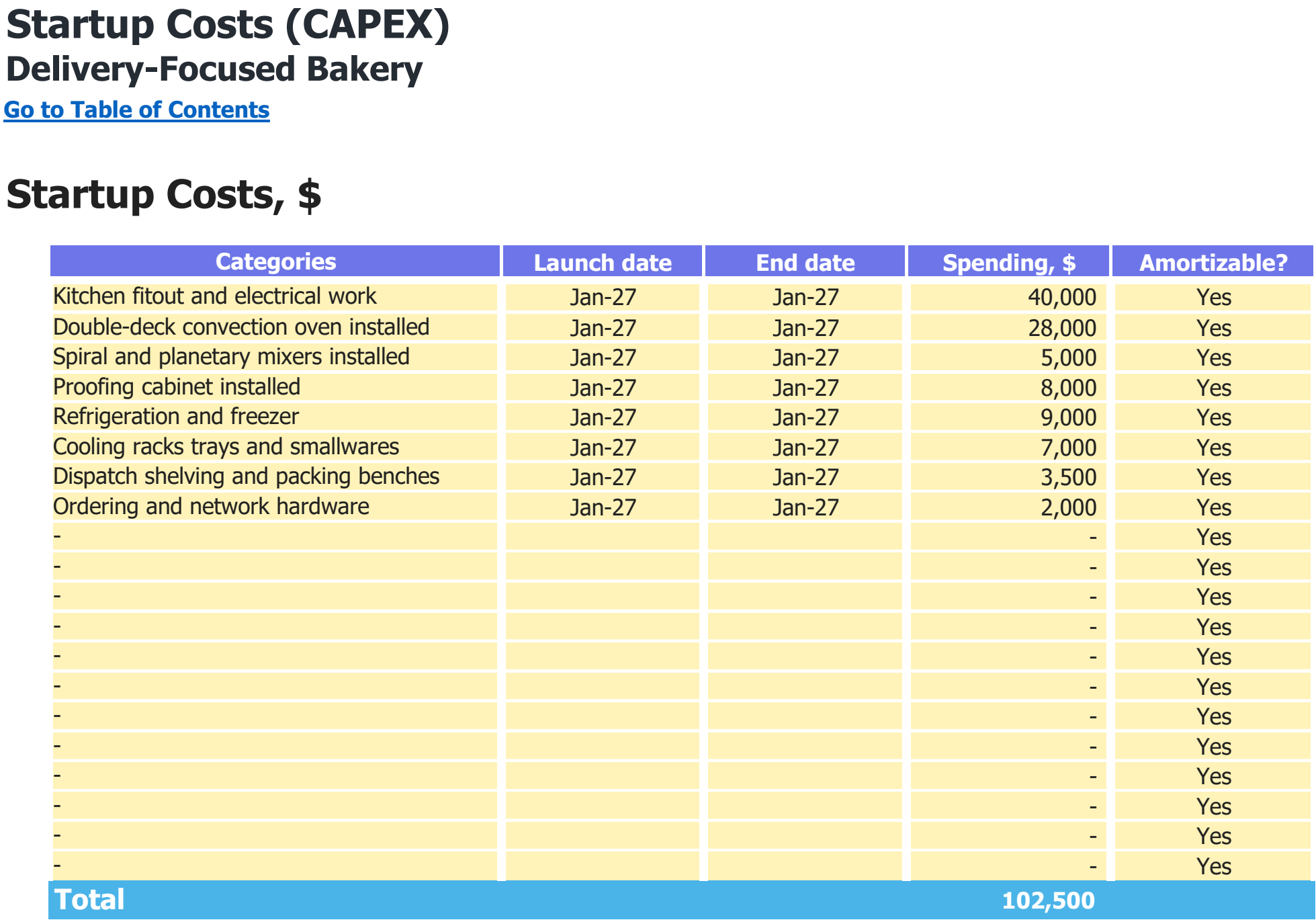
Asset categories, purchase dates and spending assumptions in USD. The total includes every scheduled purchase shown, including later replacements where present.
Enlarge image in a new tab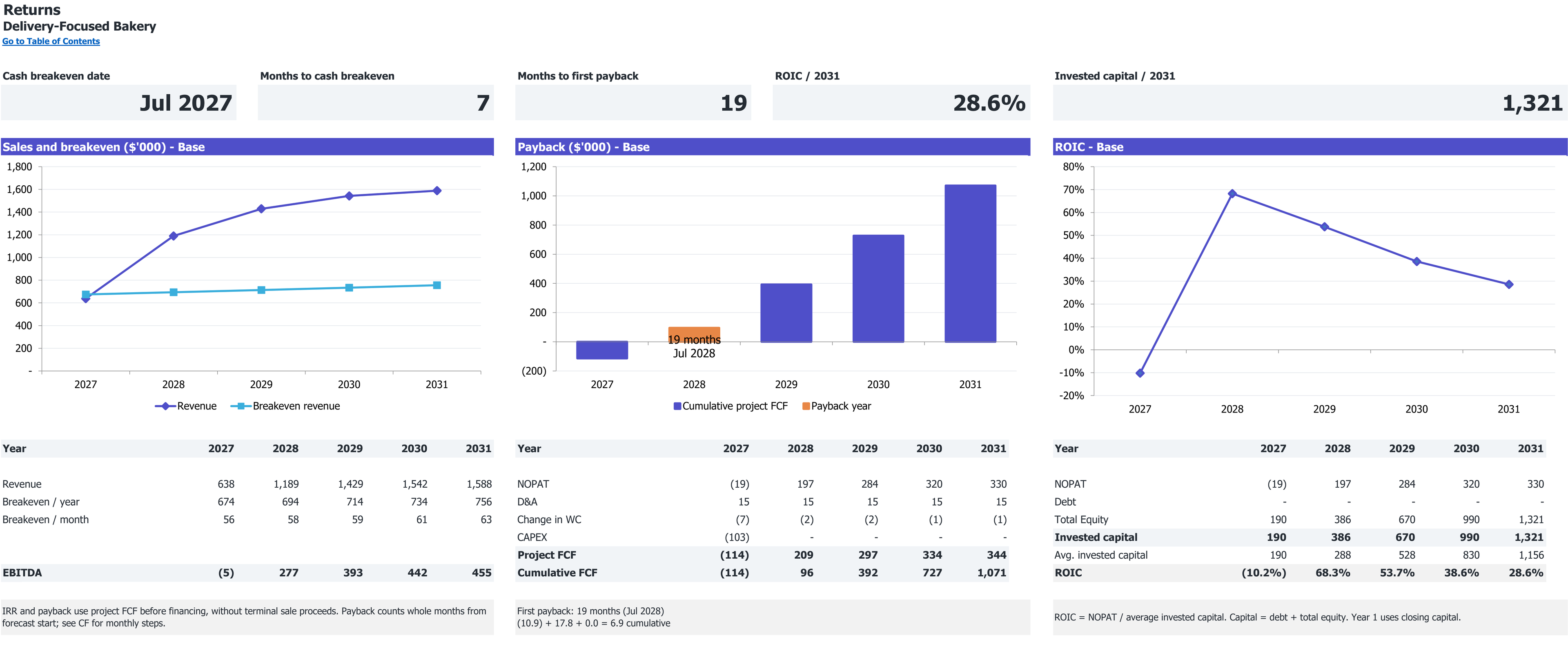
Excerpt from Returns: cumulative project free cash flow and first payback, if reached. 2027–2031 base case; dollar amounts in thousands.
Open full Returns view in a new tabExcerpt from Returns: revenue, annual and monthly break-even revenue, and EBITDA. 2027–2031 base case; dollar amounts in thousands.
Open full Returns view in a new tab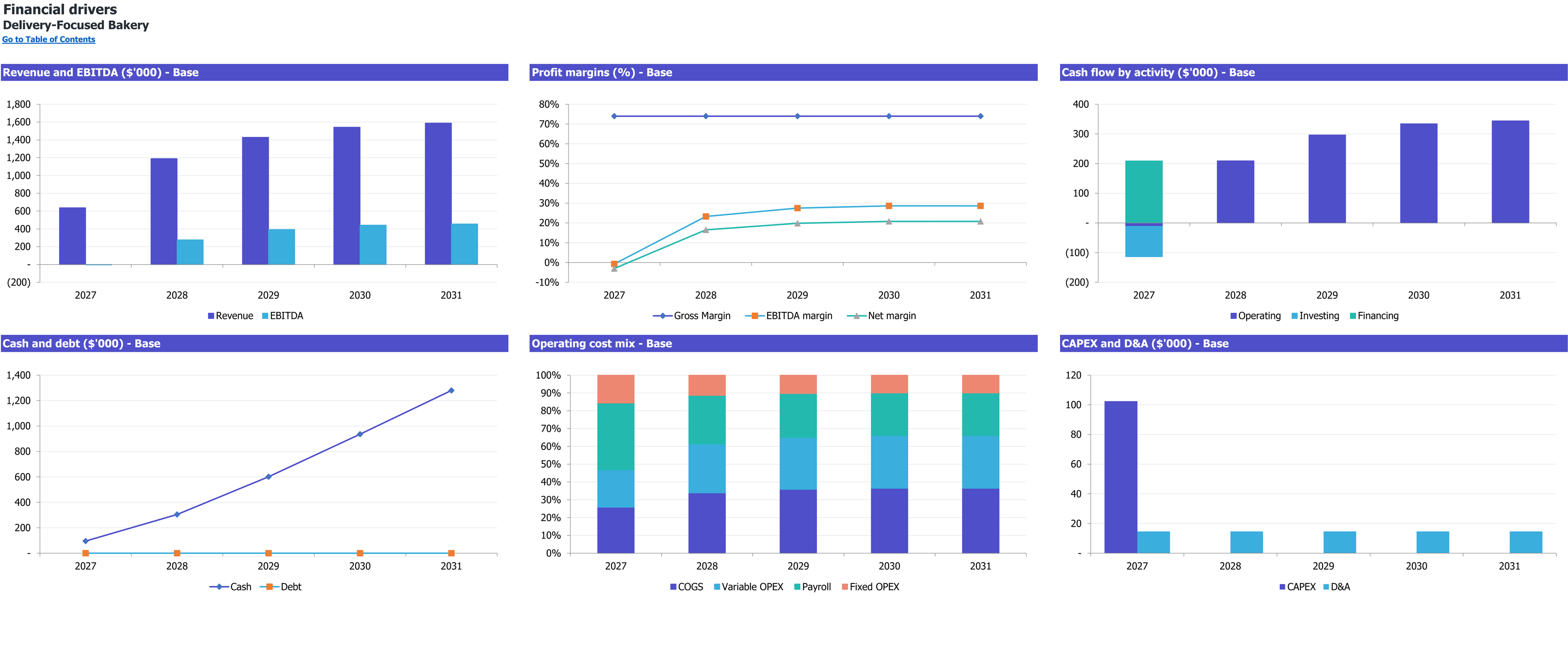
Six annual financial-driver charts for Delivery-Focused Bakery, 2027–2031 (Base scenario). Dollar amounts are in thousands; margins and cost mix are percentages.
Enlarge image in a new tab8 selected worksheet views. Figures show this workbook’s starting case.
Workbook availability
What is inside the Excel model
Connect a six-piece bakery box to production, dispatch and carrier capacity. Test whether order demand can absorb paid kitchen staff and the gap between the delivery charge and courier cost.
Selected worksheets from the documented workbook. Forecast period: January 2027–December 2031. Model reference: PHY003-05.
Inputs you control. Results you can inspect.
On a small screen, scroll within the table to read every column.
| Planning area | Inputs you review | How they connect | Results to inspect |
|---|---|---|---|
| Demand | 70 initial potential orders/open day; 50% opening ramp. | Use actual service days and a ten-active-month ramp before capacity. | Demand and fulfilled box orders. |
| Production | Independent mixer, proofer and oven ceilings; 4% rejects and 2% unsold good output. | Reduce gross capacity by both yields and compare dispatch/carrier slots. | Saleable capacity and ingredient-consuming gross production. |
| Order economics | $36 food price, $4.99 delivery charge and $6.99 carrier cost initially. | Recognize one fulfilled order; cost the courier separately. | Food sales, delivery revenue and delivery subsidy. |
| Staff and stock | 4.5 paid FTE; ten days of food/packaging inventory. | Include setup payroll, compensation load and working capital. | Operating costs and monthly cash requirements. |
| Funding | $102,500 initial CAPEX; no debt. | Cover peak project cash need and a $50,000 reserve with rounded equity. | Required equity and minimum funded cash. |
Is this the right model for your business?
Check the starting case before changing the assumptions.
The starting operation
- A production bakery selling one box format through its own online channel.
- An operator outsourcing delivery while retaining the customer delivery charge.
- A founder testing kitchen yields, paid staffing and launch cash.
Check the boundary
The saved case excludes marketplaces, an owned courier fleet, catering, subscriptions, customer advances and overnight finished-goods inventory.
Compare the other bakery typesHow this business makes money
Connect the unit sold to the resources required by this operating case.
Revenue logic
Each fulfilled online order earns the six-piece box price plus a retained delivery charge.
The delivery charge adds revenue without another order; processing rejects and unsold good boxes incur cost without sales.
Can a retained delivery charge cover the cost of fulfilling each bakery order?
The initial $4.99 charge is $2 below the $6.99 courier cost before processing. The food contribution must absorb that subsidy, paid kitchen staff and overhead. Additional demand helps only until production, dispatch or carrier capacity binds.
- Food price
- $36 per six-piece box initially
- Delivery subsidy
- $2/order before processing initially
- Carrier/dispatch
- 110 orders/day per constraint
What to establish for your own operation
- Validate the box recipe, rejects and unsold good output in batch trials.
- Confirm the service area, carrier tariff and available daily slots.
- Test launch demand and acquisition cost against the retained staffing plan.
Follow the plan from demand to cash
Open each section for the assumptions, calculations, and limits of this workbook’s starting case.
Find fulfilled orders across the kitchen and delivery chainRevenue
The direct online offer is one six-piece breakfast box of bread rolls and sweet buns. January is setup; February begins eleven selling months in the first fiscal year. Actual Monday–Saturday service days and the launch ramp determine demand.
Mixing, proofing and baking each constrain gross output. Processing rejects of 4% and unsold good output of 2% reduce saleable supply. Fulfilled orders are the smallest of demand, kitchen capacity, dispatch slots and carrier slots.
- Dispatch and carrier windows each allow 110 orders/day.
- Ingredient costs include both loss stages; finished goods do not carry overnight.
- Fractional expected annual orders are planning quantities, not a production schedule.
Keep delivery revenue and courier cost separateCOGS & OPEX
The initial food price is $36 and the retained delivery charge is $4.99 per order. The bakery is the principal for the food sale and pays a separate $6.99 contracted-courier cost, leaving a $2 delivery subsidy before processing.
The ingredient allowance is $9 per gross box, with $1.10 packaging per fulfilled order. Card cost is 3.3% plus $0.30 per order initially. These are selected budgets informed by dated observations; the recipe and local delivery tariff require confirmation.
- The delivery fee does not create another fulfilled order.
- Gross profit excludes courier and card fees, which are deducted separately.
- Dashboard monetary revenue sensitivity changes sales and percentage card fees without changing physical orders.
Fund paid setup work and the launch troughPayroll
The 4.5 paid FTE include the owner-manager, two bakers, a pack/dispatch coordinator and half an FTE for relief and sanitation. Annual base wages are $201,440; the bonus and employer charges bring loaded 2027 payroll to $241,526.56. Payroll begins in January.
January CAPEX of $102,500 covers fitout, installed oven, mixing, proofing, refrigeration, smallwares, dispatch benches and IT. Equity of $209,000 covers the $158,327 peak pre-financing cash requirement plus the $50,000 reserve and rounding cushion.
- Fixed overhead starts at $8,381 per month.
- Workers compensation is in overhead; no separate employer health-plan cost is included.
- No lease deposit, vehicle or replacement CAPEX is included.
Separate the launch loss from later utilizationCF
Base 2027 revenue is $637,941 and EBITDA is −$4,670, including setup payroll and the selling ramp. Monthly EBITDA and operating cash first become nonnegative in July 2027 and stay nonnegative through the remaining forecast.
Minimum funded cash is $50,673 in June 2027. Undiscounted project payback occurs in July 2028, month 19, excluding financing and terminal sale proceeds. Cash remains in the business; this crossing is not an owner distribution.
- The Dashboard Low case reaches −$75,346 minimum cash with original equity fixed.
- Raising carrier cost to $9.98/order reduces minimum cash to $32,401.
- Later margins depend on utilization, recipe execution and the paid staffing plan.
Selected results from the starting case
Modeled results in USD unless stated otherwise. These describe the selected inputs, not an estimate for your location or a guaranteed outcome.
- 2027 revenue
- $637,941USD, Base; eleven selling months after January setup.
- 2027 EBITDA
- −$4,670USD, Base; paid owner and setup payroll included.
- Initial CAPEX
- $102,500USD in January 2027; no replacement CAPEX is assumed.
- Minimum cash
- $50,673USD, funded Base balance in June 2027 with $209,000 equity.
- Project payback
- July 2028 / month 19Undiscounted project cash recovery before financing, without terminal sale or owner payout.
Make the case your own
Work from the operating plan toward the cash requirement.
Set the opening month, service days, local demand and ramp.
Validate mixing, proofing, baking, losses and both delivery-chain limits.
Replace recipe, carrier, payroll, premises and installed-capital allowances.
Review monthly cash, funding reserve and separate physical and monetary sensitivities.
Interpretation and scope
- The selected demand and throughput are planning assumptions, not observed order history.
- National and regional references do not establish local rent, permits or carrier availability.
- Later profitability depends on utilization and does not represent a bakery-industry average.
- Same-month settlement and ten days of materials inventory simplify cash timing.
- The tax proxy excludes cross-year loss carryforwards; one book life simplifies depreciation.
The workbook is an Excel file for local planning. Learn how to interpret assumptions and evidence.
Other bakery types
Each operating type calls for its own financial structure.
Questions
Does this model include marketplace commission?
No. It models the direct online channel with contracted delivery and card processing.
Does charging for delivery double the order count?
No. The delivery charge adds revenue to the same fulfilled order with zero additional units.
Does Dashboard Low reduce the number of boxes produced?
No. That monetary sensitivity changes sales and percentage card fees; physical demand and production inputs are separate.
Is the owner paid before profit is calculated?
Yes. The owner-manager is included in paid payroll from the January setup month.
Does project payback assume a sale of the bakery?
No. It uses cumulative operating cash after tax and working capital, less CAPEX, before financing and without a terminal sale.
Can I buy this model now?
No. Purchasing and workbook downloads are not available on this site.
Which software does the workbook use?
The documented file is an Excel workbook (.xlsx). Compatibility with other spreadsheet applications is not established by the file extension.
Read the planning guides
Explore the relevant operating questions and how to interpret a workbook’s assumptions.
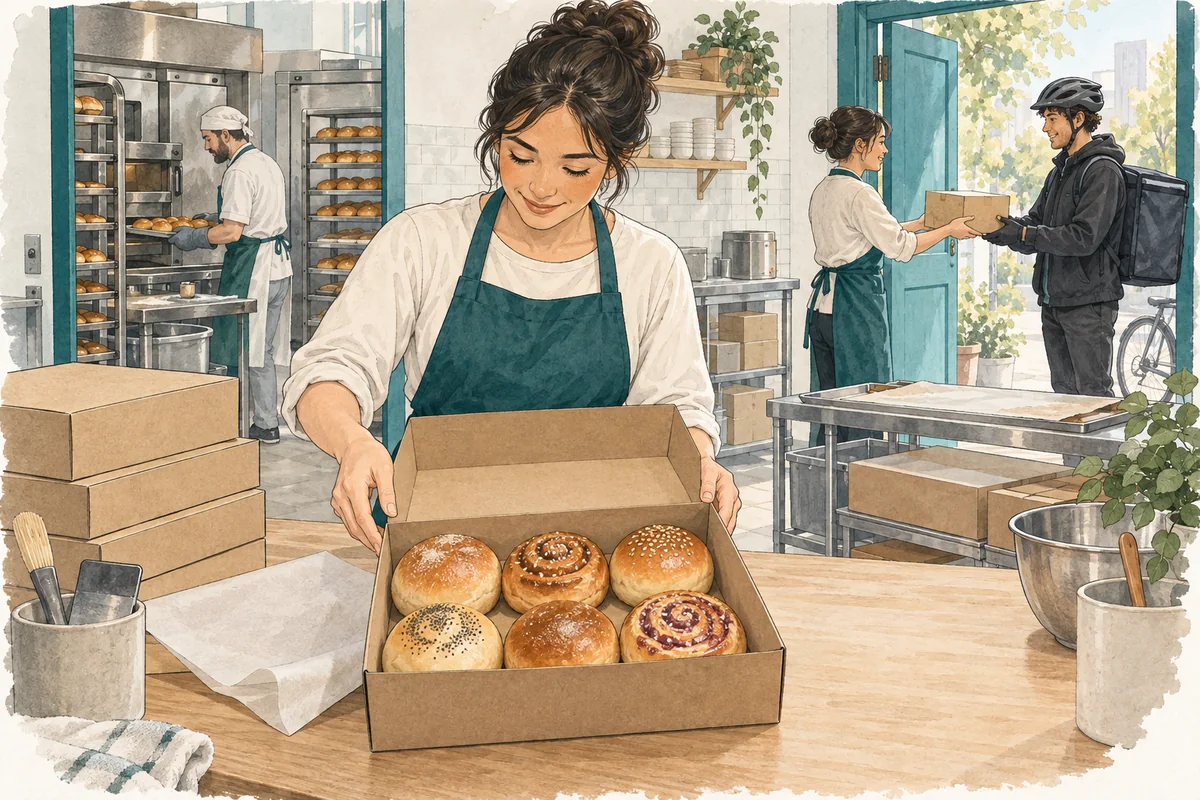
What does a delivered bakery box leave after production loss and courier cost?
Follow a six-piece bakery box through separate yield losses, packaging, retained delivery revenue, courier payment, and processing costs before testing payroll coverage.
Read the guide
Should your bakery sell cafe visits, branded orders, or private-label production?
Choose a bakery format by its buyer, production promise, route to market, inventory responsibility, and the work you want to manage.
Read the guide
How to read financial assumptions before editing an Excel model
Follow the chain from operating assumptions to calculated results, check units and timing, and keep a useful record of changes to a financial workbook.
Read the guideEvidence and scope
Operationally specified by the analyst. An active local operator, commercial demand and legal permission require separate validation.
The links below provide operating-format context; they do not verify the workbook’s selected inputs or calculated returns.
The workbook guide and figures describe model PHY003-05, revision r01, for January 2027–December 2031. These are a documented planning case, not observed results for a particular business.