The delivery-focused bakery case sells one six-piece breakfast box of bread rolls and sweet buns through a direct online channel. Its U.S. Base forecast runs from January 2027–December 2031 in USD, with January setup and February sales. Prices, recipes, losses, and delivery costs below are selected case inputs, not current carrier quotes or national bakery benchmarks.
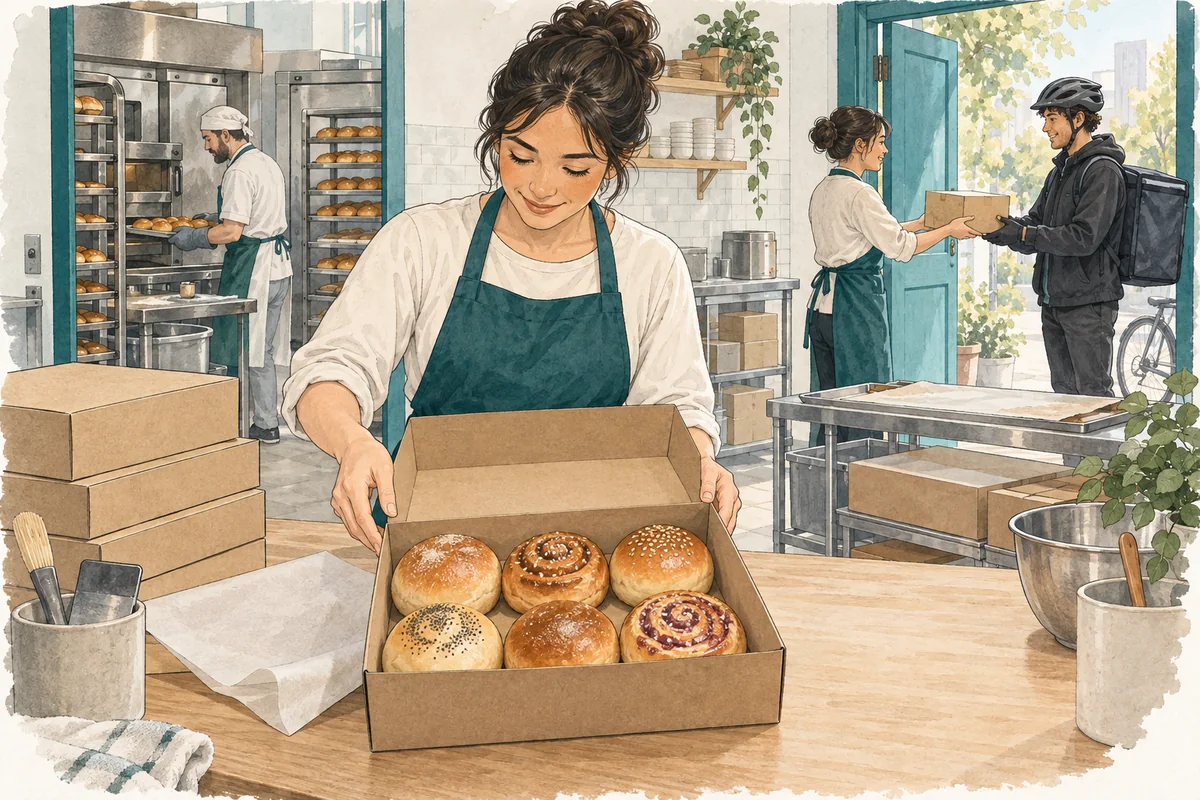
What is sold in one box order?
One fulfilled order earns a $36 food price plus a $4.99 retained delivery charge, totaling $40.99 in 2027. The bakery is responsible for the food sale and pays a contracted courier separately. The delivery charge accompanies the same order; it does not represent another box or another fulfilled transaction.
This case has no marketplace commission, owned delivery fleet, catering, subscription, or customer advance. Sales tax and tips are excluded from revenue. Those boundaries matter to the calculation: adding a marketplace or an employed driver would require changing the cost structure rather than treating this direct-channel contribution as unchanged.
How do separate production losses affect ingredient cost?
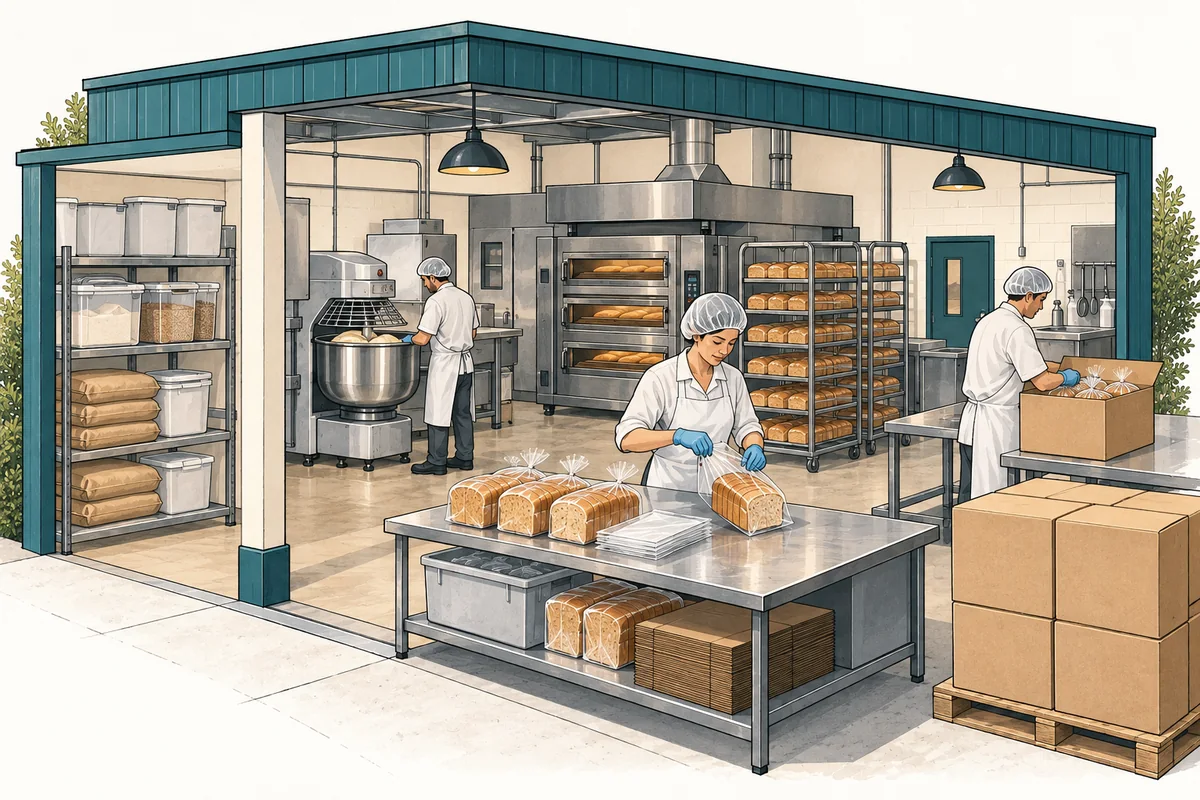
The plan loses 4% of gross output to processing rejects, then 2% of the remaining good output to unsold products. Starting with 100 gross box-equivalents therefore leaves 100 × 96% × 98% = 94.08 saleable box-equivalents. The combined loss is 5.92% of gross output, because the second loss applies after the first.
To fulfill one sold box, gross production is 1 ÷ (96% × 98%) = 1.062925 box-equivalents. The selected recipe costs $9 per gross six-piece box, so ingredients cost $9 ÷ (96% × 98%) = $9.56633 per fulfilled order, displayed as $9.57. Ingredient spending follows required gross production, not just the six pieces delivered.
The model costs rejected and unsold output without booking revenue or overnight finished-goods inventory. Packaging is separate at $1.10 per fulfilled order. Keeping those bases distinct prevents either omitting ingredient losses or adding a second complete waste charge after the recipe cost has already been adjusted for yield.
How much of the courier charge does the customer cover?
The selected courier payment is $6.99 per fulfilled order, while the bakery retains $4.99 from the customer. The resulting $2.00 delivery subsidy per order is already part of the contribution calculation. It is the difference before other costs; collecting a delivery charge does not make delivery cost-neutral.
The selected processing budget is 3.3% of the full $40.99 sale plus one $0.30 transaction charge, or $1.65267 per order. The percentage applies to both the food price and retained delivery charge. The table retains full precision in its calculation and rounds displayed money to cents.
On a narrow screen, scroll within the table to follow the order contribution.
| Component | Calculation or basis | USD/order |
|---|---|---|
| Food and retained delivery revenue | $36 + $4.99 | 40.99 |
| Ingredients after both yield losses | $9 ÷ 96% ÷ 98% | −9.57 |
| Packaging | One completed order package | −1.10 |
| Courier payment | One contracted delivery | −6.99 |
| Processing | $40.99 × 3.3% + $0.30 | −1.65 |
| Contribution before scheduled payroll and fixed overhead | Revenue less the four cost groups above | 21.68 |
Holding price, yield, packaging, and processing unchanged, each additional dollar of courier cost removes one dollar of contribution. An illustrative $9.98 courier input, also used in the source model’s sensitivity testing, would reduce this order calculation to $18.69. That is an isolated change to 2027 unit economics, not a new full-model forecast or a claim that a particular address qualifies for that price.
What remains for committed payroll and overhead?
The case funds 4.5 paid full-time equivalents: owner-manager, two bakers, a pack/dispatch coordinator, and half an FTE of relief. Loaded 2027 payroll is $241,526.56 per year, or $20,127.21 per month on an average monthly basis. Fixed overhead is another $8,381 per month, for $28,508.21 of scheduled monthly coverage before depreciation, financing, and income tax.
Dividing the unrounded $28,508.21333 monthly cost by the unrounded $21.68100347 contribution gives 1,314.89 expected orders per month, approximately 1,315 whole orders. This static coverage calculation holds 2027 prices, recipes, staffing, and overhead constant. It does not establish a launch break-even date, account for startup capital purchases, or prove that the required customers will order.
Physical capacity must support those orders. Mixing, proofing, oven output, and both loss stages constrain the kitchen; dispatch and carrier windows separately cap the case at 110 fulfilled orders per open day. Unused capacity at one stage cannot compensate for an insufficient carrier window. Annual quantities may be fractional planning expectations, while actual baking and dispatch require workable schedules.
The delivery bakery model collects sales and pays couriers in the same month, but holds ten days of food and packaging inventory. Payroll starts during January setup, before February sales and the launch ramp. Review monthly cash alongside order contribution, using an actual recipe, delivery quote and capacity agreement, loss records, and paid staffing plan to replace the selected inputs.