
Bakery Financial Model: Subscription Bakery
Plan a subscription bakery: One loaf per active subscriber per scheduled Friday. Review capacity, operating costs and five-year cash flow.
- Excel (.xlsx)
- Market: U.S. planning case
- Sale unit: One loaf per active subscriber per scheduled Friday.
Planning several types? Compare 8 bakery formats
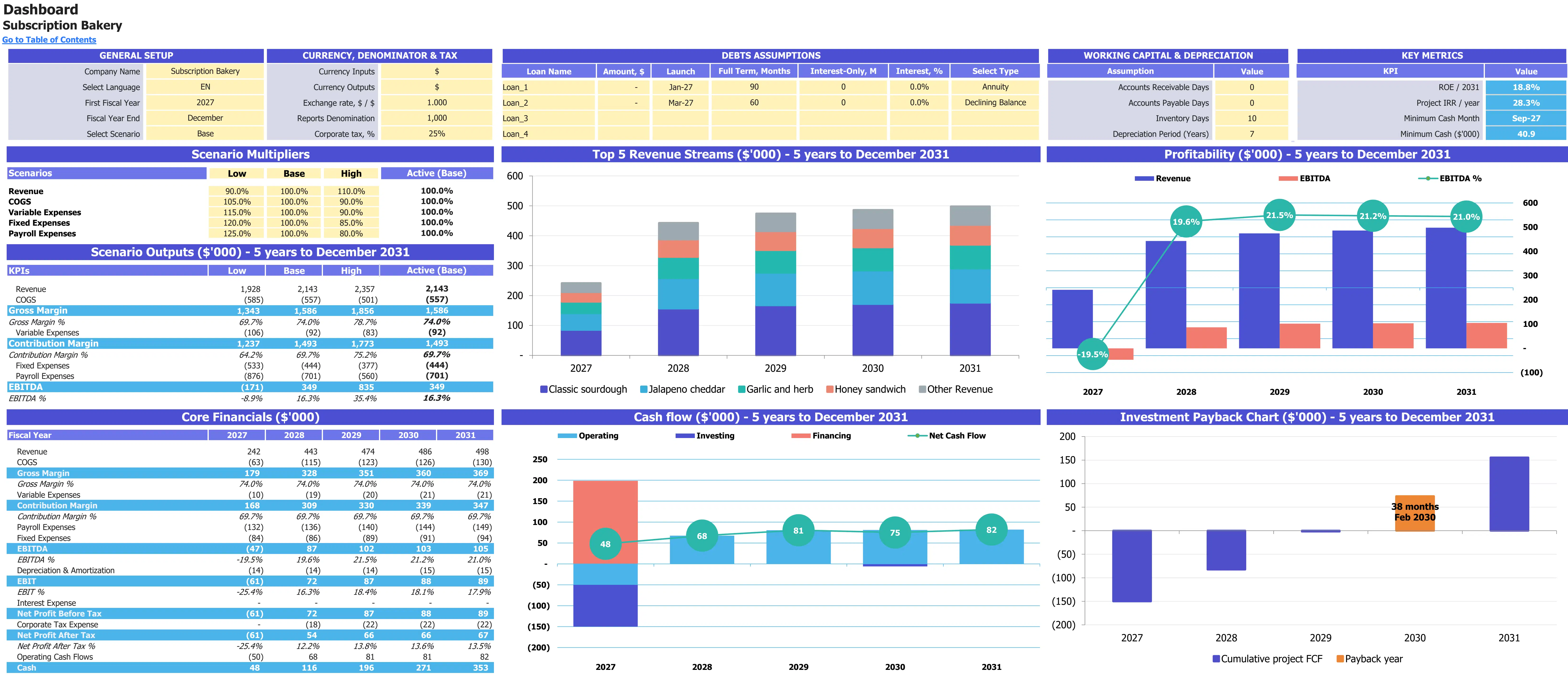
Base-case financial dashboard for 2027–2031. Report amounts are in thousands of USD; percentages and operating measures retain their own units. Enlarge to read detailed tables.
Enlarge image in a new tab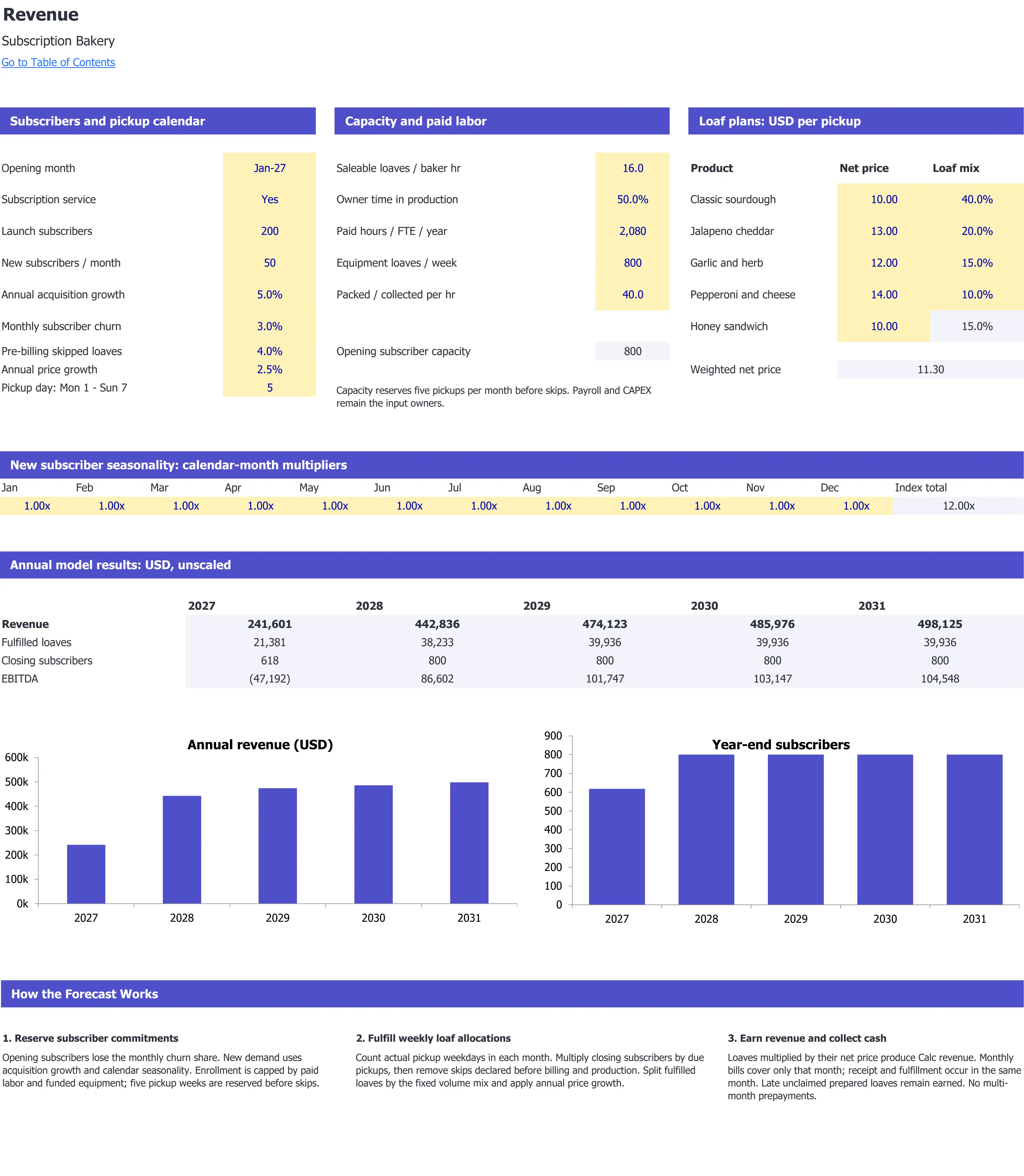
Business-specific demand, selling prices, capacity and revenue assumptions for 2027–2031. Follow each USD, volume, time and percentage label; annual totals and inputs can use different scales.
Enlarge image in a new tab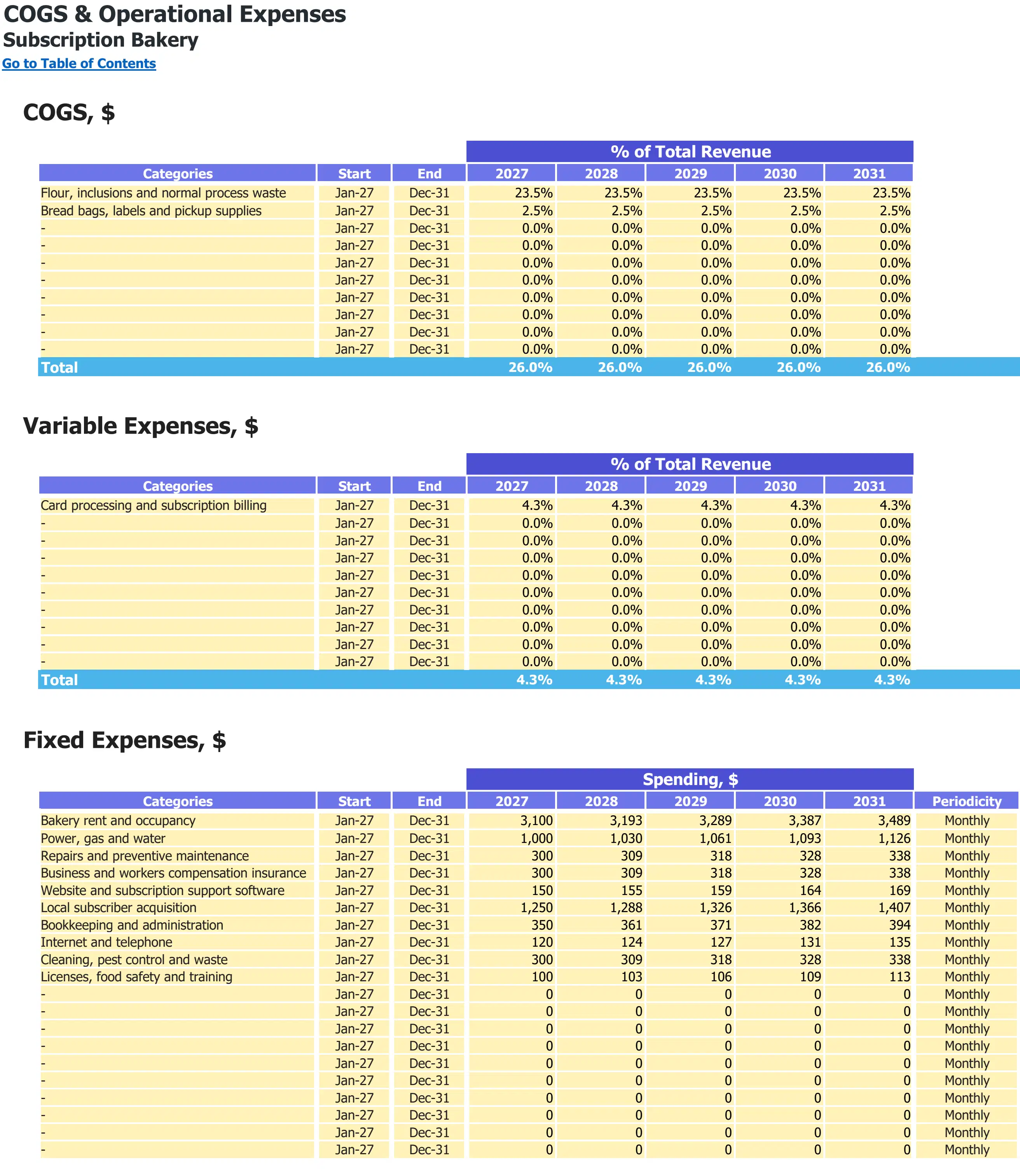
Operating-cost inputs and spending schedules for 2027–2031. Fixed amounts follow the displayed monthly or one-time timing; specialized material costs can use USD per sale unit rather than a revenue percentage.
Enlarge image in a new tab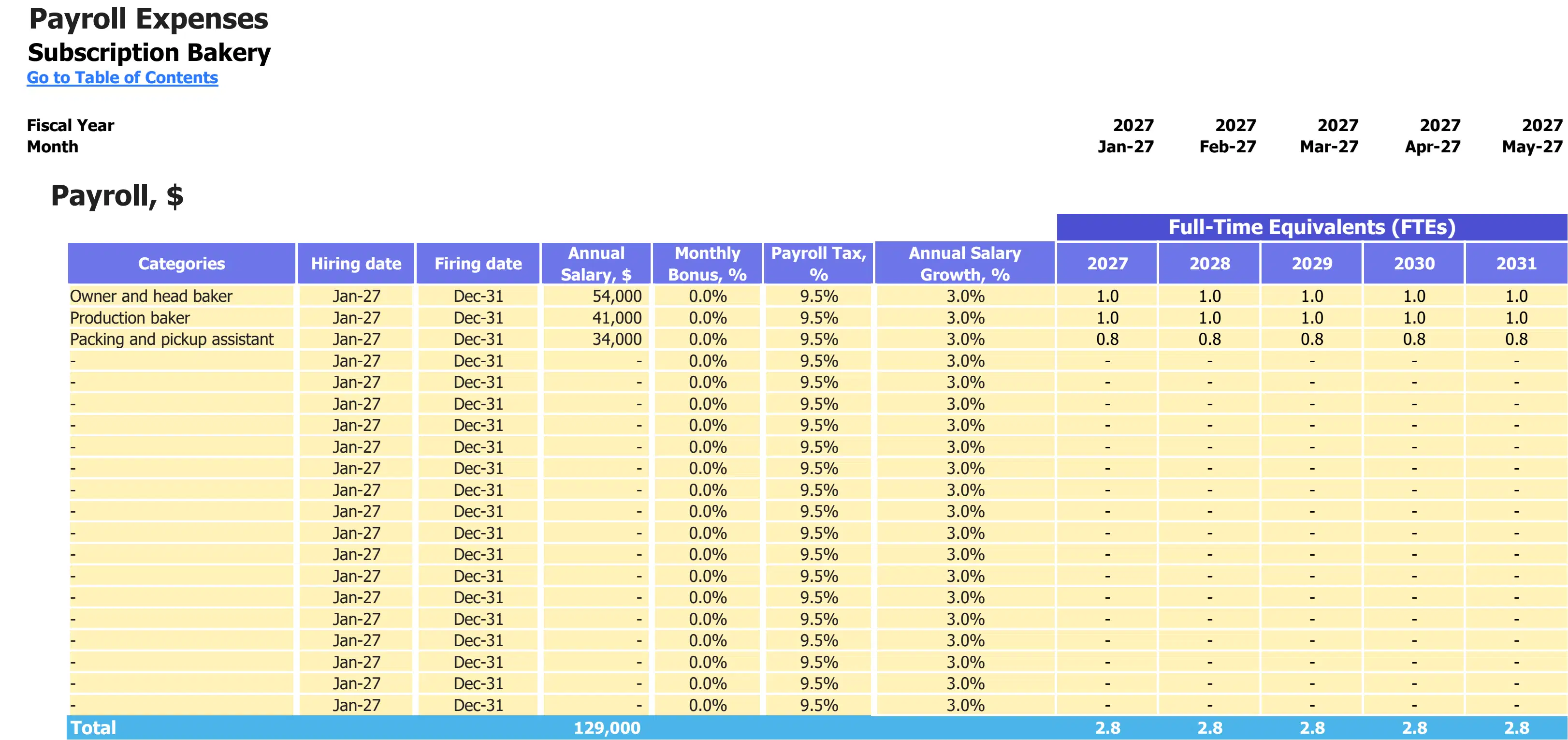
Annual role salaries, hiring dates, payroll rates and forecast FTE inputs. Salary inputs alone are not fully loaded payroll expenditure. Some long role labels can be clipped in the source cells.
Enlarge image in a new tab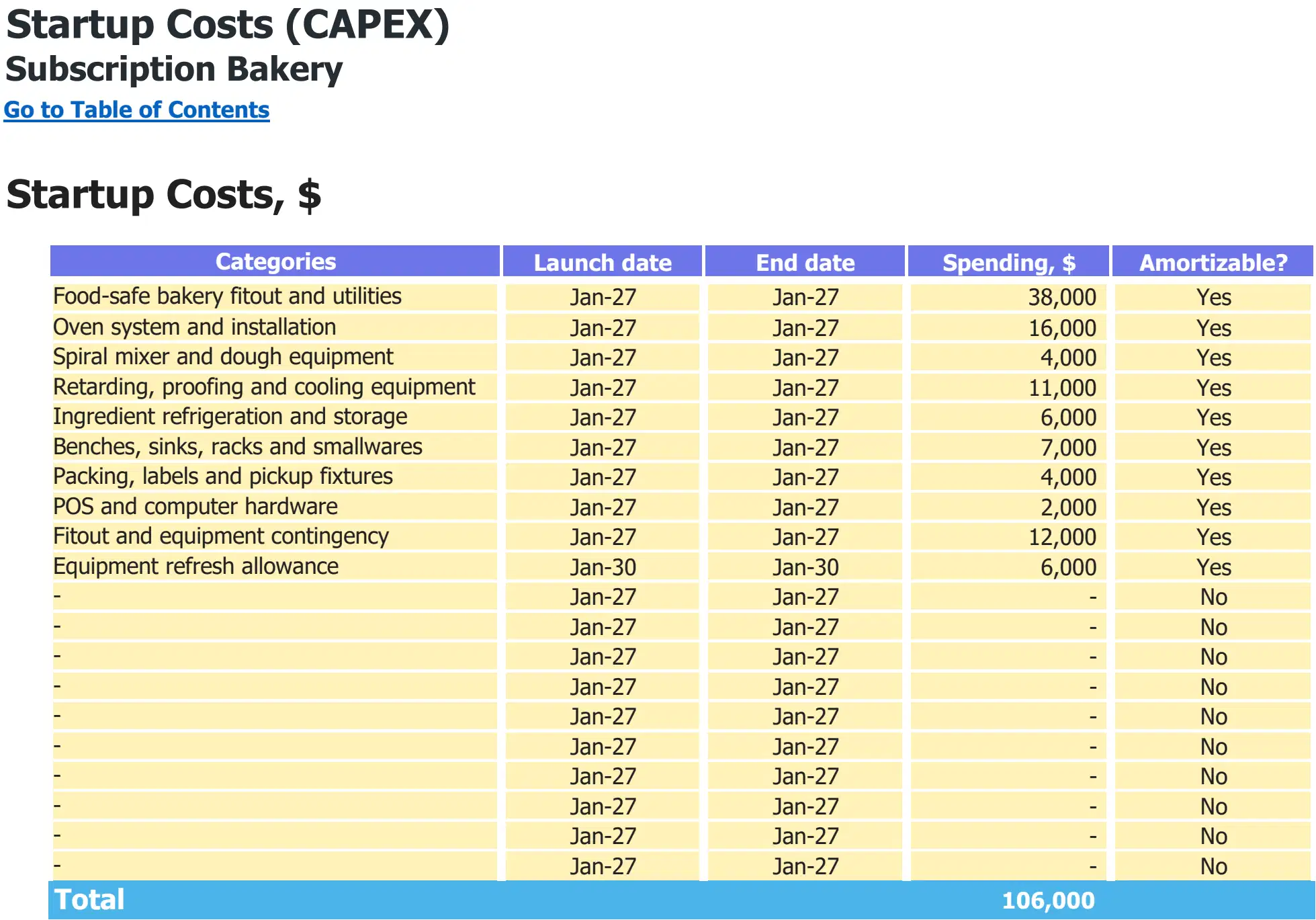
Asset spending in USD and its scheduled purchase dates. Later replacements may be included; the displayed total is not the opening funding requirement. Some long asset labels can be clipped in the source cells.
Enlarge image in a new tab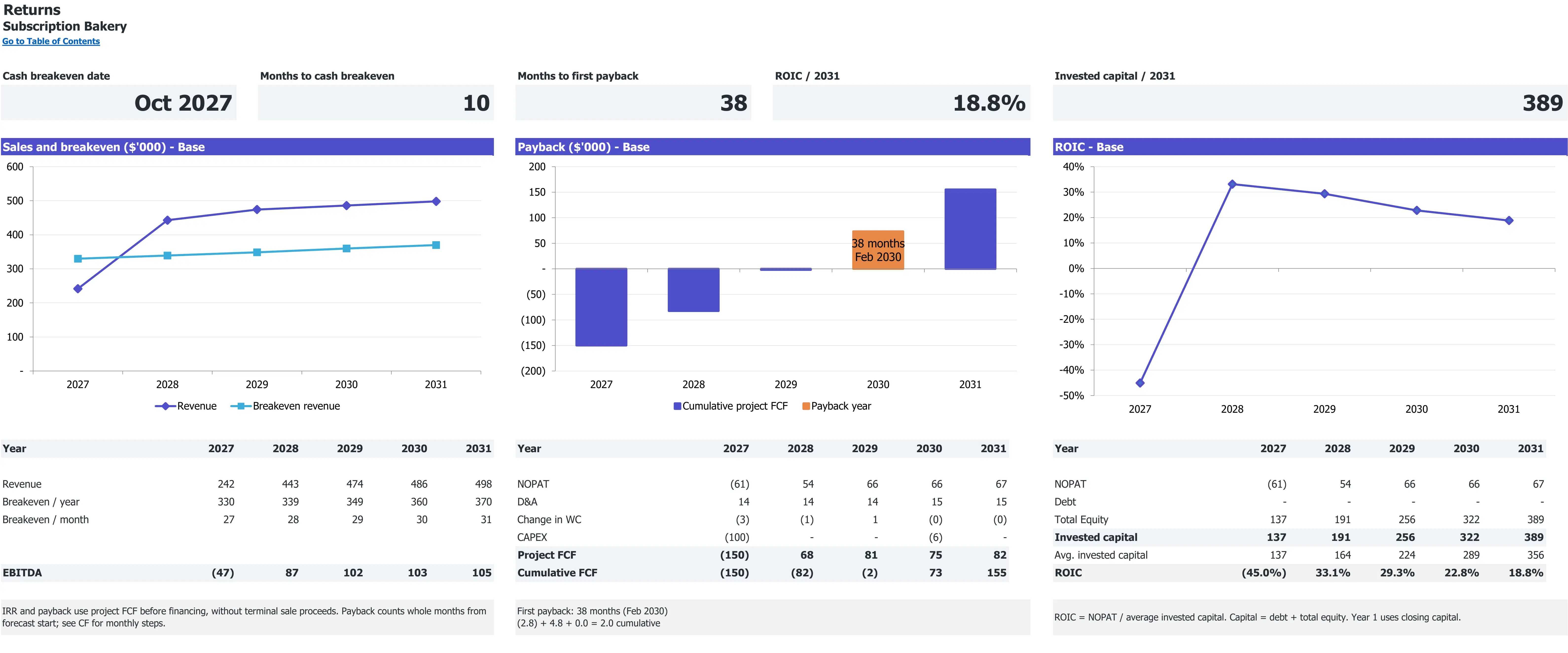
Returns excerpt for Subscription Bakery, Base case 2027–2031, USD thousands. Project cash-flow investment payback, counted from forecast start. A Not reached result means no payback within this forecast. Enlarge for the complete original sheet.
Open full Returns view in a new tabReturns excerpt for Subscription Bakery, Base case 2027–2031, USD thousands. Annual pretax-income break-even sales proxy: forecast revenue compared with sales needed to cover modeled costs before income tax, including depreciation and any interest. This differs from EBITDA break-even, cash break-even dates and project payback. Enlarge for the complete original sheet.
Open full Returns view in a new tab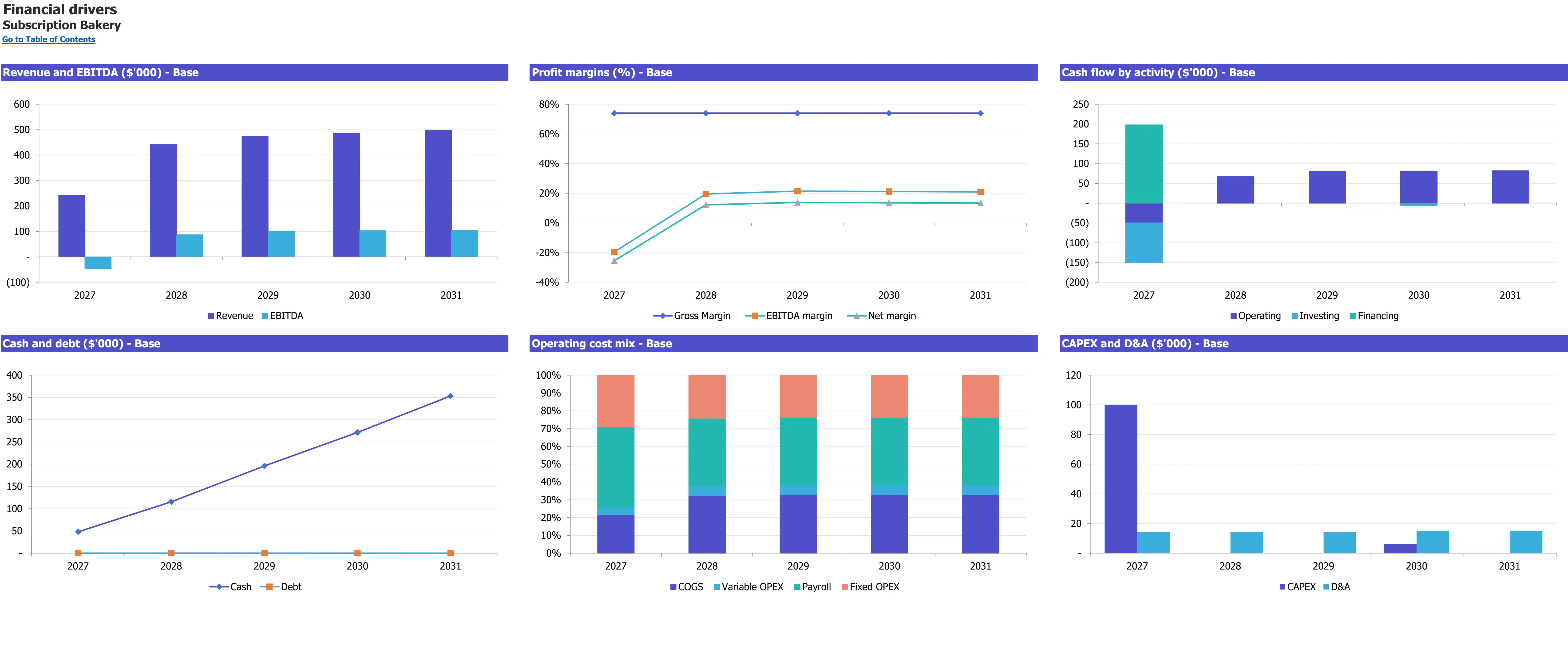
Financial charts for 2027–2031. Report amounts use thousands of USD; margin and cost-share series use percentages.
Enlarge image in a new tab8 selected worksheet views. Figures show this workbook’s starting case.
EXCEL FINANCIAL MODEL
Subscription Bakery

Inspect the model before you plan.
Review the workbook inputs and the documented starting case.
- Review demand and prices
- Review operating capacity
- Review costs and paid staffing
Check the operating fit and assumptions for your own business.
Preview the workbookOpens the existing worksheet gallery.
Workbook overview
What is inside the Excel model
Enrollment reserves capacity for five-Friday months. Skips before billing remove both production and revenue.
Selected worksheets from the documented workbook. Forecast period: January 2027–December 2031. Model reference: PHY003-06.
Inputs you control. Results you can inspect.
On a small screen, scroll within the table to read every column.
| Planning area | Inputs you review | How they connect | Results to inspect |
|---|---|---|---|
| Demand and prices | Starting demand, launch timing, category prices and the supported sales mix. | Fulfilled weekly loaf allocations × the five loaf prices. | Fulfilled activity and earned sales. |
| Operating capacity | Retained subscribers plus capacity-admitted new members; Funded production and packing labor; Commissioned oven, mixer and proofing equipment | Enrollment reserves capacity for five-Friday months. Skips before billing remove both production and revenue. | Capacity-constrained fulfilled sales. |
| Costs and paid staffing | Sales-based ingredient and packaging allowances; Paid owner, baker and packing labor; Subscription billing and payment charges; Rent and recurring operating overhead | Review monetary budgets and paid headcount on their designated schedules. | Gross profit, EBITDA and cash operating costs. |
| Investment and funding | Asset costs, acquisition timing, equity and the selected working-capital assumptions. | Follow monthly cash through setup, opening and the demand ramp. | Funding requirement and the lowest cash month. |
Is this the right model for your business?
Check the starting case before changing the assumptions.
The starting operation
- This is a US national planning case for a 1,200 sq ft leased bakery making five loaf varieties for local weekly pickup.
- One loaf per active subscriber per scheduled Friday.
- An operator comparing launch losses, cash requirements and investment recovery.
Check the boundary
Local weekly pickup only; no walk-in cafe, delivery, annual prepayments or gift-card balances.
Compare the other bakery typesHow this business makes money
Connect the unit sold to the resources required by this operating case.
Revenue logic
Fulfilled weekly loaf allocations × the five loaf prices.
Enrollment reserves capacity for five-Friday months. Skips before billing remove both production and revenue.
What happens when demand outgrows the funded operation?
Enrollment reserves capacity for five-Friday months. Skips before billing remove both production and revenue.
- Revenue unit
- One loaf per active subscriber per scheduled Friday.
- Shared constraints
- Retained subscribers plus capacity-admitted new members; Funded production and packing labor; Commissioned oven, mixer and proofing equipment
What to establish for your own operation
- Establish attainable customer demand and selling prices.
- Measure the paid workload and equipment throughput of your operation.
- Replace budget allowances with quotations and re-test monthly cash.
Follow the plan from demand to cash
Open each section for the assumptions, calculations, and limits of this workbook’s starting case.
Connect fulfilled sales to shared capacityRevenue
This is a US national planning case for a 1,200 sq ft leased bakery making five loaf varieties for local weekly pickup. Each active subscriber commits to one loaf per scheduled Friday. The business opens in January 2027. The five forecast years are complete January–December years, with 60 monthly periods through December 2031. Figures are projections, not achieved performance.
The opening cohort is admitted against funded capacity. Thereafter, prior subscribers less monthly churn are retained; new acquisitions are admitted only to the remaining commitment capacity. Acquisition seasonality affects new customers only. A fixed loaf/subscriber mix splits fulfilled quantities into five products, and each quantity is multiplied by its annually escalated price. Expected fractional subscribers and loaves are acceptable for planning, not customer billing records.
Actual four- or five-Friday months drive allocations. Skips declared before billing and production remove both the allocation and charge. Each current-calendar-month invoice covers that month only and is received and released to earned revenue within the same month. Opening and closing customer advances are zero. Unclaimed prepared allocations remain fulfilled under the assumed pickup terms, with no automatic refund or cost reversal. Processor settlement is assumed in the same month.
Enrollment is capped at the minimum of equipment, production labor and packing/collection capacity. Every accepted subscriber reserves a full weekly loaf before skips. Paid labor reserves capacity for a five-pickup month, preventing a four-week month from admitting an unsustainable commitment. Owner production time is allocated once. Positive funded oven, mixer and proofing equipment, plus completed acquisition dates, gate the equipment limit.
Size startup funding around cash requirementsCF
Month-one equity is USD 198,000. No debt, interest, principal repayment, refinancing, dividends or pre-existing balance-sheet balances are assumed. This equity is a modeled funding requirement, not committed investment. SBA financing was reviewed ; uncertain initial demand supports the selected all-equity case.
January 2027 CAPEX is USD 100,000; January 2030 refresh CAPEX is USD 6,000. Peak unfunded month-end cash need is USD 157,138.78 in September 2027: USD 100,000 initial CAPEX plus USD 57,138.78 cumulative operating cash burn including inventory. Adding the chosen USD 40,000 reserve and rounding funding upward to USD 1,000 gives USD 198,000. USD 197,000 would leave only USD 39,861.22, below the reserve.
The modeled minimum closing cash is USD 40,861 in month 9, September 2027. The buffer covers month-end cash only; daily purchase peaks, deposits and timing friction require a separate local cash plan. Inventory builds from zero; the 10-day stock requirement is included in operating cash flow. No second funding round is assumed.
Distinguish profit from investment recoveryReturns
First positive monthly EBITDA is month 10 (October 2027). November 2027 reverses to a USD 269.39 EBITDA loss in a four-pickup month; sustained positive EBITDA begins in December 2027 and continues through December 2031 in this case. This is an operating-profit threshold before depreciation and tax, not investor capital recovery. No exact continuous break-even subscriber target is asserted.
Undiscounted project payback is month 38 (February 2030), measured from January 2027. Cumulative operating cash flow after tax/inventory, less initial and subsequent CAPEX, first reaches zero. It includes the USD 6,000 January 2030 refresh and remains nonnegative thereafter. There is no interpolation, terminal sale or equity cash injection in this recovery series. The USD 40,000 reserve is retained cash, not an operating outflow. Payback does not mean the full equity contribution has been distributed back; distributions are zero.
Five-year simple accounting ROI is 96.7%: USD 191,412 cumulative net income divided by USD 198,000 contributed equity over January 2027–December 2031. It is neither annualized nor a realized cash-on-cash shareholder return; owner salary is already expensed, cash remains in the business, and no terminal sale proceeds are assumed.
The native annualized project IRR is 28.3%, derived from monthly project cash flow. the workbook and the overall check intentionally remain REVIEW: cash flow changes sign in October 2027, January 2030 (the refresh) and February 2030. The native NPV residual reconciles and a numerical polynomial-root review finds one positive discount-factor root in this case, but unconventional cash-flow IRR requires caution. The warning is retained; this release is qualified, not all-green. Simple ROI, project IRR and ROIC answer different questions.
Selected results from the starting case
Modeled results in USD unless stated otherwise. These describe the selected inputs, not an estimate for your location or a guaranteed outcome.
- 2027 Revenue
- $241,601USD, Base; January–December 2027. Annual modeled flow, including any setup months.
- 2027 EBITDA
- −$47,192USD, Base; January–December 2027. Annual modeled flow, including any setup months.
- 2027 Net income
- −$61,478USD, Base; January–December 2027. Annual modeled flow, including any setup months.
- 2027 Closing cash
- $47,999USD, Base; January–December 2027. December closing balance, after modeled funding.
Make the case your own
Work from the operating plan toward the cash requirement.
Start with the sale unit, category mix and opening plan.
Check demand against the shared equipment and paid-labor limits.
Replace cost, staffing and asset assumptions with operating evidence.
Inspect monthly cash and separate operating profit from project payback.
Interpretation and scope
- This is a modeled U.S. planning case, not achieved performance or a location-specific feasibility study.
- Local weekly pickup only; no walk-in cafe, delivery, annual prepayments or gift-card balances.
- Subscriber acquisition, retention and sustainable saleable throughput dominate this case. A 3% monthly churn assumption implies roughly 69% annual cohort retention before new acquisitions; it must be tested locally. Capacity reaches its 800-subscriber commitment ceiling, so price, retention, labor efficiency and cost control matter after enrollment fills. Minimum cash falls below the intended buffer in several tested stresses; the delivery equity amount is not automatically resized when inputs change.
- The original USD 198,000 equity remains fixed. Negative minimum cash means additional financing or corrective action is required. Native Dashboard stress factors are independent: the protected template cancels Revenue_mult from percentage-cost sensitivities before applying each cost multiplier; it does not automatically scale every cost with scenario sales.
The workbook is an Excel file for local planning. Learn how to interpret assumptions and evidence.
Other bakery types
Each operating type calls for its own financial structure.
Questions
What does a customer buy?
One loaf per active subscriber per scheduled Friday.
Does higher demand automatically create more sales?
Enrollment reserves capacity for five-Friday months. Skips before billing remove both production and revenue.
Which formats are outside this case?
Local weekly pickup only; no walk-in cafe, delivery, annual prepayments or gift-card balances.
Are these results a forecast for my location?
They describe the saved Base inputs for January 2027–December 2031. Replace prices, paid staffing, asset budgets and demand with evidence for your own operation before interpreting the results.
What if a purchased file is damaged or cannot be downloaded?
See the refund and replacement policy for file correction, replacement and download assistance. Keep the product name and your order reference when requesting help.
Which software does the workbook use?
The documented file is an Excel workbook (.xlsx). Compatibility with other spreadsheet applications is not established by the file extension.
Read the planning guides
Explore the relevant operating questions and how to interpret a workbook’s assumptions.

How to read financial assumptions before editing an Excel model
Follow the chain from operating assumptions to calculated results, check units and timing, and keep a useful record of changes to a financial workbook.
Read the guide
Which financial statements and assumptions belong in a small-business funding plan?
Connect your funding request to a five-year forecast, monthly opening cash and documented operating assumptions.
Read the guide
How do credit sales, inventory and payment timing change a monthly cash-flow forecast?
Follow earned sales, customer collections, inventory purchases and supplier payments through a transparent monthly cash example.
Read the guideEvidence and scope
BreadHive supports a local pickup subscription and date-adjustment rules. This is an operator example, not evidence of national demand, margins, churn or a universal no-show recognition policy.
The links below provide operating-format context; they do not verify the workbook’s selected inputs or calculated returns.
The workbook guide and figures describe model PHY003-06, revision r01, for January 2027–December 2031. These are a documented planning case, not observed results for a particular business.