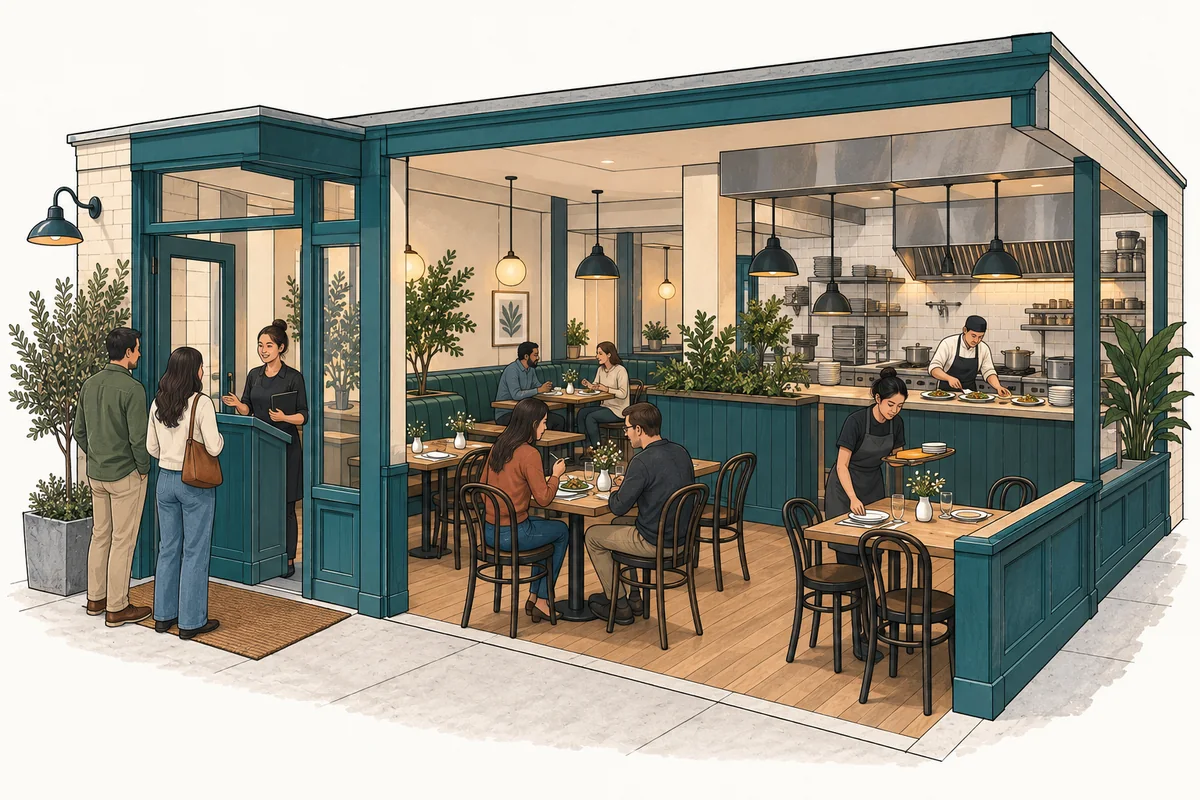
This guide follows one alcohol-free, lunch-and-dinner restaurant. The full-service restaurant planning case uses 80 seats in 3,000 square feet and includes a paid working owner. Those are selected case assumptions, not a minimum size, a local occupancy approval, or evidence of customer demand. If the concept is still unsettled, start with the restaurant business idea guide.
What must you decide before looking for premises?
Write a service description that a chef, contractor, and lender could interpret the same way. Specify the meal occasions, menu range, table service, ordering and payment process, and expected guest visit. A restaurant designed for a short weekday lunch has different operating demands from a restaurant built around a long evening meal, even when both use the same dining room.
Build a trial menu with recipe quantities, preparation steps, holding needs, and finishing tasks. Separate work that can happen before service from work that must happen when an order arrives. Ask which menu items compete for the same cooking station and which require storage or equipment that the core menu otherwise would not need. This turns a concept into requirements that can be priced and tested.
Keep the launch scope explicit. This case excludes alcohol, delivery, and catering. Adding one of those activities calls for its own revenue assumptions, labor, equipment, and local requirements; its sales should not appear as a free addition to the dining-room forecast.
Can the site support this menu and service?
Confirm the proposed use and approval path before treating a promising property as a restaurant location. The SBA explains that location and business activities determine licensing requirements and directs owners to local zoning authorities. Take your actual menu, hours, and proposed layout to the relevant offices. SBA launch guidance.
A previous restaurant tenancy is useful background, but obtain current evidence for your own project. Ask the landlord and qualified project team to document existing ventilation, fire suppression, electrical service, gas, water, drainage, grease handling, refrigeration, and accessible customer facilities. Identify what can be reused, what needs testing, and who pays for any upgrade. A low advertised rent cannot settle those questions.
The FDA recommends reviewing equipment locations and building services on plans before purchases and construction create expensive problems. Use the applicable local plan-review process to resolve those details; the federal guide itself is not a permit. FDA food establishment plan review guide.
On a narrow screen, scroll within the table to read the evidence needed for each decision.
| Decision | Evidence to collect | What it changes |
|---|---|---|
| Food-service use and hours | Written direction from the relevant planning and licensing offices for the proposed activity. | Whether this site and service schedule remain candidates. |
| Kitchen systems | Equipment schedule, utility capacity, ventilation assessment, and itemized installation bids. | Menu feasibility, construction scope, and equipment order dates. |
| Dining-room layout | A reviewed arrangement for tables, circulation, accessible service, exits, and restrooms. | Usable seating and the guest experience; a furniture count alone is insufficient. |
| Lease responsibilities | Agreed responsibility for repairs, approvals, deposits, rent commencement, and handover condition. | Upfront cash, recurring occupancy costs, and exposure to delay. |
| Opening dependencies | A dated list of work, inspections, equipment commissioning, and outstanding decisions. | The earliest credible training and opening sequence. |
How should you turn the menu into paid shifts?
Build shifts from the workday rather than dividing expected sales by a payroll percentage. Include receiving, preparation, service, breaks, cleaning, closing, and management. Mark which employee can cover each station during a busy interval, and identify who takes over when that employee steps away. The same person cannot provide simultaneous kitchen and dining-room capacity.
In the source case, owner compensation starts before the restaurant opens, followed by kitchen preparation and training payroll. That is a useful sequencing reminder, not a prescribed hiring calendar. The model eventually funds 16.1 full-time equivalents across management, kitchen, dishwashing, service, and hosting. An FTE budget expresses paid hours; it is not a list of employees or proof that a particular weekly roster works.
Recruit the lead roles early enough to help finish recipes, supplier specifications, training materials, and service standards. For every role, use current local pay, benefit, payroll, and scheduling requirements in the cost plan. Keep paid owner work visible; expected future profit does not perform the owner’s opening tasks.
What should a service rehearsal prove?
Rehearse the entire journey from greeting to table reset using the opening menu and planned staffing. Include awkward orders, a missing ingredient, a payment correction, and several tables ordering together. Record where tickets wait and whether food quality, order accuracy, clearing, or communication deteriorates as arrivals bunch together.
Set an initial reservation and walk-in policy from that evidence. Empty seats do not establish that the kitchen can handle another wave of arrivals. The source model treats seats, equipment, kitchen labor, and service labor as separate constraints; the restaurant demand and capacity guide explains that calculation. Your rehearsal supplies operating evidence that a spreadsheet cannot observe.
Use a short issue log with the problem, responsible person, correction, and repeat-test result. Reduce the launch menu or guest load if that is what the evidence supports. A soft opening is still service to real guests, so confirm the required approvals before offering it.
How do opening commitments become a cash plan?
Date each cash commitment using the actual lease, supplier terms, construction milestones, payroll starts, and financing availability. Include initial stock, training, professional work, and marketing alongside construction and equipment. Keep a separate line of reasoning for the cash retained after those payments and the losses that may occur while sales develop.
The source case has $442,200 of initial capital spending and $717,000 of initial financing, made up of equity and debt. These amounts describe one fitted-shell planning case; they are not competing estimates of a typical restaurant’s price. Capital assets are one use of funding, while the cash forecast also includes operating commitments, financing costs, and working-capital timing.
Test a later opening by moving sales and reviewing every cost start date explicitly. Rent and salaries do not necessarily move because guest revenue moves. Likewise, an unsigned loan proposal should not be treated as available construction cash. The restaurant opening cash reserve guide shows how the case separates spent contingency from cash retained at the forecast low point.
When is the restaurant ready to announce an opening?
Use a readiness decision with named evidence, then select the date. The owner should be able to explain which activities are approved, which systems are commissioned, which staff are trained, and which payments remain due. A favorable projected profit cannot compensate for an unresolved kitchen installation or a shift that lacks coverage.
Before announcing the date, resolve these practical questions:
- Can the launch menu be produced consistently through the busiest tested service?
- Are suppliers, delivery access, receiving checks, and fallback products confirmed?
- Can the opening roster cover preparation, service, and closing with paid relief?
- Are site-specific approvals complete, with any operating conditions reflected in the plan?
- Does dated funding cover the opening sequence and the revised sales ramp?
After opening, compare guest arrivals, ticket times, purchasing losses, paid hours, and cash collections with the plan. Correct the operating assumptions before expanding the menu, seats, or hours. The assumptions review guide provides a way to keep that revision trail readable.