Which physical quantity earns revenue?
The saved Wholesale Production Bakery case separates manufacturing attempts, good output, rejects, external shipments and closing stock. It uses five loaf groups and a standard-loaf inventory pool. January 2027 is preparation, with commercial opening in February and a forecast through December 2031.
The Base inputs assume 650 external loaf orders per Monday–Saturday dispatch day, a 97% good-output yield and a starting weighted net price of $3.90 per loaf. Orders and shipments are different: capacity, losses, available stock and a closing reserve can stop the plant from fulfilling every request. These are analytical case inputs, not national bakery averages or signed contracts.
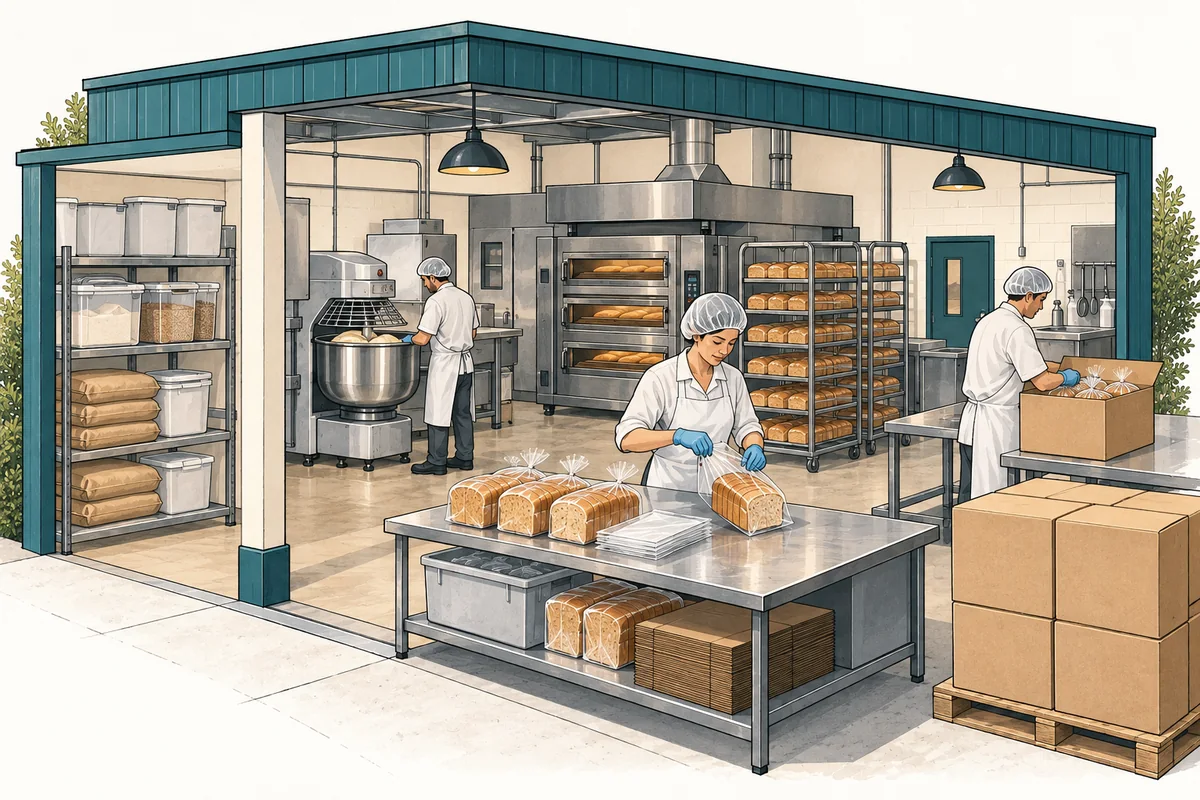
How can a production bridge avoid invented sales?
For illustration only, assume a month starts with 100 good loaves, discards 10, attempts 1,000 new loaves at 97% yield and ships 900. Good new output is 970, and closing stock is 100 − 10 + 970 − 900 = 160 loaves. The 1,000 attempts and 970 good units are not extra customer sales.
At the case’s $3.90 starting weighted price, this hypothetical 900-loaf shipment would earn $3,510 before any other price or mix change. The unit bridge is a teaching example, not an extracted month from the workbook. Actual model shipments obey the shared mixing, proofing, baking and paid-labor constraints.
Why does finished stock carry cost?
The saved case carries direct materials and productive manufacturing labor at weighted-average cost. A capitalization credit offsets productive labor already included in paid payroll; historical cost then returns to expense on shipment or write-off. Subtracting the same labor from both full payroll and inventory releases without that credit would count it twice.
Plant overhead, depreciation and unproductive labor remain period costs in this management-cost convention. It is not full-absorption GAAP inventory valuation. The stock-days window is a planning proxy rather than a food-safety shelf-life recommendation, and the pooled standard unit does not schedule individual bread SKUs.
How do credit terms change the cash requirement?
The Base case assumes 15 calendar days of customer receivables and no supplier payment delay. Raw materials target seven production days. Those assumptions can require cash for ingredients, production and retained stock before the corresponding shipment proceeds are collected; revenue alone cannot explain the lowest cash month.
Review contracted customer terms, actual collection behavior, paid production hours and workable stock cover together. Increasing orders while an oven is constrained need not improve shipments, and longer collections can worsen cash without changing earned sales. Use the monthly cash bridge to separate these timing effects before resizing funding.