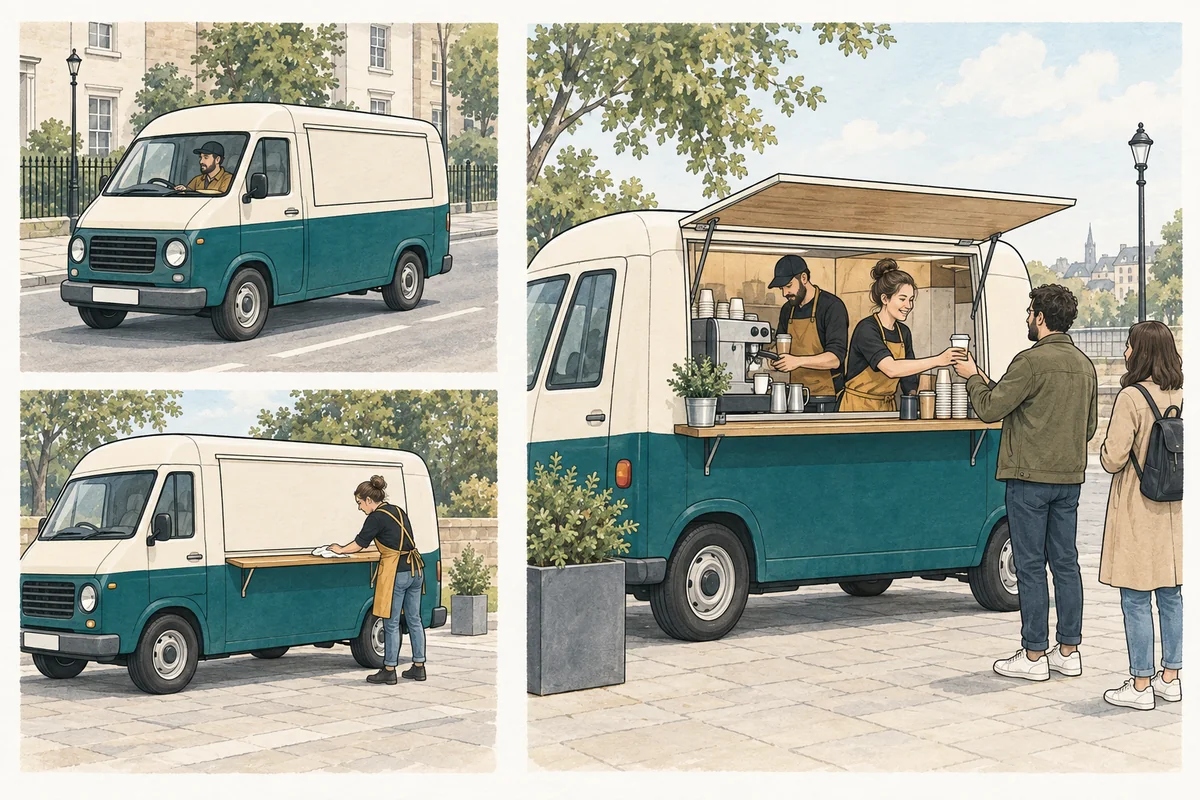
The workplace coffee service case is a U.S. Base planning forecast for January 2027–December 2031 in USD. The operator installs automatic coffee stations and bills employers. Employees make no separate drink payment. Its selected fees, consumption, service times, and portfolio growth are assumptions, not signed contracts or observed operator results.
What does the employer pay for?
Each serviced site has 100 eligible employees, assigned 60% to a $20 standard plan and 40% to a $25 specialty plan per month in 2027. The blended invoice is 60% × $20 + 40% × $25 = $22 per employee-month, giving $2,200 per serviced site-month. Included drinks do not create a second retail revenue stream.
The forecast ramps from 50% of its 24-site first-year target to 100% over twelve monthly observations. Fractional site-months represent expected portfolio exposure, not fractions of a machine. The physical stations remain whole assets, and switching off one plan removes its assigned share rather than automatically selling that share under the other plan.
On a narrow screen, scroll within the table to compare billing and service units.
| Layer | Selected basis | What it determines |
|---|---|---|
| Employer invoice | 100 eligible employees × $22/month | $2,200 revenue per serviced site-month |
| Included beverages | 88 drinks/site-day × 21 workdays | 1,848 drinks/site-month for supply planning |
| Purchased stations | 24 stations at launch | Whole installed assets cap site exposure |
| Replenishment visits | 2 visits × 0.8 service hour/site-month | 1.6 productive driver hours per site-month |
| Technical maintenance | 0.5 service hour/site-month | Separate technician-capacity constraint |
| Employer's daily tasks | Water, electricity, cleaning, refilling, and milk handling | Host responsibilities assumed by this service design |
Keep eligibility and consumption separate when drafting the commercial plan. A change in the number of covered employees can change billing; a change in drinks consumed per covered employee can change supplies without adding invoice revenue. The source case assumes one employer payment per site-month and same-month collection, so longer payment terms would also change its cash assumptions.
Which station and service resources cap active sites?
Serviced exposure is the smallest of requested sites, purchased stations, driver capacity, and technician capacity. Having enough coffee machines therefore does not establish that a geographically dispersed portfolio can be replenished and maintained by the funded team. Each resource needs a limit stated in the same site-month unit.
The driver calculation starts with 173.33 paid monthly hours per full-time equivalent and a 70% productive-time factor. Dividing by two visits of 0.8 hour gives 173.33 × 70% ÷ (2 × 0.8) = 75.83 site-months per driver FTE, using the source note’s rounded monthly hours. This is a theoretical planning capacity; the geography and service allowance still require route trials.
The first-year payroll funds one driver and 0.25 technician FTE, alongside paid owner and support roles. Technician service is tested separately at 0.5 hour per site-month. The 24 purchased launch stations remain a hard ceiling even when calculated driver capacity is higher. Extra driver time cannot be used as an unpurchased machine or counted again as technician time.
How does included consumption affect costs?
At the selected plan mix, daily use is 100 × (60% × 0.8 + 40% × 1.0) = 88 beverages per serviced site-day. Across 21 workdays, standard-plan employees account for 1,008 drinks and specialty-plan employees for 840, totaling 1,848 drinks per site-month. These quantities, rather than the $2,200 invoice alone, drive beverage supplies.
The case limits each machine to 200 drinks per day. Base consumption uses 88 ÷ 200 = 44% of that selected daily ceiling; this is arithmetic utilization of a case input, not a measured operating target. The contract assumes a shared machine limit, so the forecast does not promise unlimited drinks to every employee regardless of simultaneous demand or downtime.
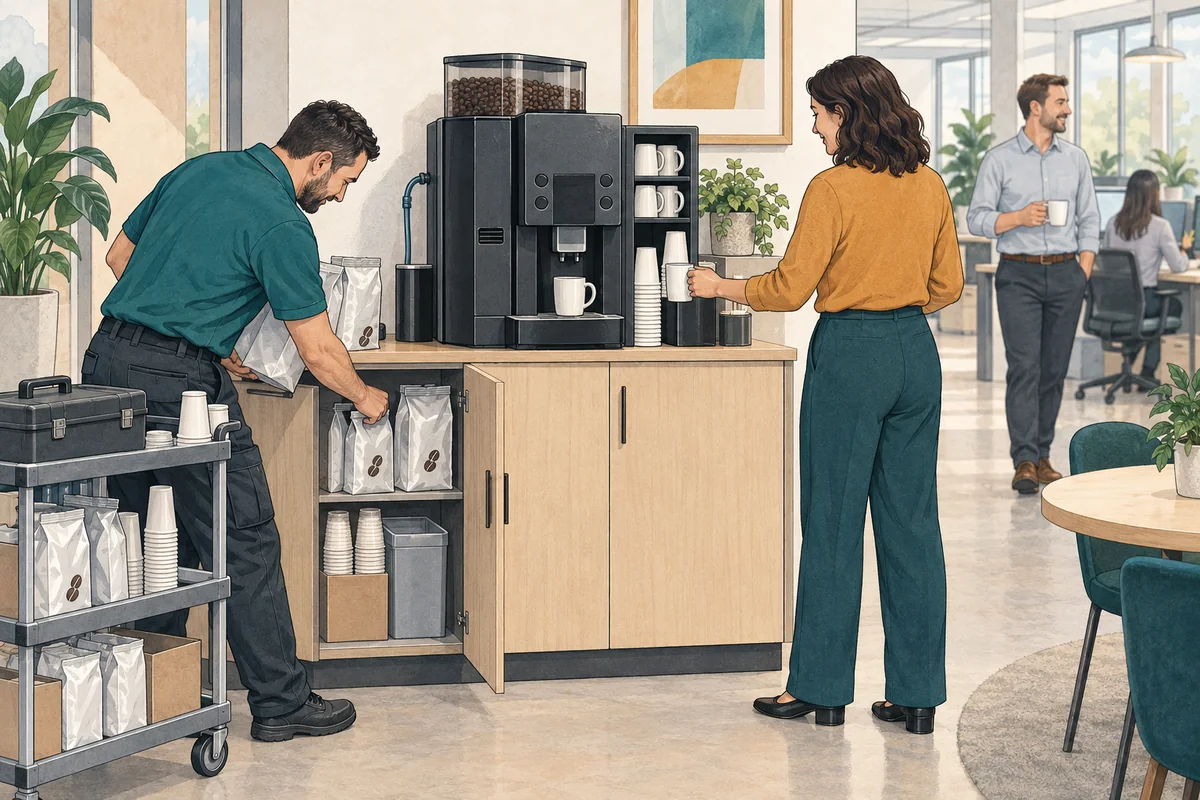
Recipes also differ by plan: the selected milk share is 15% for standard drinks and 50% for specialty drinks. Applying only the employee split to supply costs would miss differences in both use and recipes. The operator supplies stock and periodic service; the employer’s assumed daily cleaning, refilling, utilities, and milk handling must be clear in the site agreement for this staffing model to apply.
When should new equipment enter the cash forecast?
The case purchases 24 stations at launch, then eight more in months 13, 25, 37, and 49. At the selected $11,000 installed cost per station, launch stations require $264,000, and each later eight-station purchase requires $88,000. These are case capital budgets, not current equipment quotes or proof of customer demand.
The station additions raise the physical limits to 32, 40, 48, and 56. The source staffing schedule also changes over the five years, and a second van is purchased in month 25. Capacity planning therefore joins customer acquisition, whole equipment purchases, and paid service coverage; changing only the site target cannot create the other resources.
Later capital purchases are already included in the source model’s cash-funding calculation. Adding them again as an extra funding requirement would count the same uses twice. Review their timing against contracted exposure and the minimum monthly cash balance in the workplace coffee model, with employee eligibility, service responsibilities, routes, and payment terms documented before replacing the assumptions.