
Restaurant Financial Model: Subscription Restaurant
Model meal-credit subscriptions, renewals, carryover, refunds, shared restaurant capacity and earned revenue separately from cash billings.
- Excel (.xlsx)
- Starting restaurant: 2,000 sq ft / 40 seats
- Plan: Eight monthly meal credits / $88 initial price
- Opening: March 2027 / Monday–Saturday service
Planning several types? Compare 17 restaurant formats
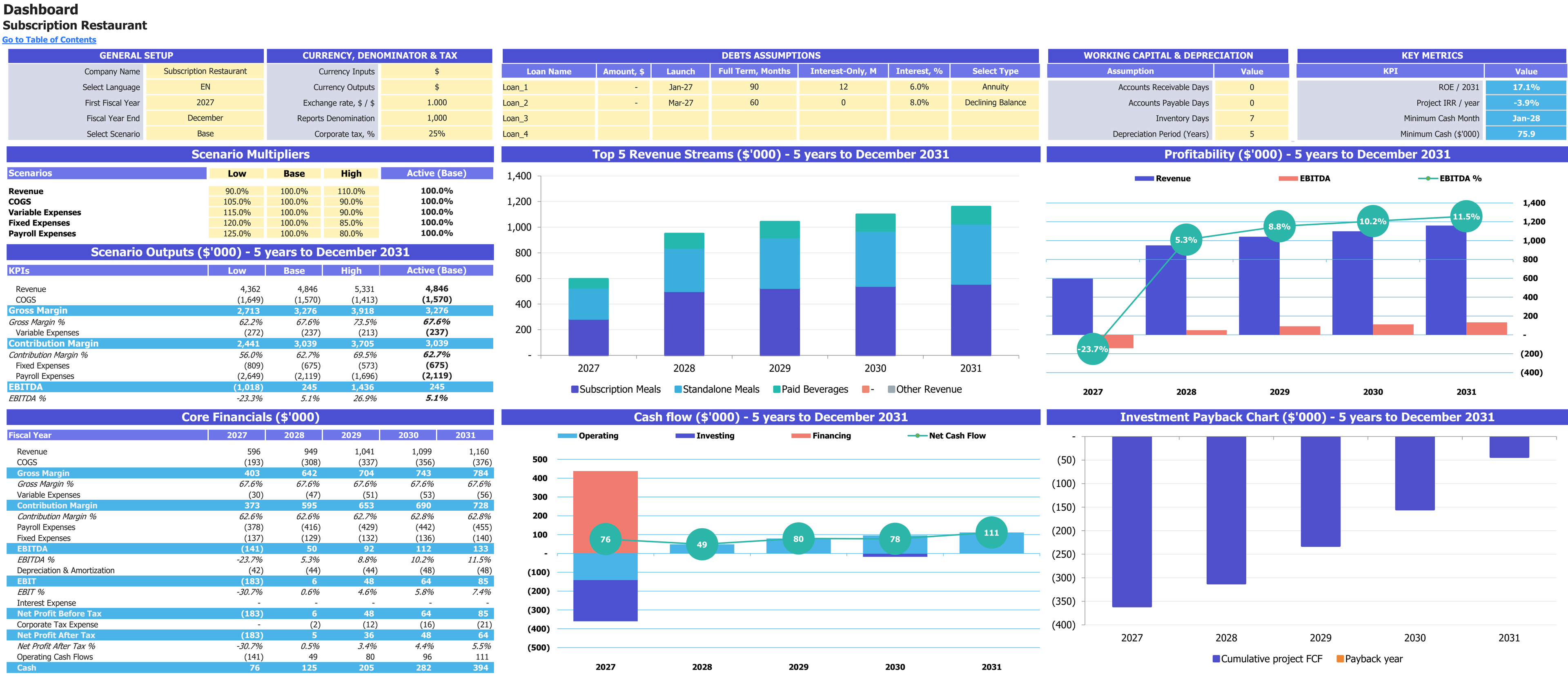
Base-case scenario controls, annual financial results and charts for 2027–2031. Financial report amounts are shown in thousands of USD; percentage measures retain their own units.
Enlarge image in a new tab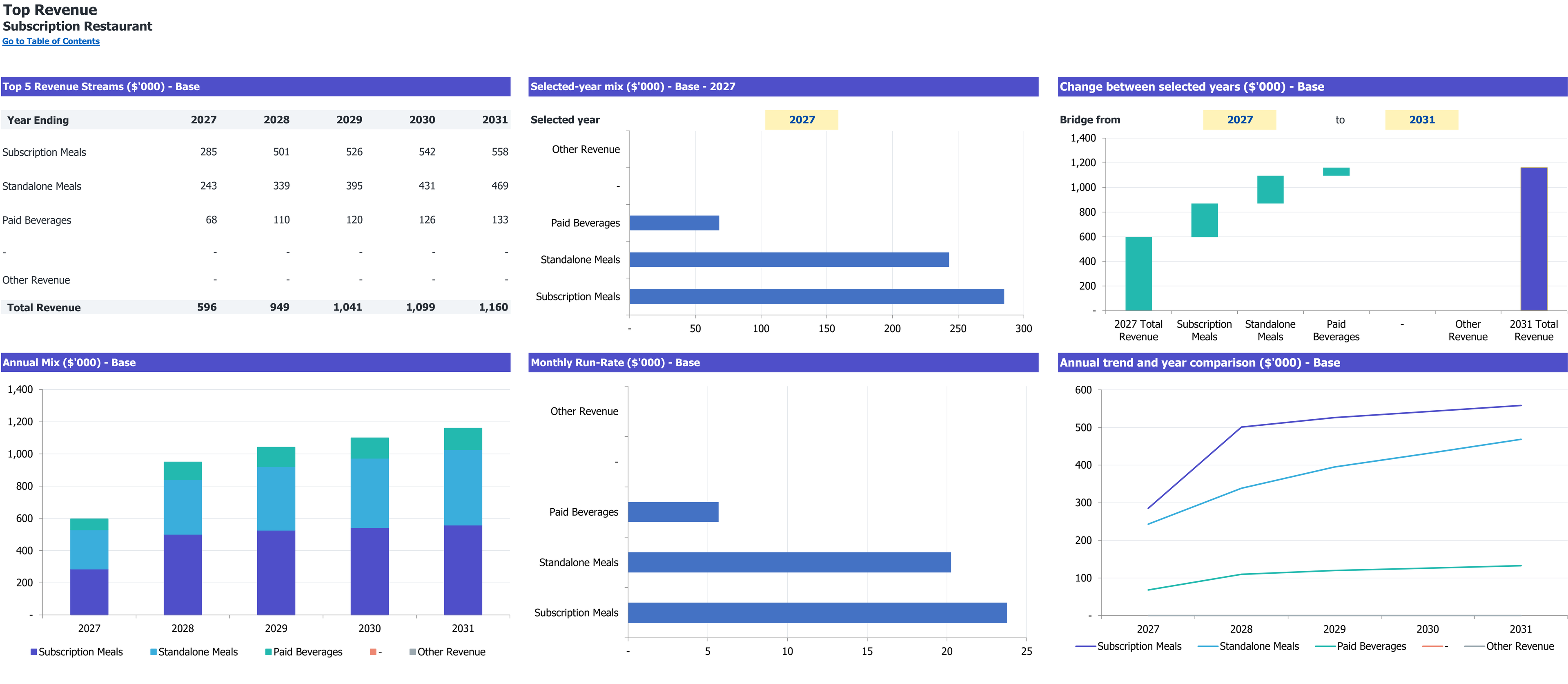
Revenue summary for 2027–2031 and selected-year comparison, in thousands of USD.
Enlarge image in a new tab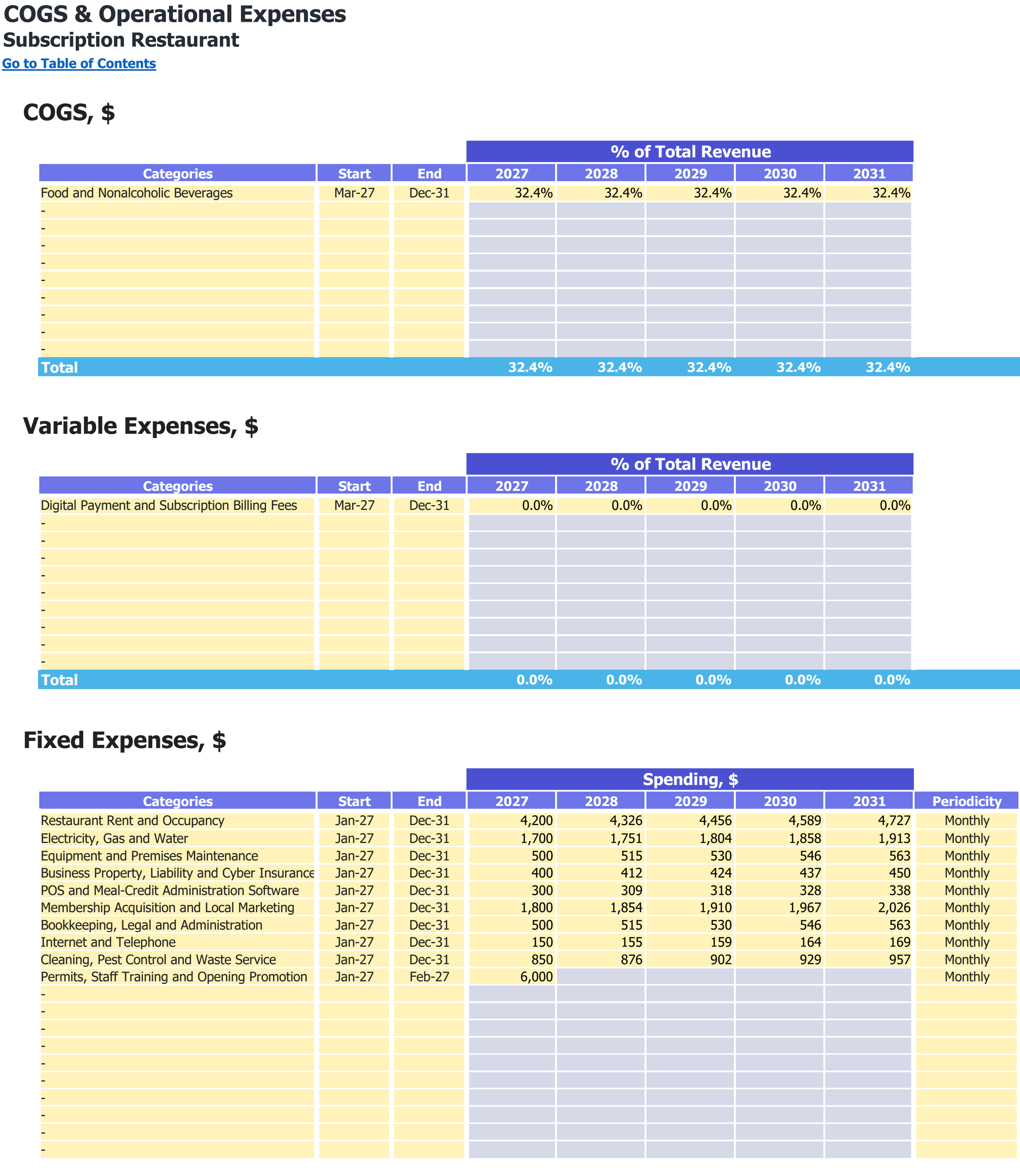
Food and other direct-cost categories, variable expense shares and fixed operating expenses. Monetary inputs are USD; the annual percentage columns are cost shares of revenue.
Enlarge image in a new tab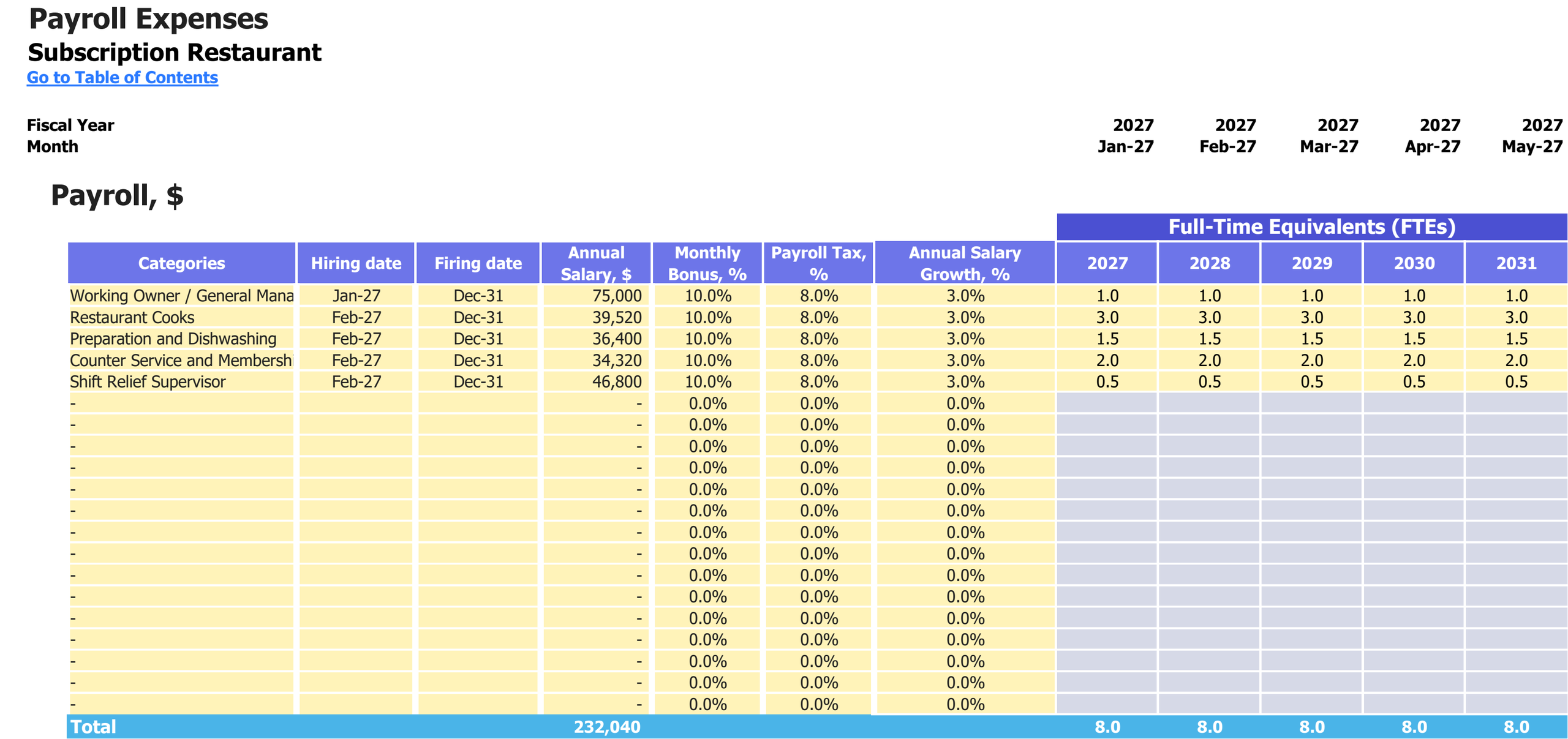
Paid roles, annual salary and employer-load assumptions, with staffing in full-time equivalents for 2027–2031. Salary amounts are USD; percentages and FTEs are labelled separately.
Enlarge image in a new tab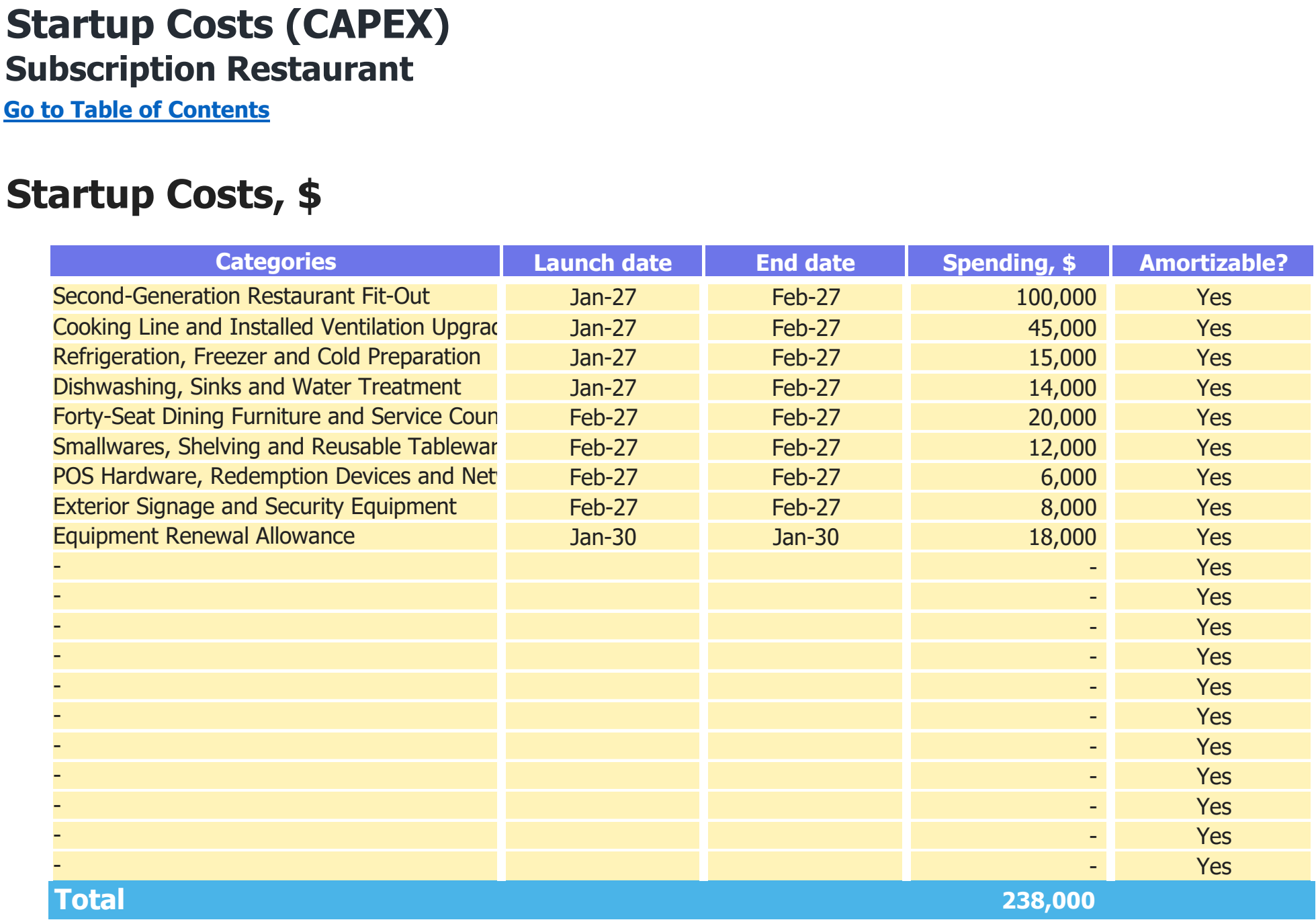
Asset categories, purchase dates and spending assumptions in USD. The total includes every scheduled purchase shown, including later replacements where present.
Enlarge image in a new tab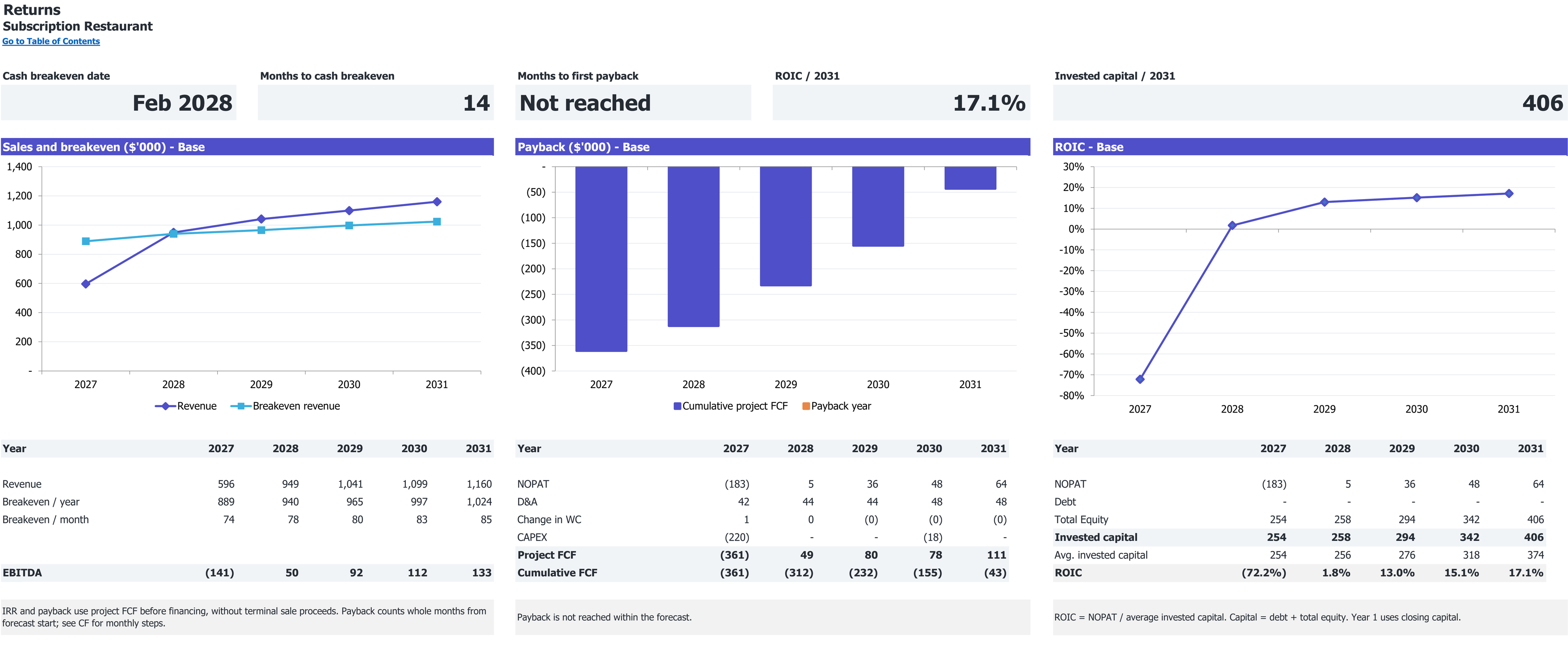
Excerpt from Returns: cumulative project free cash flow and first payback, if reached. 2027–2031 base case; dollar amounts in thousands.
Open full Returns view in a new tabExcerpt from Returns: revenue, annual and monthly break-even revenue, and EBITDA. 2027–2031 base case; dollar amounts in thousands.
Open full Returns view in a new tab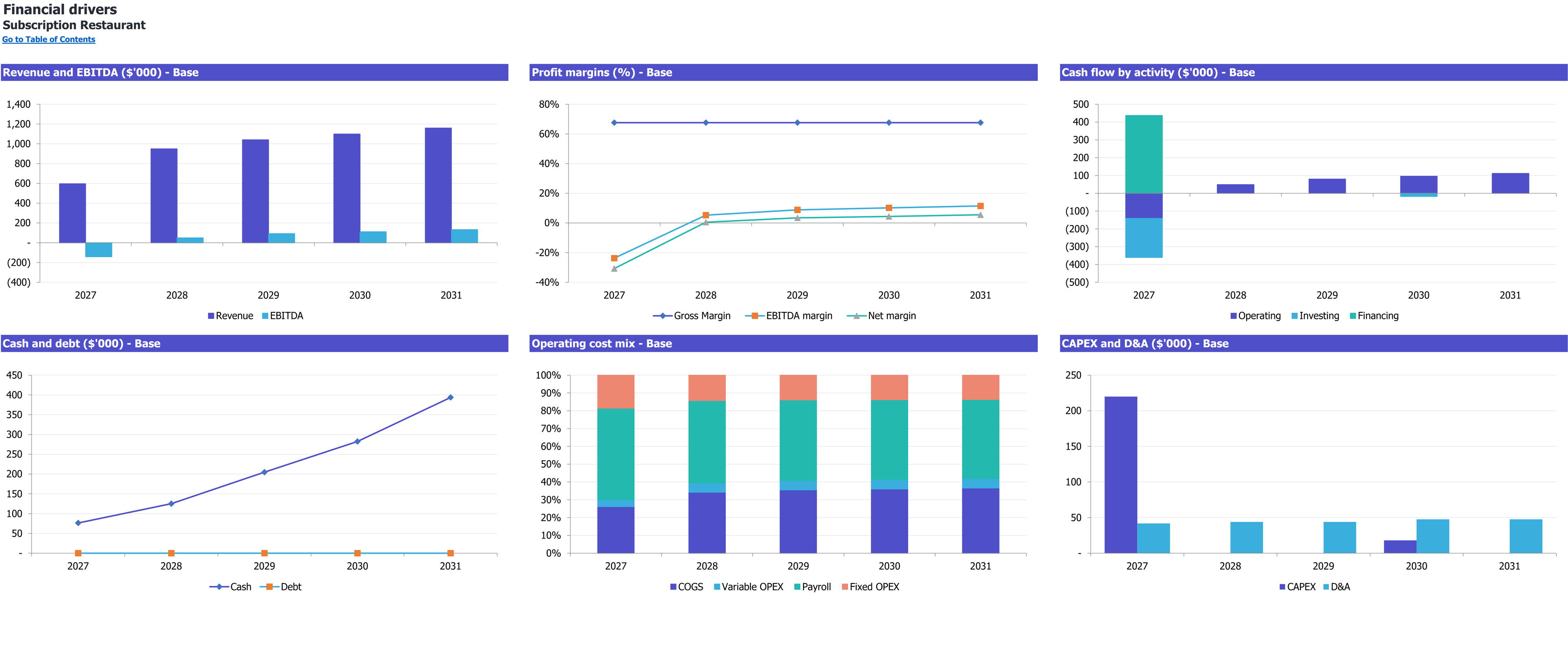
Six annual financial-driver charts for Subscription Restaurant, 2027–2031 (Base scenario). Dollar amounts are in thousands; margins and cost mix are percentages.
Enlarge image in a new tab8 selected worksheet views. Figures show this workbook’s starting case.
Workbook overview
What is inside the Excel model
Track prepaid meal credits from membership billing through redemption, carryover and refunds. Combine subscriber and standalone visits within one funded restaurant capacity and follow the resulting cash obligations.
Selected worksheets from the documented workbook. Forecast period: January 2027–December 2031. Model reference: PHY001-17.
Inputs you control. Results you can inspect.
On a small screen, scroll within the table to read every column.
| Planning area | Inputs you review | How they connect | Results to inspect |
|---|---|---|---|
| Membership | 250 opening joining requests; 94% renewal; 500-member ceiling. | Prioritize renewals and cap admissions by full entitlements after carried credits. | Accepted members, nonrenewals and waitlisted requests. |
| Credit behavior | 85% current use; 60% next-month carried use. | Retain unused credits for one extra month and refund older unused rights. | Redemption revenue and advance liabilities. |
| Shared capacity | Peak seating, 40 equipment meals/hour and funded cooks/counter. | Serve carried credits first, then new credits, then standalone meals. | Fulfilled meal visits and lost standalone demand. |
| Cost method | 32.4% food/beverage budget; paid owner and staff. | Apply the preserved percentage-cost and payroll schedules. | Operating margins without a physical ingredient recipe. |
| Investment and cash | $220,000 initial CAPEX; $18,000 renewal; $437,000 equity. | Reconcile credit billings, releases and refunds with project cash. | Reserve coverage and investment recovery. |
Is this the right model for your business?
Check the starting case before changing the assumptions.
The starting operation
- A restaurant selling prepaid bundles of identifiable meal credits.
- An operator combining memberships with standalone meal customers.
- A team testing carryover, refunds and capacity-led admissions.
Check the boundary
The case is not an unlimited-access subscription, breakage-revenue model, recipe-cost system or transaction-level membership administration tool.
Compare the other restaurant typesHow this business makes money
Connect the unit sold to the resources required by this operating case.
Revenue logic
Redeemed meal credits and standalone meals earn revenue, with separately purchased beverages.
Unused credits remain advances or are refunded; the case recognizes no breakage revenue.
Why does a membership limit need to consider unused meal credits?
Paid credits remain service or refund obligations after the original billing month. The model reserves capacity for carried rights before accepting new entitlements, then gives those carried meals first priority. Billing growth alone therefore cannot establish earned growth or available capacity.
- Entitlement
- Eight meals per admitted monthly member
- Carryover
- One additional month, then refund at issue price
- Priority
- Carried credits before new credits and standalone meals
What to establish for your own operation
- Validate renewal and redemption behavior with actual customer evidence.
- Reconcile billings, redemptions, refunds and liabilities.
- Test capacity and refund liquidity separately from acquisition growth.
Follow the plan from demand to cash
Open each section for the assumptions, calculations, and limits of this workbook’s starting case.
Earn revenue when meal credits are redeemedRevenue
The initial $88 plan contains eight credits valued at $11 each. Renewals take priority over new members, and admissions are capped by the full entitlement capacity after outstanding carried credits. No rejected or waitlisted request is charged.
Unused new credits carry one additional month. Older unused credits are automatically refunded at their original issue price, including across year boundaries. Cancellation ends future renewal without cancelling paid rights. The case recognizes no breakage revenue.
- Opening advances plus billings less earned releases and refunds equals closing advances.
- Expected cohort counts can be fractional; this is not a customer account ledger.
- Beverages attach to existing meal visits without creating extra meal capacity.
Share one kitchen between members and standalone guestsPayroll
Carried meals are served first, followed by current credits and standalone meals. Seats, peak occupancy, equipment, paid cooking and counter resources all limit the same meal flow. The starting standalone meal costs $14 and a paid beverage $3.50.
Food and beverages use a 32.4% earned-revenue budget, not recipe quantities or waste measurements. Payroll includes a $75,000 owner salary, cooks, preparation/dishwashing, membership counter staff and relief. The loaded wage multiplier is 1.188.
- Food cost changes through its preserved scenario convention, not a physical demand simulation.
- Subscription billings add a recurring-billing fee to successful-charge fees.
- Original successful-charge fees are not reversed when unused credits are refunded.
Budget opening assets and the refund obligationCAPEX
Initial CAPEX is $220,000 for second-generation fitout, kitchen systems, dining, tableware and redemption hardware. January 2030 adds $18,000 renewal spending. Assets use a global five-year purchase-month depreciation method.
January equity of $437,000 covers the worst unfinanced cash deficit plus a $75,000 minimum month-end reserve. There is no debt or later contribution. Minimum funded cash is $75,856 in January 2028.
- The reserve is separate from the opening asset budget.
- No restricted refund escrow or daily settlement volatility is modeled.
- Outstanding advances remain customer obligations at the end of the forecast.
Distinguish operating progress from capital recoveryCF
Base 2027 revenue is $596,367 and EBITDA is −$141,390. Monthly EBITDA first becomes positive in February 2028 and stays positive; operating cash first turns positive in the same month.
Project payback is not reached within 60 months. Cumulative undiscounted project cash ends at −$43,301 after startup and renewal capital. December 2031 cash is $393,699, including $7,428 customer advances.
- The Worst monetary scenario gives −$801,191 minimum cash with original equity fixed.
- The 120-member limit test produces a larger funding gap.
- Multiple project cash-flow sign changes retain the native IRR warning; no owner dividends are modeled.
Selected results from the starting case
Modeled results in USD unless stated otherwise. These describe the selected inputs, not an estimate for your location or a guaranteed outcome.
- 2027 earned revenue
- $596,367USD, Base; redeemed meals, standalone meals and beverages.
- 2027 EBITDA
- −$141,390USD, Base; includes January–February startup.
- Initial CAPEX
- $220,000USD; before opening, with $18,000 additional renewal in January 2030.
- Minimum cash
- $75,856USD, funded Base balance in January 2028.
- Project payback
- Not reached within 60 monthsCumulative undiscounted project FCF remains −$43,301 at December 2031.
Make the case your own
Work from the operating plan toward the cash requirement.
Set plan entitlements, prices, renewal and carryover policies.
Validate paid production and peak seating capacity.
Replace premises, payroll and percentage-cost budgets.
Review outstanding credits, downside funding and cumulative project cash.
Interpretation and scope
- This is a national analytical offer, not an existing chain’s subscription policy.
- Expected cohorts are not individual account records or a refund-administration system.
- Food cost is an approved percentage budget rather than recipe costing.
- Same-month settlement excludes processor receivables crossing month end.
- The 25% tax rate has no chosen jurisdiction or cross-year loss carryforward; return-pattern warnings remain.
The workbook is an Excel file for local planning. Learn how to interpret assumptions and evidence.
Other restaurant types
Each operating type calls for its own financial structure.
Questions
Are monthly billings immediately revenue?
No. Revenue is earned on modeled redemptions; undelivered credits remain advances.
What happens to unused credits?
They carry for one extra month; older unused credits are refunded at their original issue price.
Does cancellation erase paid meal rights?
No. It stops future renewal while preserving existing rights.
Does each drink use another meal slot?
No. Drinks attach to meal visits and are tracked separately.
Can funded cash be treated as owner profit?
No. It includes equity and outstanding customer advances; project payback is not reached.
What if a purchased file is damaged or cannot be downloaded?
See the refund and replacement policy for file correction, replacement and download assistance. Keep the product name and your order reference when requesting help.
Which software does the workbook use?
The documented file is an Excel workbook (.xlsx). Compatibility with other spreadsheet applications is not established by the file extension.
Read the planning guides
Explore the relevant operating questions and how to interpret a workbook’s assumptions.
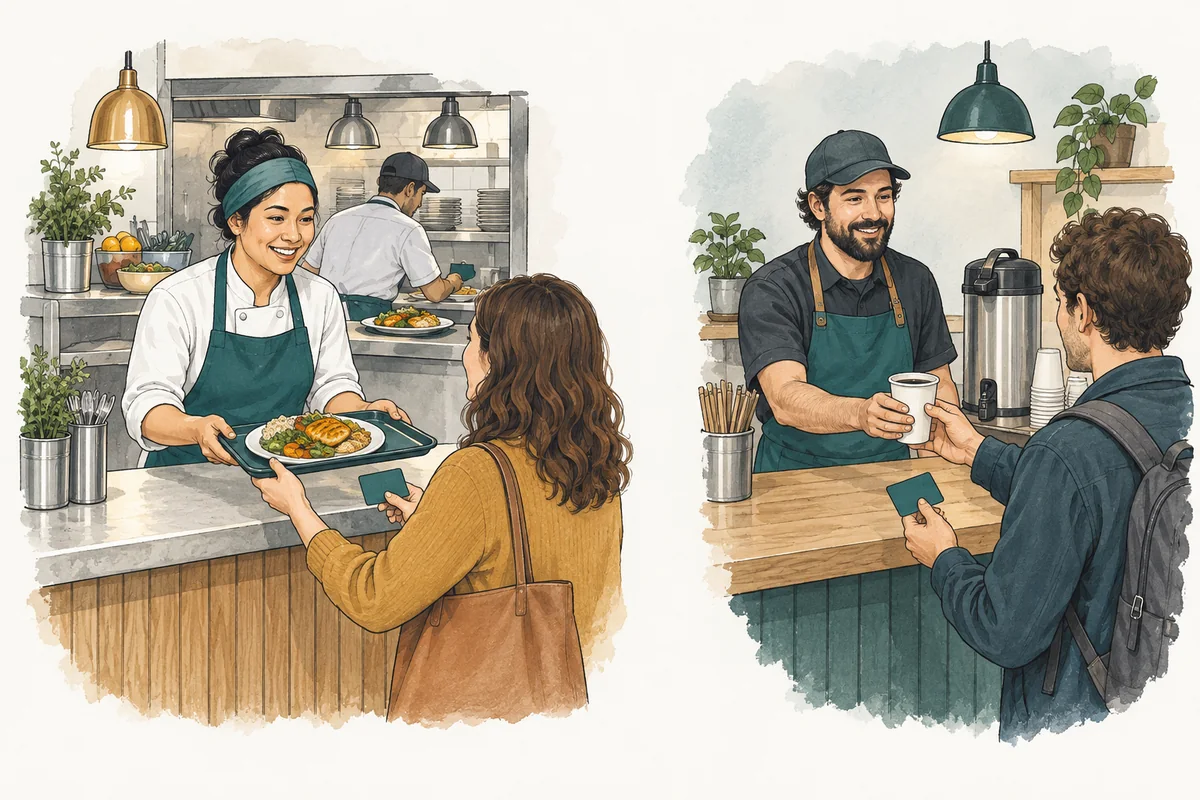
How should food and coffee subscriptions separate members, use and earned revenue?
Compare refundable meal credits with an expiring monthly coffee service, tracing membership billing, redemption, capacity, refunds, and customer advances.
Read the guide
How to read financial assumptions before editing an Excel model
Follow the chain from operating assumptions to calculated results, check units and timing, and keep a useful record of changes to a financial workbook.
Read the guideEvidence and scope
Primary operator examples support only the operating features described in the source registry. This full configuration, all formulas, local feasibility and numerical economics remain analyst-authored and unverified.
The links below provide operating-format context; they do not verify the workbook’s selected inputs or calculated returns.
The workbook guide and figures describe model PHY001-17, revision r02, for January 2027–December 2031. These are a documented planning case, not observed results for a particular business.