
Coffee Shop Financial Model: Subscription Coffee Shop
Plan brewed-coffee memberships alongside paid drinks and pastries, with redemption priority, capacity credits, usage costs and startup funding.
- Excel (.xlsx)
- Premises: 1,200 sq ft second-generation cafe
- Membership: $24.99/month / maximum 30 included drinks
- Staff and service: Paid owner + three baristas / ten hours daily
Planning several types? Compare 8 coffee shop formats
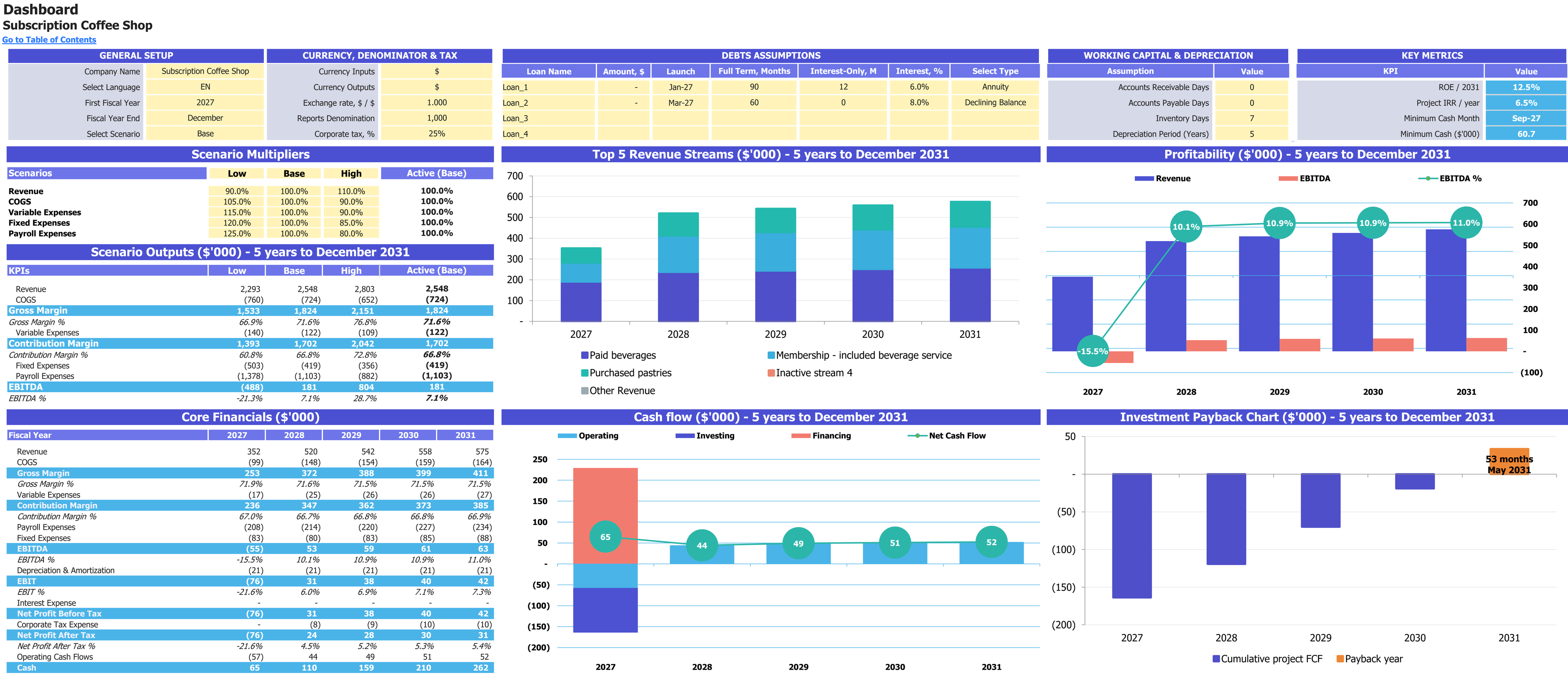
Base-case scenario controls, annual financial results and charts for 2027–2031. Financial report amounts are shown in thousands of USD; percentage measures retain their own units.
Enlarge image in a new tab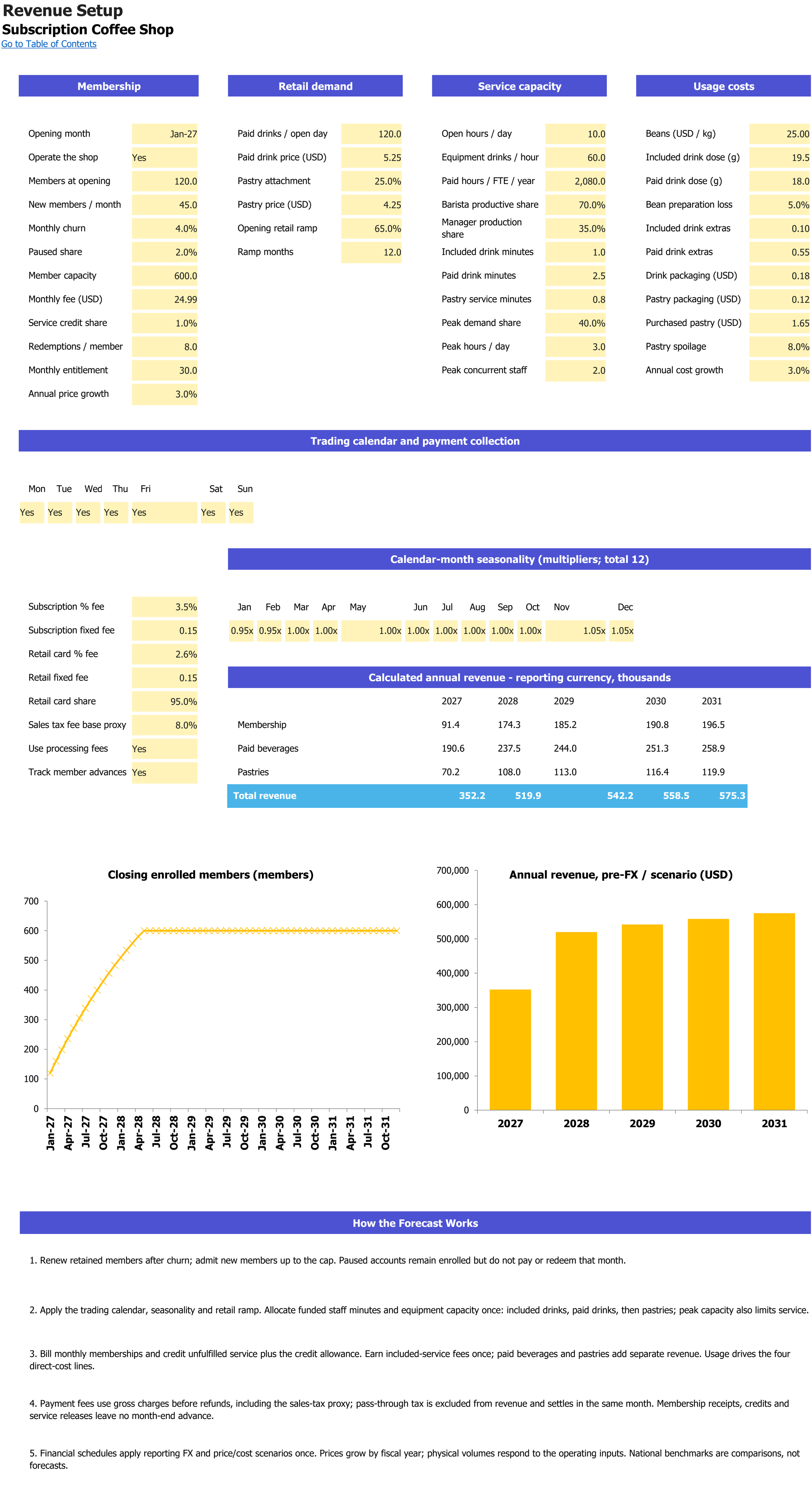
Membership enrollment, redemptions, paid drinks and pastries with shared service capacity. Monetary inputs and sales use USD; operating volumes retain their labelled units. Forecast years are 2027–2031.
Enlarge image in a new tab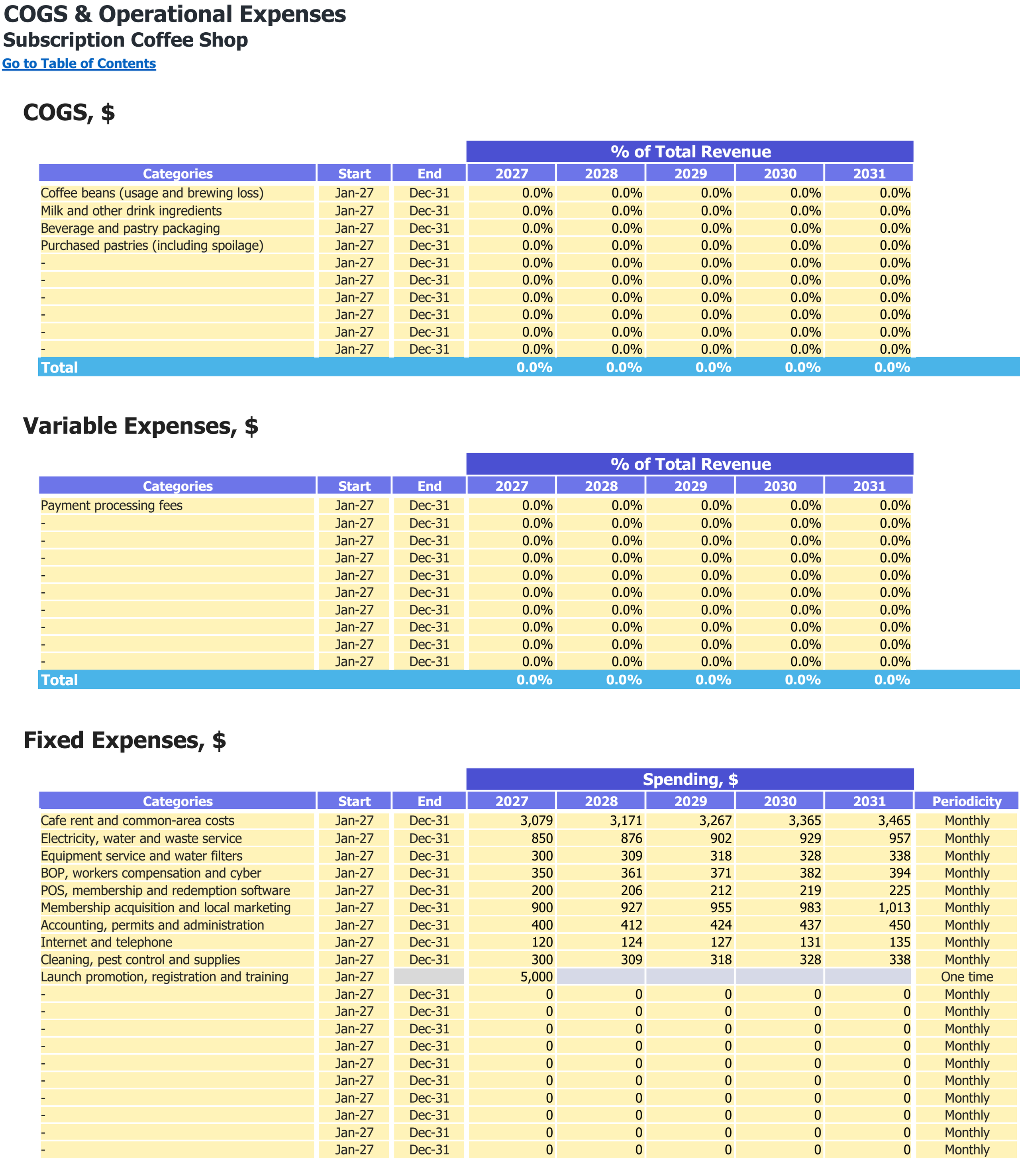
Food and other direct-cost categories, variable expense shares and fixed operating expenses. Monetary inputs are USD; the annual percentage columns are cost shares of revenue.
Enlarge image in a new tab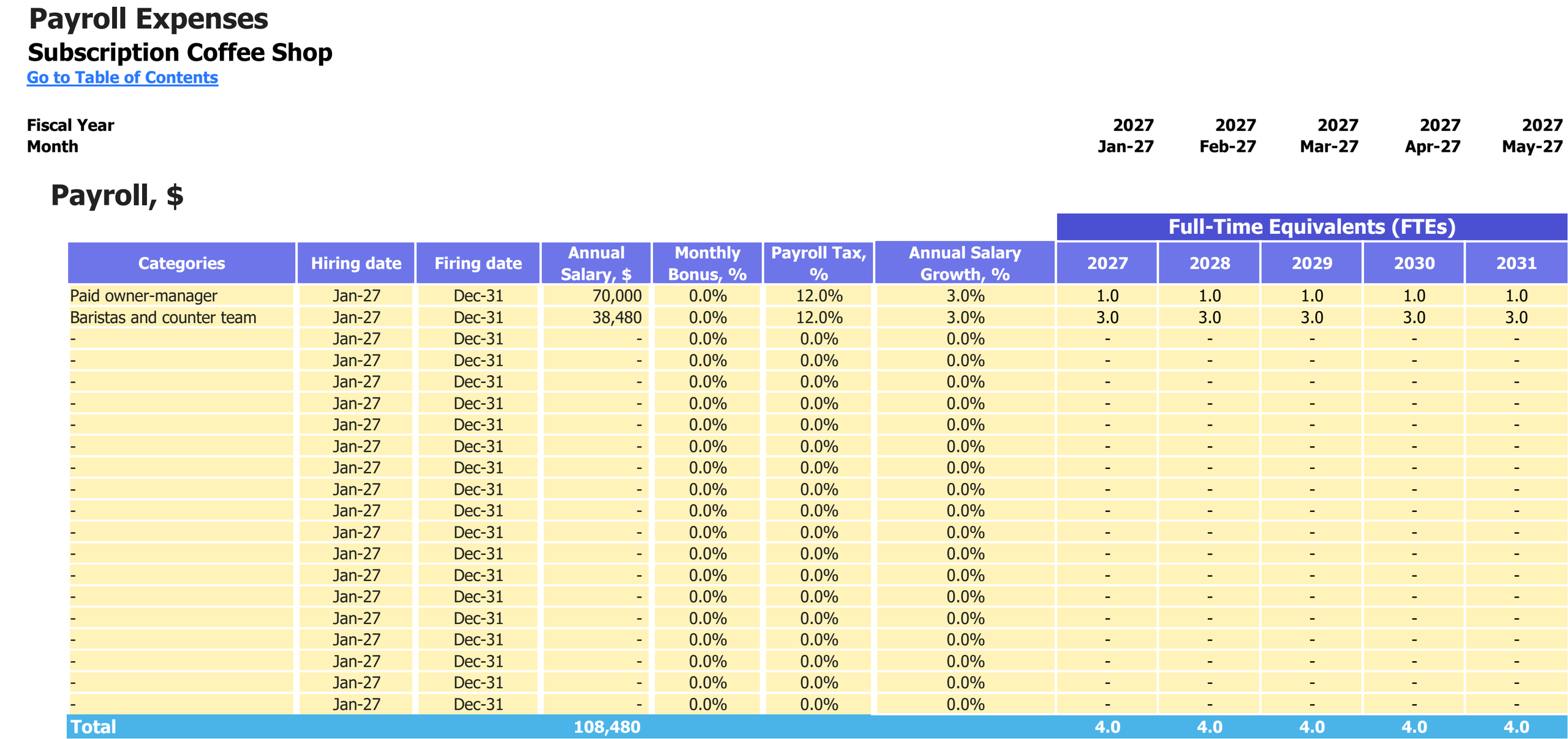
Paid roles, annual salary and employer-load assumptions, with staffing in full-time equivalents for 2027–2031. Salary amounts are USD; percentages and FTEs are labelled separately.
Enlarge image in a new tab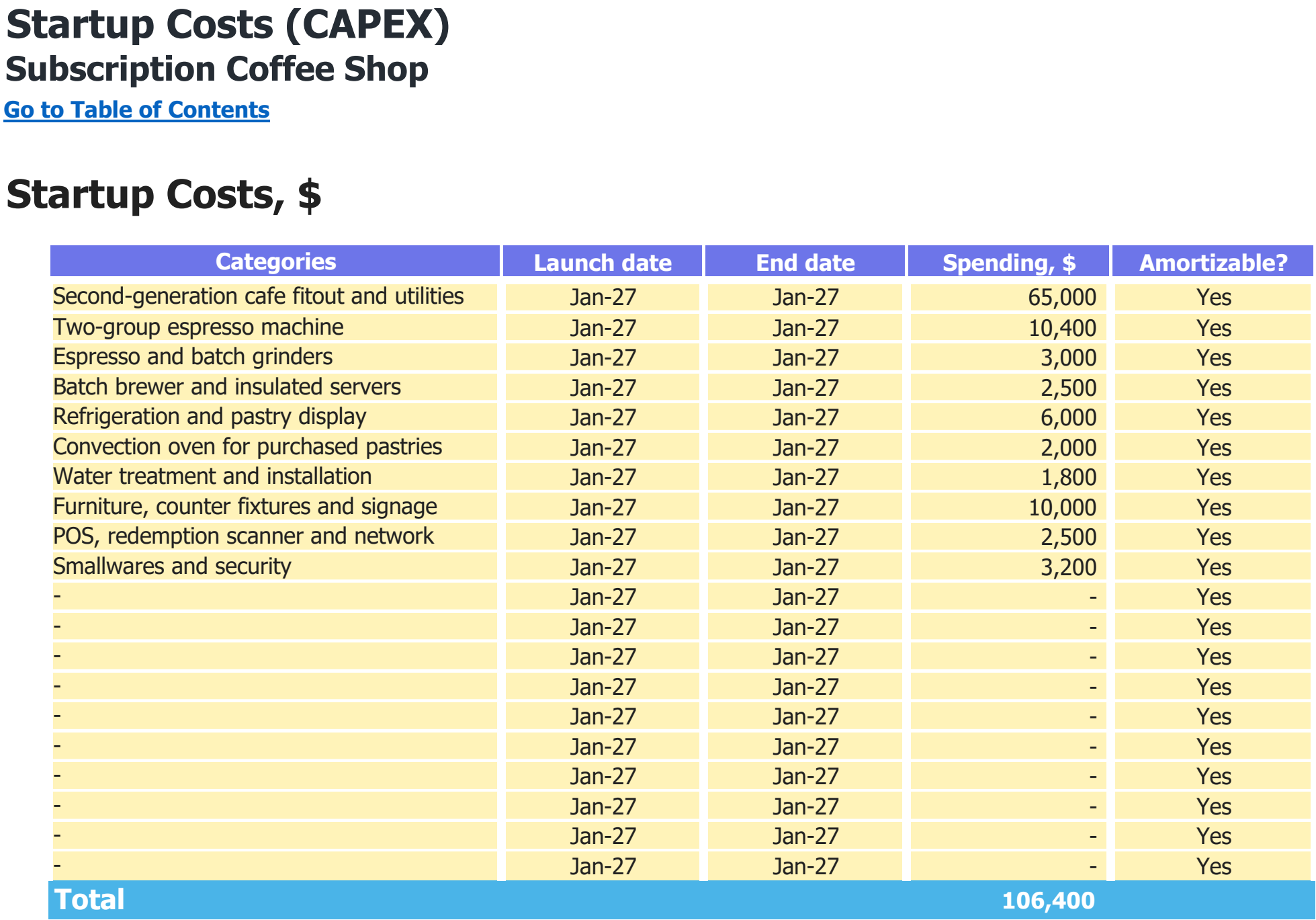
Asset categories, purchase dates and spending assumptions in USD. The total includes every scheduled purchase shown, including later replacements where present.
Enlarge image in a new tab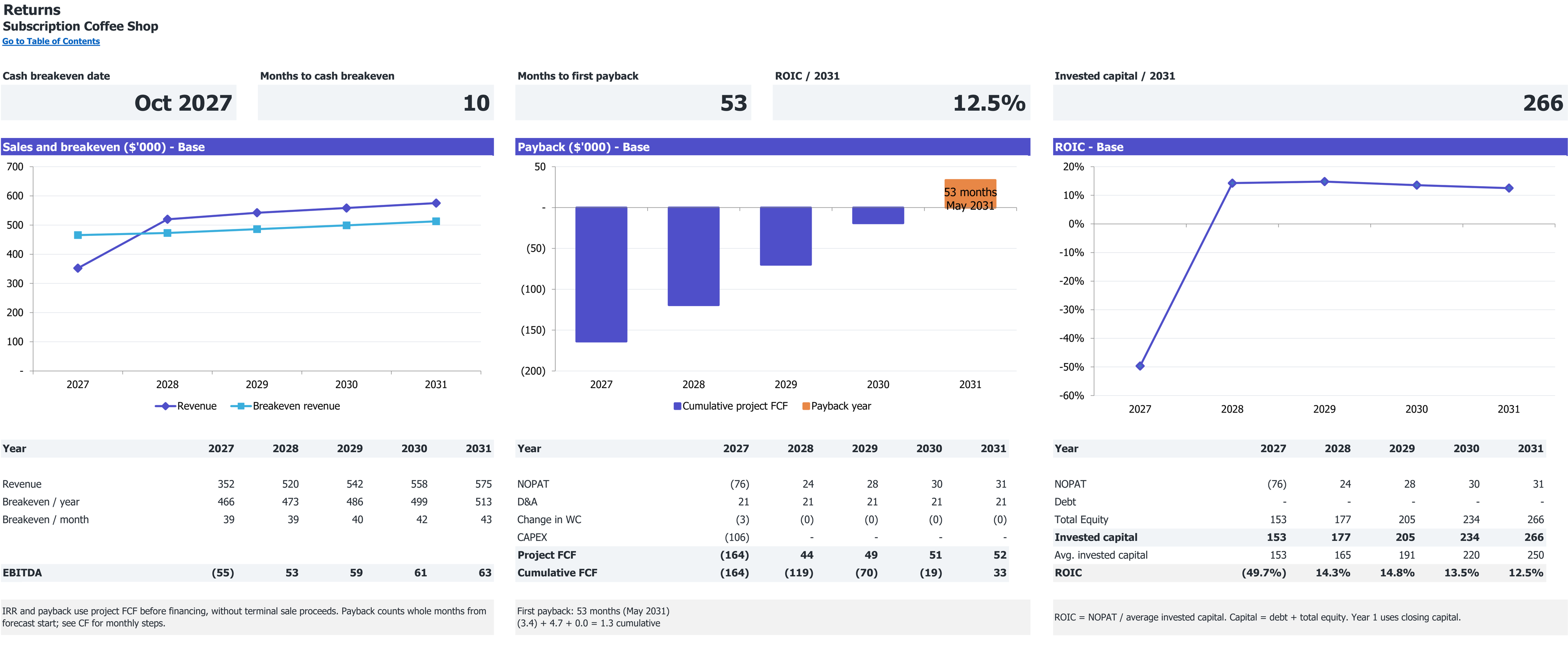
Excerpt from Returns: cumulative project free cash flow and first payback, if reached. 2027–2031 base case; dollar amounts in thousands.
Open full Returns view in a new tabExcerpt from Returns: revenue, annual and monthly break-even revenue, and EBITDA. 2027–2031 base case; dollar amounts in thousands.
Open full Returns view in a new tab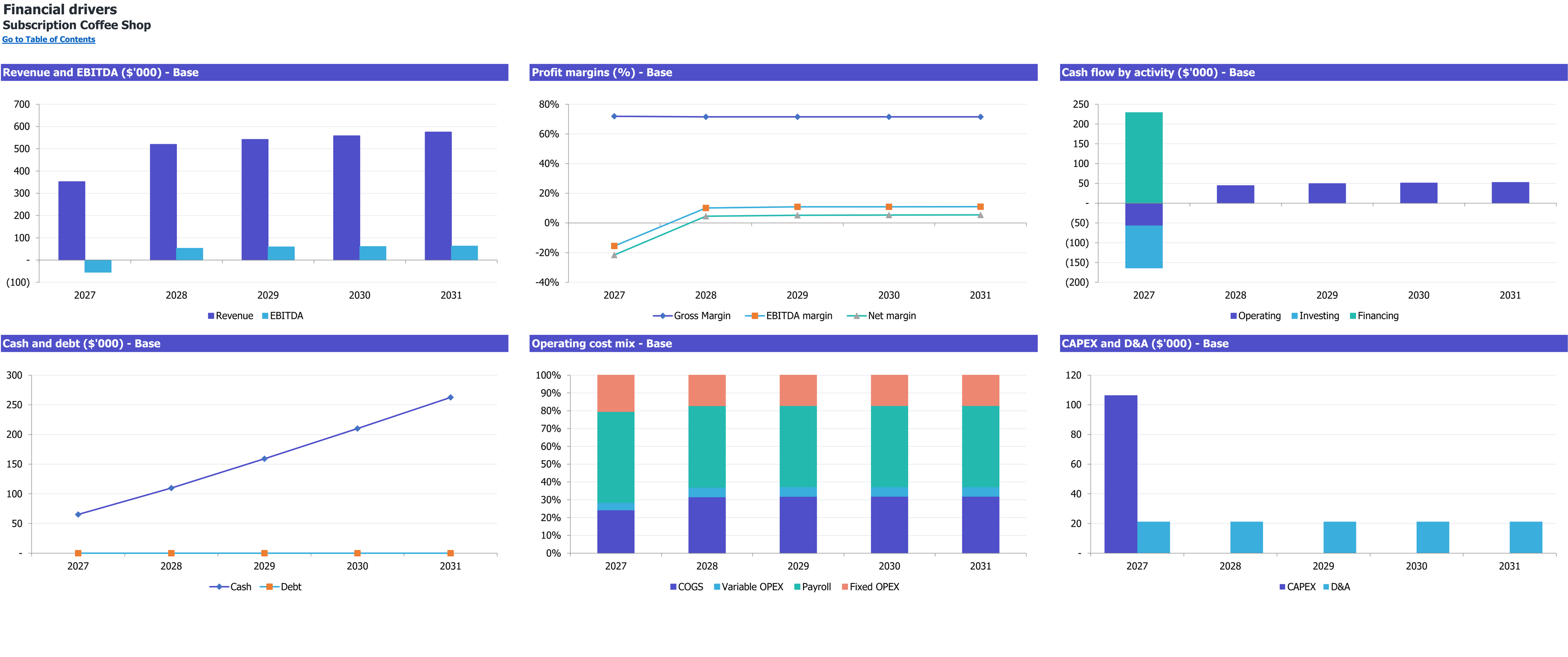
Six annual financial-driver charts for Subscription Coffee Shop, 2027–2031 (Base scenario). Dollar amounts are in thousands; margins and cost mix are percentages.
Enlarge image in a new tab8 selected worksheet views. Figures show this workbook’s starting case.
Workbook availability
What is inside the Excel model
Test how subscription usage competes with paid drinks and pastries for the same staff and equipment. Track membership credits and actual ingredient consumption separately from the monthly fee.
Selected worksheets from the documented workbook. Forecast period: January 2027–December 2031. Model reference: PHY002-08.
Inputs you control. Results you can inspect.
On a small screen, scroll within the table to read every column.
| Planning area | Inputs you review | How they connect | Results to inspect |
|---|---|---|---|
| Members | 120 launch members; 45 monthly new members; 4% churn; 2% pauses. | Renew and admit accounts subject to the 600-member ceiling. | Enrolled, billed and active service cohorts. |
| Redemption | Eight expected monthly uses before seasonality; service-credit policy. | Serve included requests first and credit unfulfilled service proportionally. | Earned membership fees and included-drink workload. |
| Retail | 120 paid drinks/day before ramp; pastries attach to all drinks. | Allocate remaining staff/equipment capacity after included drinks. | Paid drink and pastry sales. |
| Usage costs | Different included/paid recipes; 5% bean loss; 8% pastry spoilage. | Calculate actual physical usage through the approved cost interface. | COGS independent of pure price-scenario changes. |
| Funding | $106,400 initial CAPEX; $229,000 equity; $60,000 reserve. | Cover launch losses and stock in the monthly cash curve. | Funded minimum cash and project payback. |
Is this the right model for your business?
Check the starting case before changing the assumptions.
The starting operation
- A neighborhood cafe offering brewed-coffee memberships.
- An operator combining included drinks with paid specialty drinks and pastries.
- A team evaluating retention, service credits and shared capacity.
Check the boundary
The saved offer excludes premium espresso from membership, annual subscription deferrals, entitlement carryover, delayed settlement and owner distributions.
Compare the other coffee shop typesHow this business makes money
Connect the unit sold to the resources required by this operating case.
Revenue logic
Earned monthly membership fees, separately paid drinks and pastries form three revenue streams.
Included brewed drinks are never billed again; unused monthly entitlements expire.
Can higher subscription use reduce the cafe’s earnings?
It can increase ingredients and consume scarce staff minutes without changing the fixed membership fee. Because included drinks have priority, more use can also displace paid drinks or pastries. Retention and redemption therefore need to be tested together.
- Included service
- Brewed drinks before paid retail demand
- Cost basis
- Actual drink recipes and pastry procurement
- Capacity
- Total staff time plus peak-window constraints
What to establish for your own operation
- Measure expected redemptions and peak timing.
- Test service credits when requests exceed capacity.
- Assess paid retail displacement alongside member acquisition.
Follow the plan from demand to cash
Open each section for the assumptions, calculations, and limits of this workbook’s starting case.
Track billed membership separately from included drinksRevenue
The independent offer starts at $24.99 per month for brewed coffee. Expected redemptions are eight before seasonality, capped at thirty. Paused accounts remain enrolled but are neither billed nor served; unused monthly entitlements expire.
Membership billings are reduced by a 1% service-credit allowance and proportional credits for unfulfilled requests. Included drinks receive first priority, paid drinks second and pastries last. More usage can consume capacity without raising the fixed membership fee.
- Premium espresso is outside the included offer.
- Included beverages are not recorded as another sale.
- Same-month charges, refunds and earned releases leave no closing customer advance.
Cost consumption even when the fee stays fixedPayroll
Included brewed and paid drinks have different doses, other ingredients and preparation times. Beans carry one 5% preparation loss; purchased pastries carry 8% spoilage. Packaging applies to the relevant served products.
One owner-manager receives $70,000 starting annual pay and three baristas each receive $38,480. Productive shares and a separate peak-window limit constrain service. Wage changes alter cost; funded headcount alters available capacity.
- The approved cost interface follows actual usage, not a fixed percentage of membership sales.
- Original processing fees remain on charges later refunded or credited.
- A pastry attached to an existing paid-drink ticket does not create another payment charge.
Fund the loss-making membership rampCAPEX
January CAPEX totals $106,400 for fitout, espresso and batch equipment, refrigeration/display, purchased-pastry baking, furniture and redemption hardware. All assets use five-year book depreciation. No replacement investment or terminal sale is included.
Initial equity is $229,000 with no debt. The peak project funding need is $168,320 before financing, leaving minimum cash of $60,680 in September 2027 against a $60,000 reserve objective.
- The reserve is a retained balance, not an expense.
- Seven inventory days follow usage costs; AR and AP are zero.
- Daily cash timing and annual plan deferrals are outside the saved method.
Compare membership growth with the time needed to recover investmentCF
Base 2027 revenue is $352,181 and EBITDA is −$54,710. Monthly EBITDA and operating cash first become positive in October 2027; EBITDA stays positive thereafter. No universal break-even drink count is implied.
Project payback occurs in May 2031, month 53, and remains nonnegative. It is cumulative undiscounted cash recovery after CAPEX, operating deficits and working capital, before owner funding and without sale proceeds.
- The five-year net project cash surplus is $33,499.
- Retained business cash is not an owner dividend.
- Retention, usage and retail displacement remain central uncertainties.
Selected results from the starting case
Modeled results in USD unless stated otherwise. These describe the selected inputs, not an estimate for your location or a guaranteed outcome.
- 2027 revenue
- $352,181USD, Base; net membership fees, paid drinks and pastries.
- 2027 EBITDA
- −$54,710USD, Base; paid owner and barista costs included.
- Initial CAPEX
- $106,400USD; January 2027 cafe and service equipment.
- Minimum cash
- $60,680USD, funded Base balance in September 2027.
- Project payback
- May 2031 / month 53Cumulative undiscounted project cash recovery; no later reversal or owner distribution.
Make the case your own
Work from the operating plan toward the cash requirement.
Set membership pricing, churn, pauses and expected usage.
Validate service priority, staff minutes and peak demand.
Replace recipe, pastry procurement and cafe budgets.
Review credited revenue, usage costs, reserve and long project recovery.
Interpretation and scope
- This independent US offer is not a chain’s policy or a verified local acquisition forecast.
- Monthly and peak-window capacity do not simulate queues.
- Same-month settlement excludes annual deferrals and delayed receipts.
- The 25% tax allowance has no selected jurisdiction or loss carryforward.
- Absolute payroll, expense, asset and funding dates require review after calendar changes.
The workbook is an Excel file for local planning. Learn how to interpret assumptions and evidence.
Other coffee shop types
Each operating type calls for its own financial structure.
Questions
Are included drinks charged again?
No. They are delivered against the membership fee.
Do unused entitlements carry into next month?
No. They expire under the saved offer.
Are paused members billed?
No. They remain enrolled but receive neither billing nor service for the paused month.
Do more members automatically mean more retail revenue?
No. Included drink requests can consume capacity that would otherwise serve retail sales.
Are closing customer advances recorded?
No. Membership cash, credits and earned releases settle within the same calendar month.
Can I buy this model now?
No. Purchasing and workbook downloads are not available on this site.
Which software does the workbook use?
The documented file is an Excel workbook (.xlsx). Compatibility with other spreadsheet applications is not established by the file extension.
Read the planning guides
Explore the relevant operating questions and how to interpret a workbook’s assumptions.
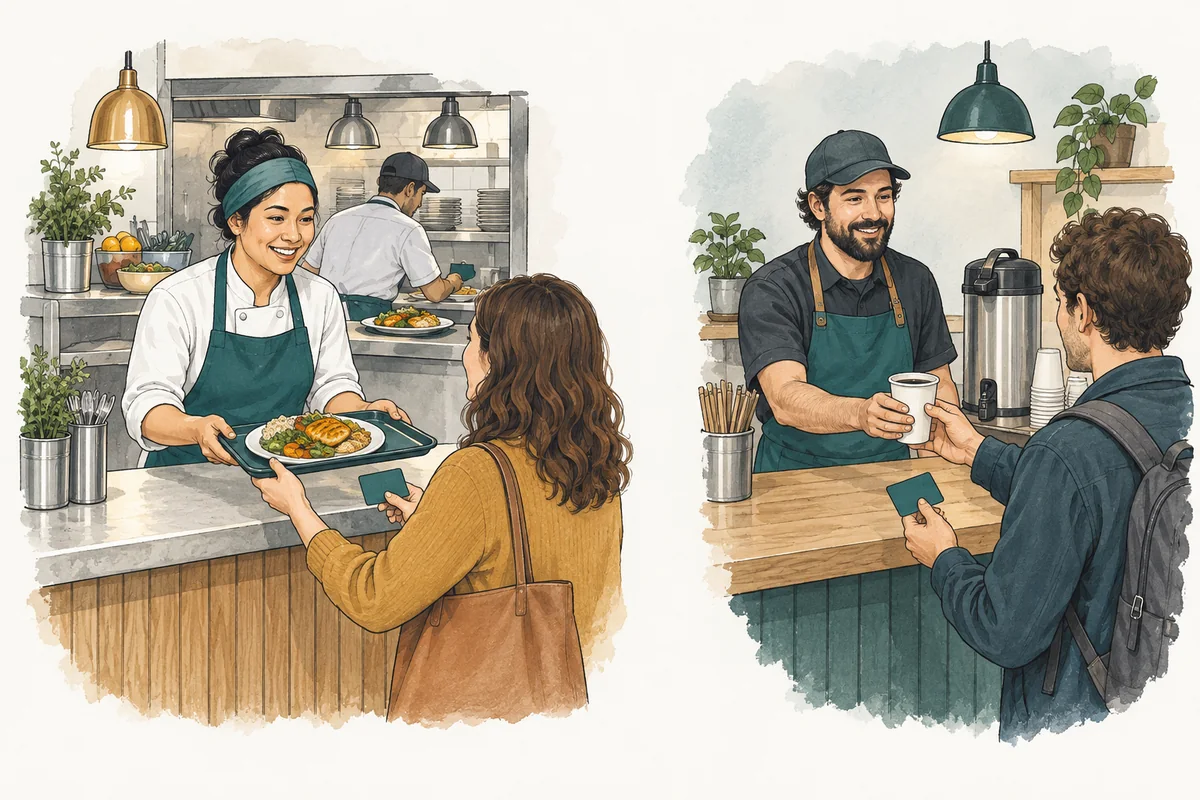
How should food and coffee subscriptions separate members, use and earned revenue?
Compare refundable meal credits with an expiring monthly coffee service, tracing membership billing, redemption, capacity, refunds, and customer advances.
Read the guide
How to read financial assumptions before editing an Excel model
Follow the chain from operating assumptions to calculated results, check units and timing, and keep a useful record of changes to a financial workbook.
Read the guideEvidence and scope
Current terms support paid beverage subscriptions with defined eligible drinks and redemption limits. Do not inherit historical unlimited terms, assume all drinks are included, or infer national pricing or retention.
The links below provide operating-format context; they do not verify the workbook’s selected inputs or calculated returns.
The workbook guide and figures describe model PHY002-08, revision r01, for January 2027–December 2031. These are a documented planning case, not observed results for a particular business.