
Restaurant Financial Model: Dinner-Show Restaurant
Plan dinner-show tickets, synchronized meal service, performers, customer advances and startup funding in a five-year Excel case.
- Excel (.xlsx)
- Venue: 5,500 sq ft / 150-guest ceiling
- Schedule: One show Wednesday–Sunday
- Opening: March 2027 after two startup months
Planning several types? Compare 17 restaurant formats
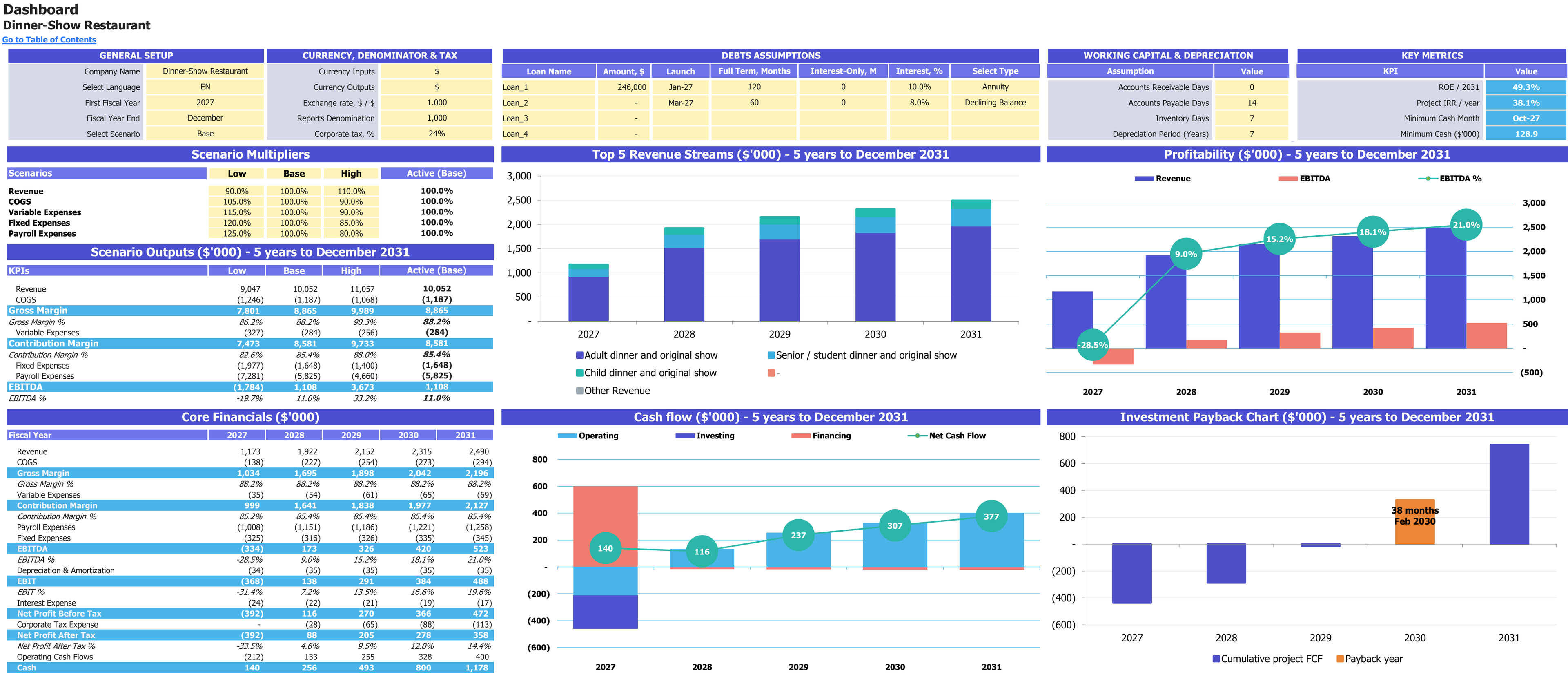
Base-case scenario controls, annual financial results and charts for 2027–2031. Financial report amounts are shown in thousands of USD; percentage measures retain their own units.
Enlarge image in a new tab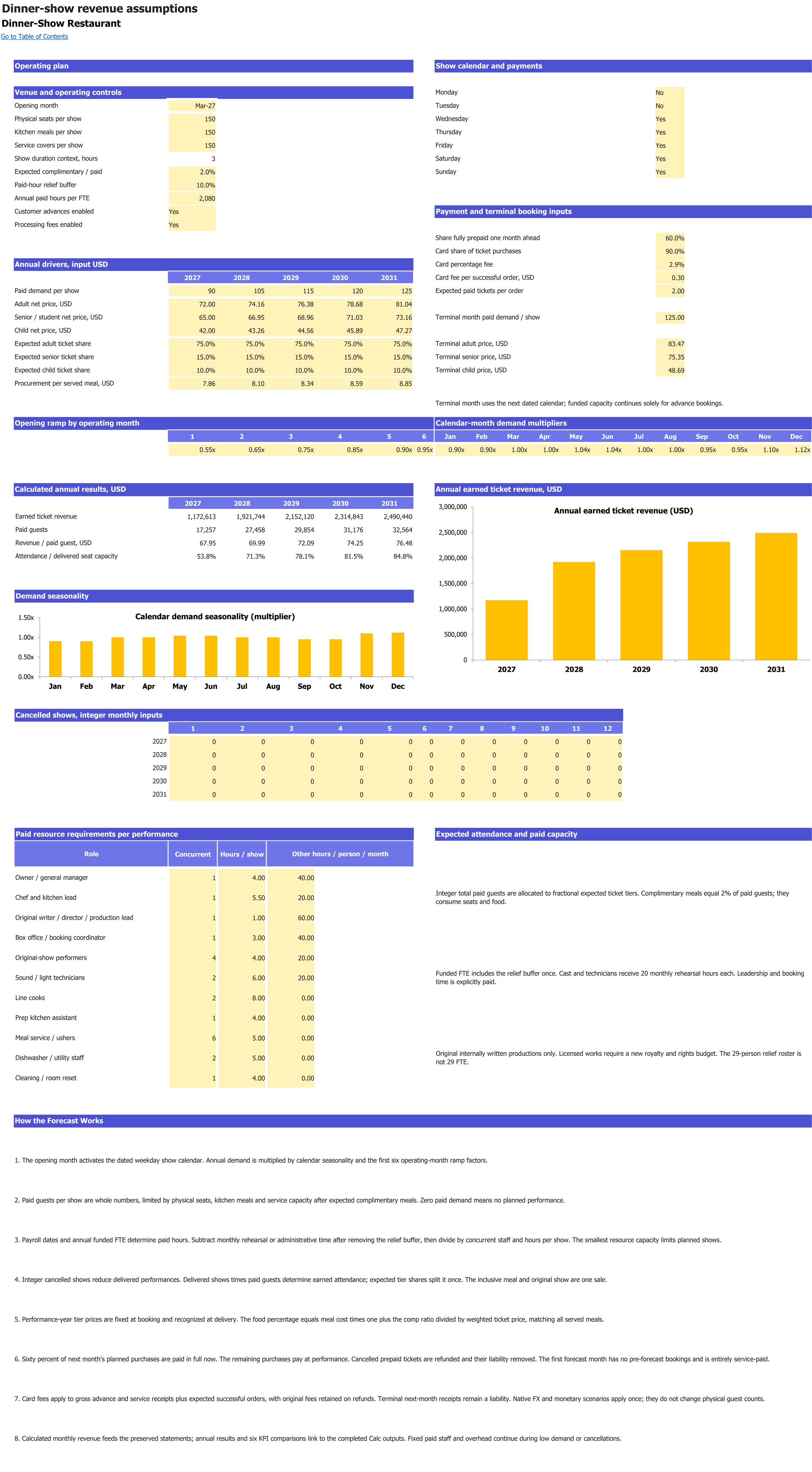
Dinner-show ticket categories, audience demand and scheduled show capacity. Monetary inputs and sales use USD; operating volumes retain their labelled units. Forecast years are 2027–2031.
Enlarge image in a new tab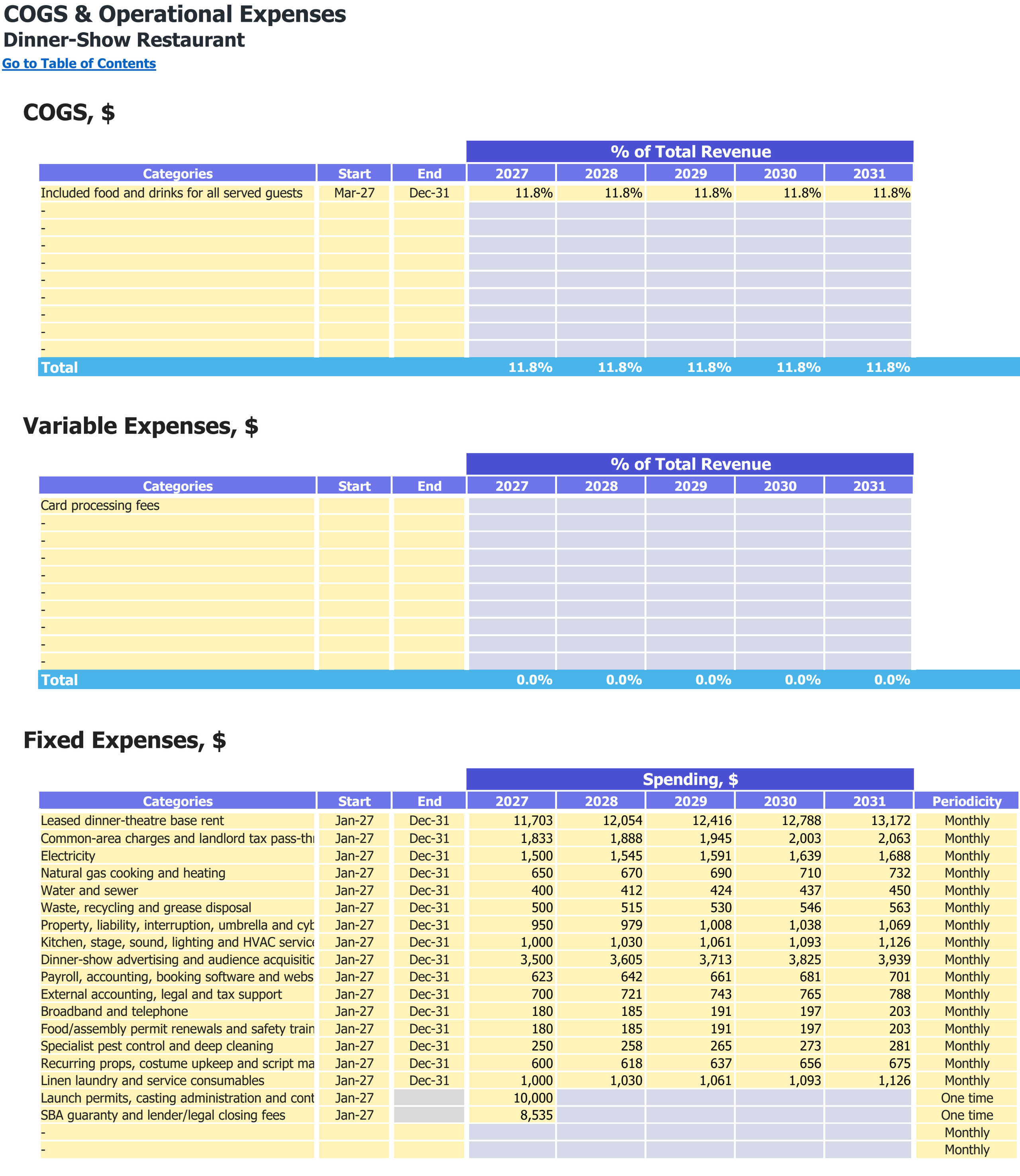
Food and other direct-cost categories, variable expense shares and fixed operating expenses. Monetary inputs are USD; the annual percentage columns are cost shares of revenue.
Enlarge image in a new tab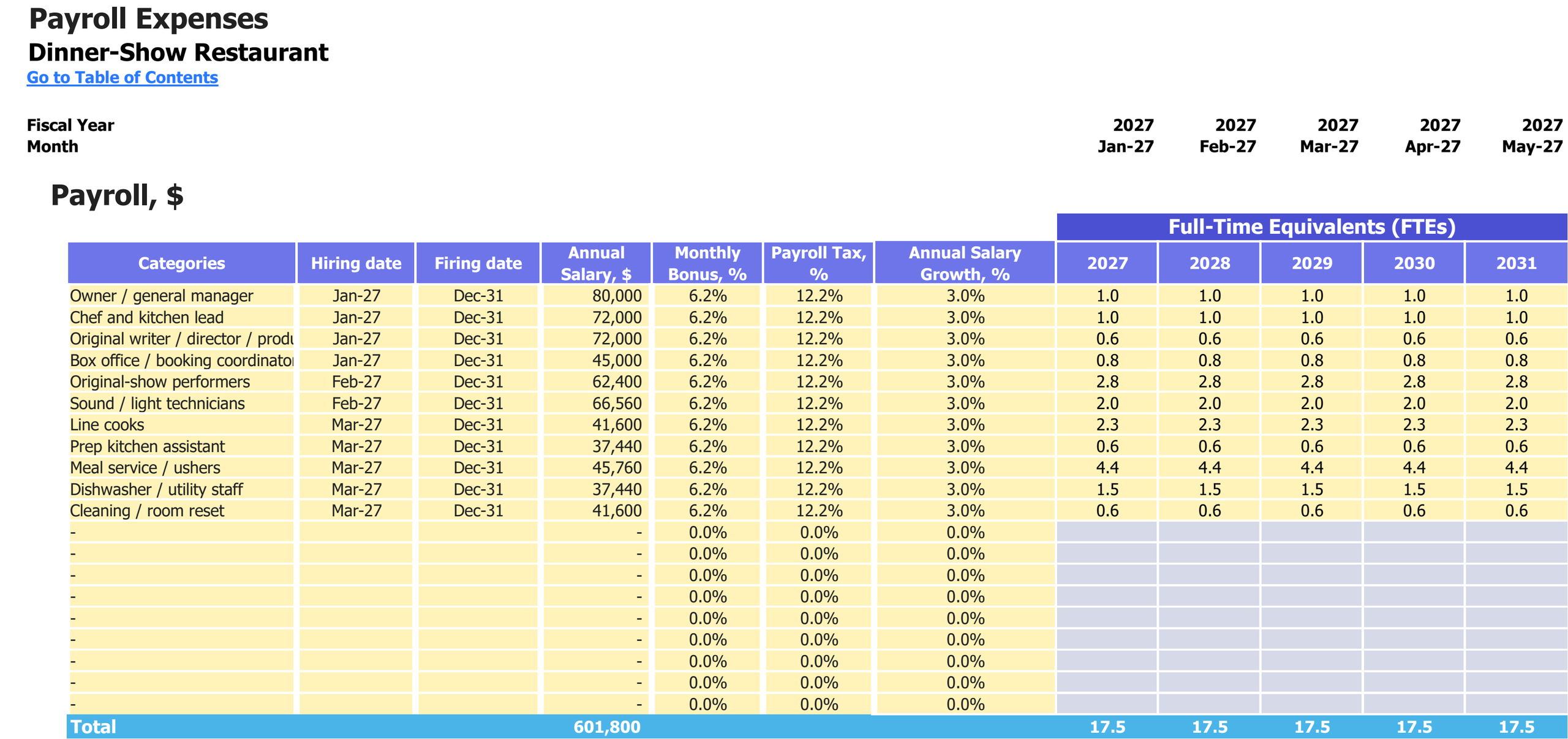
Paid roles, annual salary and employer-load assumptions, with staffing in full-time equivalents for 2027–2031. Salary amounts are USD; percentages and FTEs are labelled separately.
Enlarge image in a new tab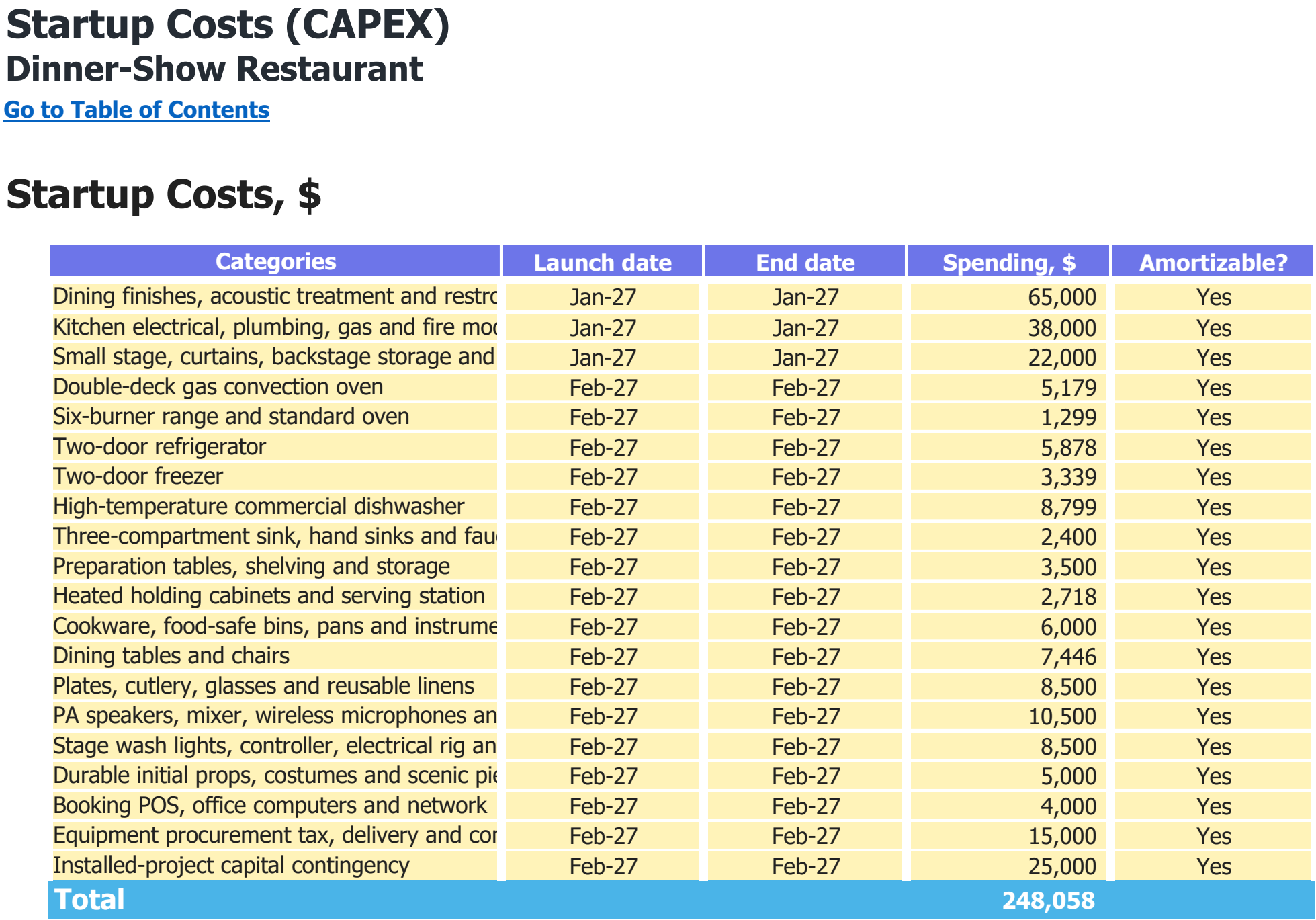
Asset categories, purchase dates and spending assumptions in USD. The total includes every scheduled purchase shown, including later replacements where present.
Enlarge image in a new tab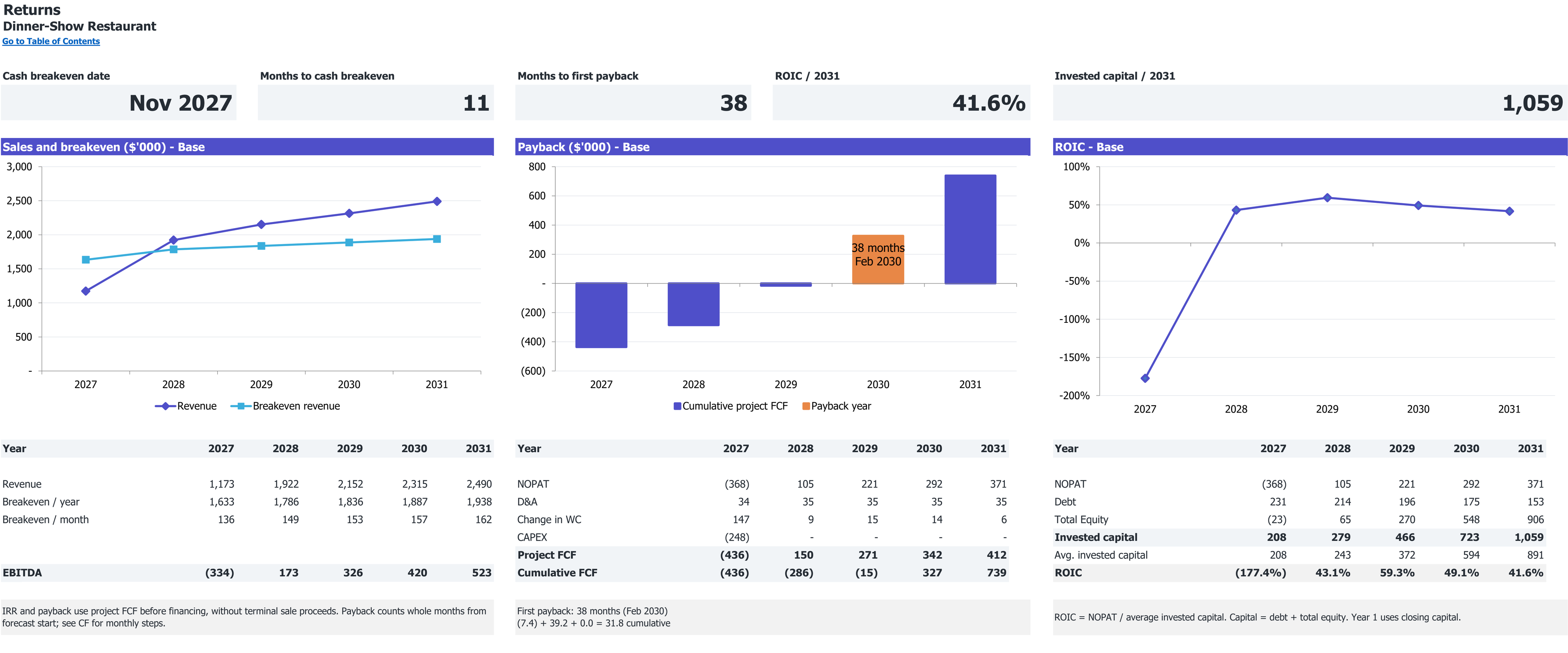
Excerpt from Returns: cumulative project free cash flow and first payback, if reached. 2027–2031 base case; dollar amounts in thousands.
Open full Returns view in a new tabExcerpt from Returns: revenue, annual and monthly break-even revenue, and EBITDA. 2027–2031 base case; dollar amounts in thousands.
Open full Returns view in a new tab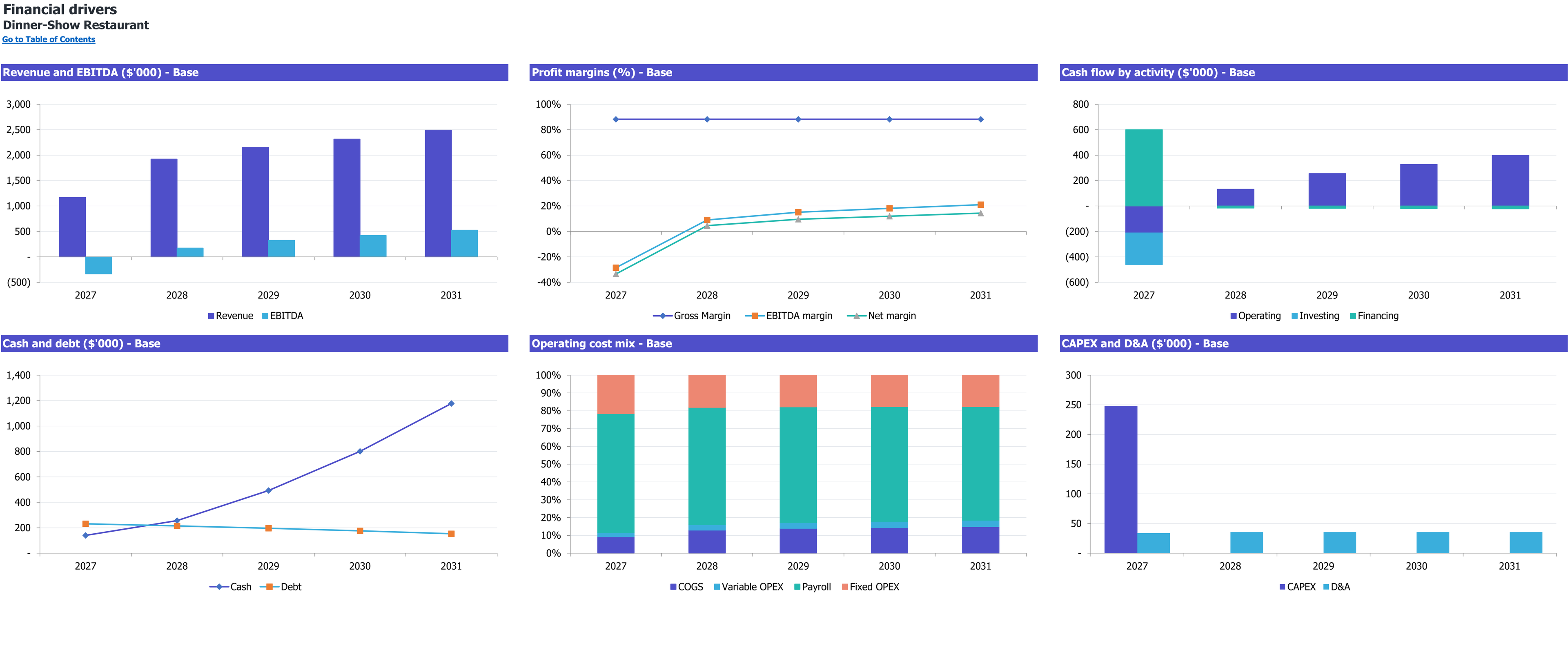
Six annual financial-driver charts for Dinner-Show Restaurant, 2027–2031 (Base scenario). Dollar amounts are in thousands; margins and cost mix are percentages.
Enlarge image in a new tab8 selected worksheet views. Figures show this workbook’s starting case.
Workbook overview
What is inside the Excel model
Connect inclusive dinner-show tickets to seats, meal delivery and a funded cast and service team. Separate earned show revenue from advance collections, refunds and cash needed through the launch period.
Selected worksheets from the documented workbook. Forecast period: January 2027–December 2031. Model reference: PHY001-13.
Inputs you control. Results you can inspect.
On a small screen, scroll within the table to read every column.
| Planning area | Inputs you review | How they connect | Results to inspect |
|---|---|---|---|
| Ticket demand | 90 initial unconstrained paid guests/show; tier mix and seasonal ramp. | Constrain paid attendance and expected complimentary guests together. | Delivered tickets and earned package revenue. |
| Meal costing | $7.8647903983 per served meal in 2027; 2% expected complimentary attendance. | Apply the constant annual ticket mix and food-cost relationship. | Food expense reconciled to paid and complimentary meals. |
| Paid show resources | Cast, technicians, kitchen, servers and management workloads. | Include rehearsal and a funded relief allowance once. | Show capacity and loaded payroll. |
| Customer cash | 60% advance orders; 40% service-paid orders; cancellation refunds. | Keep advance receipts in liabilities until delivery or refund. | Collections, fees and outstanding obligations. |
| Startup funding | $248,057.65 CAPEX; $369,000 equity; $246,000 debt. | Test funding against the monthly cash trough and $125,000 reserve. | Liquidity through opening and later operations. |
Is this the right model for your business?
Check the starting case before changing the assumptions.
The starting operation
- An intimate venue producing an original dinner-and-performance package.
- An operator coordinating restaurant staffing with performers and technicians.
- A planning team separating ticket revenue from customer advance liabilities.
Check the boundary
The saved case excludes licensed musicals, alcohol, show-only tickets, unrelated host revenue and an independent no-show driver.
Compare the other restaurant typesHow this business makes money
Connect the unit sold to the resources required by this operating case.
Revenue logic
Delivered paid tickets earn one inclusive meal-and-performance package at the selected tier price.
Complimentary guests occupy seats and receive meals; the included dinner is never sold twice.
Why can ticket cash arrive before dinner-show revenue?
A prepaid order creates cash and an obligation. Revenue follows delivery of the show, while cancellations can require refunds. The distinction matters when early collections help finance payroll and when advance balances remain at the end of the forecast.
- Recognition
- One delivered meal-and-performance package
- Collection mix
- 60% fully prepaid orders / 40% service-paid orders
- Ending obligations
- Advances for performances beyond December 2031
What to establish for your own operation
- Validate demand for the expanded weekly show schedule.
- Reconcile successful collections, refunds and processor charges.
- Check future service obligations before interpreting retained cash.
Follow the plan from demand to cash
Open each section for the assumptions, calculations, and limits of this workbook’s starting case.
Sell the meal and performance as one packageRevenue
The 150-guest case presents one original family comedy or mystery show Wednesday–Sunday. The initial net tiers are $72 adult, $65 senior/student and $42 child, with a constant 75%/15%/10% expected mix. The weighted starting ticket is $67.95.
Paid attendance is whole at show level. Complimentary attendance is an expected 2% of paid guests and uses the same capacity and full meal allowance. Tier and complimentary allocations are forecast expectations; no separate no-show driver is included.
- The included meal, dessert and basic beverages generate no second sale.
- Expanded show frequency and attendance are analytical assumptions.
- Changes to monthly ticket mix need a compatible review of the food-cost relationship.
Fund performers and meal service through lower attendancePayroll
The food allowance includes one procurement/waste buffer and applies to paid and complimentary meals. Its share of package revenue is lower than a meal-only restaurant ratio because the ticket also buys a performance.
Eleven payroll categories include a paid owner, chef, writer/director, booking, performers, technicians and restaurant staff. Rehearsal time and a 10% relief/training allowance are funded once. Fixed monthly capacity costs continue when attendance falls.
- The owner’s initial annual salary is $80,000.
- The selected combined employer allowance is 19.15%.
- Paid-hour budgets require an actual roster; they do not prove individual shift coverage.
Carry customer advances as obligationsCAPEX
Initial CAPEX totals $248,057.65 for venue adaptation, kitchen systems, stage, sound, lighting, furniture and commissioning. The case leases the premises and buys no land or building. Book depreciation uses seven years.
There are no opening advances or preforecast sales. Later purchases split into fully prepaid and service-paid orders. Cancelled shows refund their original prepaid cohort and earn no tickets; original successful processing charges remain expenses.
- Processor settlement is assumed to occur within the collection month.
- Funding totals $615,000, including a $246,000 ten-year loan at assumed 10%.
- Year-end 2031 advances of $121,751 relate to later performances, not terminal income.
Read the launch loss and cash recovery separatelyCF
Base 2027 earned revenue is $1,172,613 from 17,257 paid attendances. EBITDA is −$334,408. Minimum funded cash is $128,890 in October 2027; financing supports this substantial launch deficit.
The first nonnegative operating-cash month is November 2027 and first nonnegative EBITDA month is December. These are first crossings. Cumulative undiscounted project free cash flow recovers prior investment in February 2030, forecast month 38.
- Project recovery excludes equity and debt contributions.
- The baseline IRR was reconciled, but some tested boundaries have multiple roots or convergence limits.
- Customer advance balances are obligations with delivery or refund costs beyond the forecast.
Selected results from the starting case
Modeled results in USD unless stated otherwise. These describe the selected inputs, not an estimate for your location or a guaranteed outcome.
- 2027 earned revenue
- $1,172,613USD, Base; inclusive packages delivered after March opening.
- 2027 EBITDA
- −$334,408USD, Base; includes startup and operating costs.
- Initial CAPEX
- $248,057.65USD; leased-venue adaptation and owned operating assets.
- Minimum cash
- $128,890USD, funded Base balance in October 2027.
- Project payback
- February 2030 / month 38First cumulative undiscounted unlevered project FCF recovery; distinct from owner equity repayment.
Make the case your own
Work from the operating plan toward the cash requirement.
Set show dates, ticket tiers, attendance and complimentary policy.
Validate cast, rehearsal, kitchen and service workload against paid resources.
Replace installed-capital, premises and financing allowances.
Review advance liabilities, first operating crossings and cumulative project recovery.
Interpretation and scope
- This US case is not a verified venue demand forecast or assembly approval.
- A constant annual ticket mix and meal relationship underpins the native food-cost method.
- Cross-month processor settlement and independent no-show behavior are outside the case.
- The selected 24% corporate tax allowance is not a jurisdiction-specific calculation.
- Multiple cash-flow sign changes and extreme negative returns can limit IRR interpretation.
The workbook is an Excel file for local planning. Learn how to interpret assumptions and evidence.
Other restaurant types
Each operating type calls for its own financial structure.
Questions
Is dinner billed separately?
No. Each delivered paid ticket earns one inclusive package.
Are advances immediately revenue?
No. They remain liabilities until the show is delivered or refunded.
Are 60% and 40% partial payments on every ticket?
No. They are separate fully prepaid and service-paid order cohorts.
Does cancelled attendance remove all show costs?
No. Fixed funded payroll and other commitments remain; original successful processing fees are retained.
Is ending cash freely distributable?
No. It includes outstanding customer advance obligations and does not represent an owner payout.
What if a purchased file is damaged or cannot be downloaded?
See the refund and replacement policy for file correction, replacement and download assistance. Keep the product name and your order reference when requesting help.
Which software does the workbook use?
The documented file is an Excel workbook (.xlsx). Compatibility with other spreadsheet applications is not established by the file extension.
Read the planning guides
Explore the relevant operating questions and how to interpret a workbook’s assumptions.
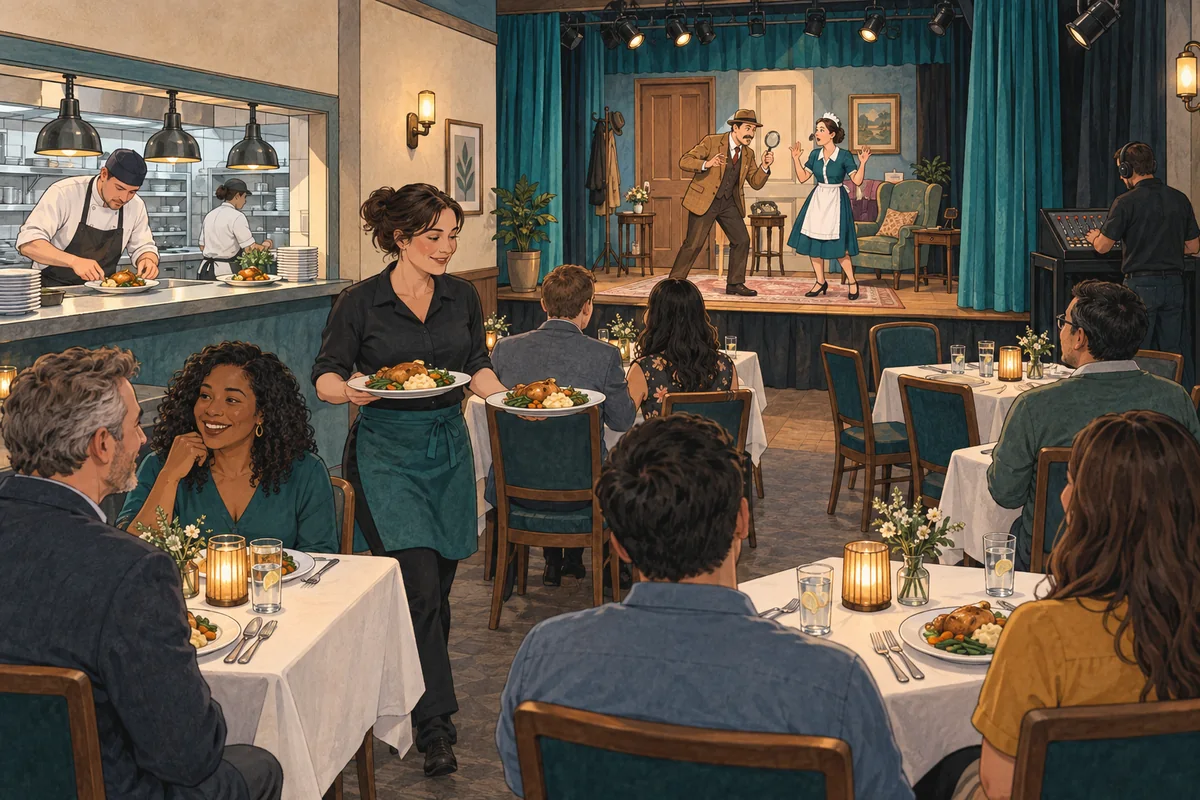
Why does dinner-show capacity require more than available seats?
Connect inclusive tickets, complimentary meals, paid performance and rehearsal time, and prepaid show cohorts in a dinner-show restaurant forecast.
Read the guide
How to read financial assumptions before editing an Excel model
Follow the chain from operating assumptions to calculated results, check units and timing, and keep a useful record of changes to a financial workbook.
Read the guideEvidence and scope
Primary operator examples support only the operating features described in the source registry. This full configuration, all formulas, local feasibility and numerical economics remain analyst-authored and unverified.
The links below provide operating-format context; they do not verify the workbook’s selected inputs or calculated returns.
The workbook guide and figures describe model PHY001-13, revision r02, for January 2027–December 2031. These are a documented planning case, not observed results for a particular business.