
Restaurant Financial Model: Guest-Cooked Korean BBQ Restaurant
Plan guest-cooked Korean BBQ packages, private-table visits, repeat-portion workload, grill servicing and all-equity cash requirements.
- Excel (.xlsx)
- Premises: 4,800 sq ft / 20 tables / 80 physical seats
- Target private-table fill: Three guests per visit
- Opening: May 2027 / eight trading months in year one
Planning several types? Compare 17 restaurant formats
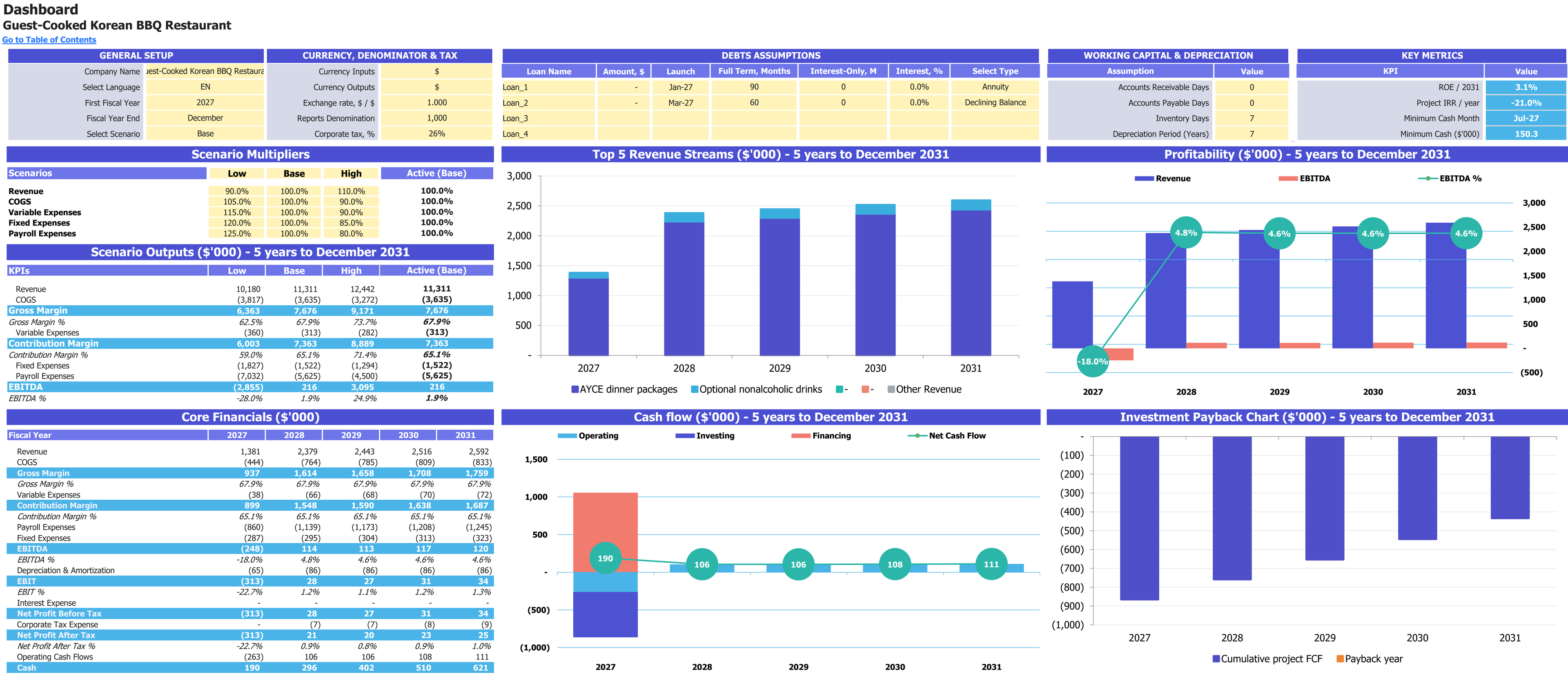
Base-case scenario controls, annual financial results and charts for 2027–2031. Financial report amounts are shown in thousands of USD; percentage measures retain their own units.
Enlarge image in a new tab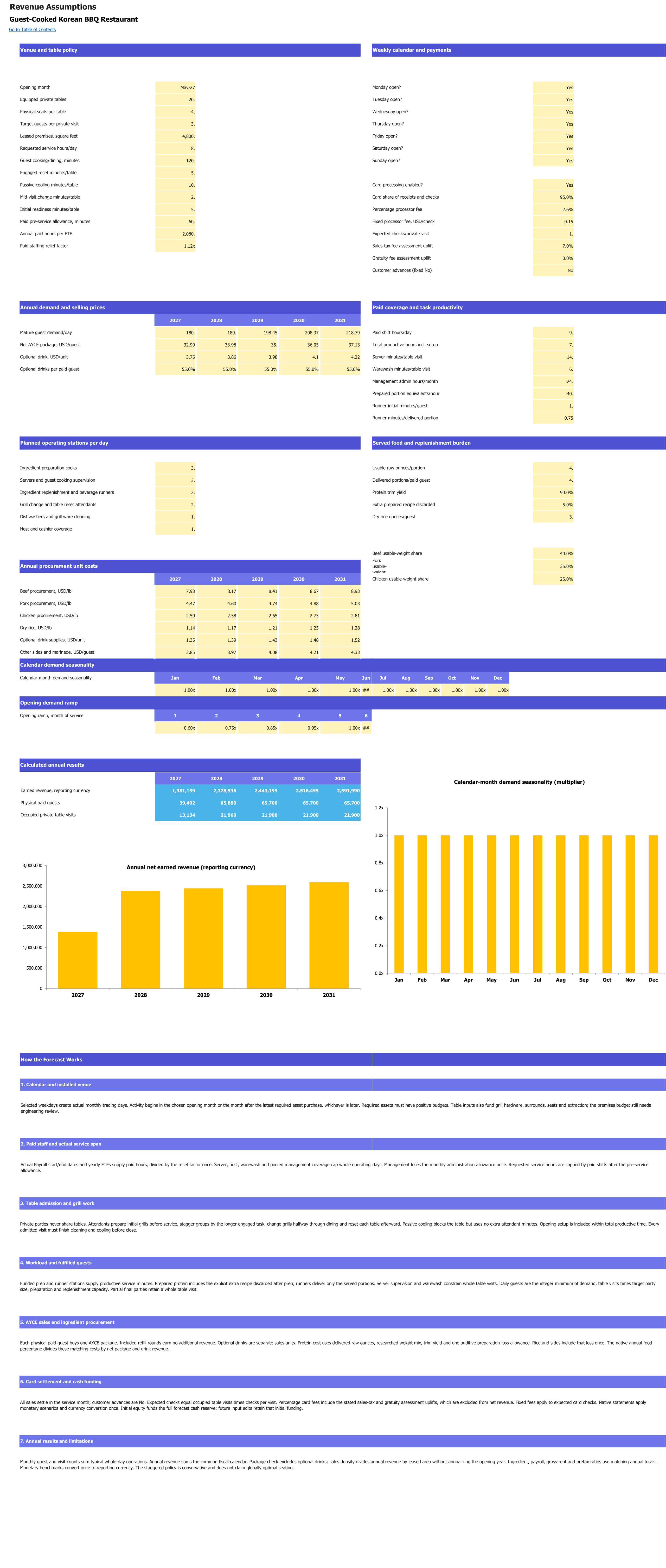
Dining demand, grill-table capacity, guest food consumption and paid service resources. Monetary inputs and sales use USD; operating volumes retain their labelled units. Forecast years are 2027–2031.
Enlarge image in a new tab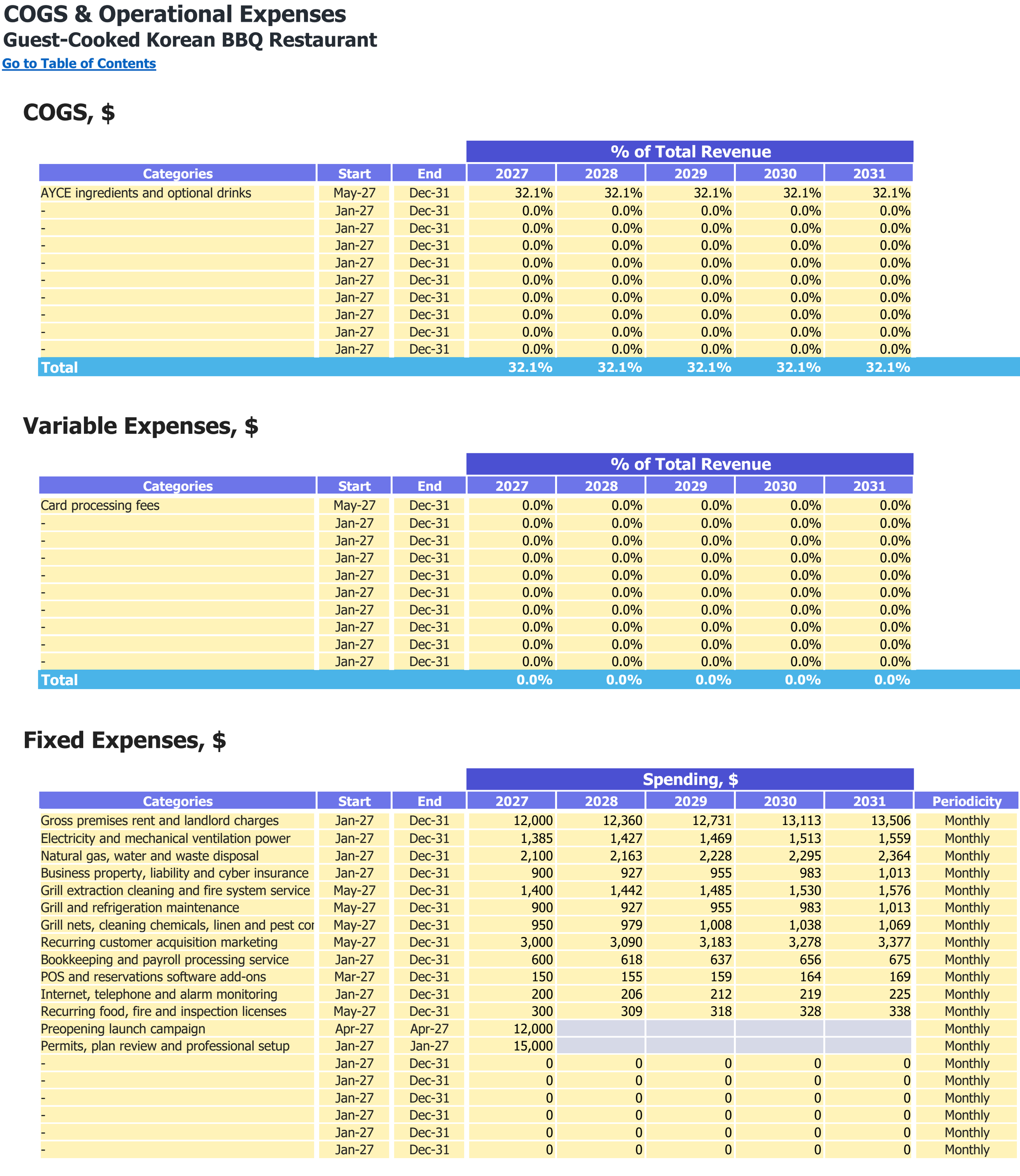
Food and other direct-cost categories, variable expense shares and fixed operating expenses. Monetary inputs are USD; the annual percentage columns are cost shares of revenue.
Enlarge image in a new tab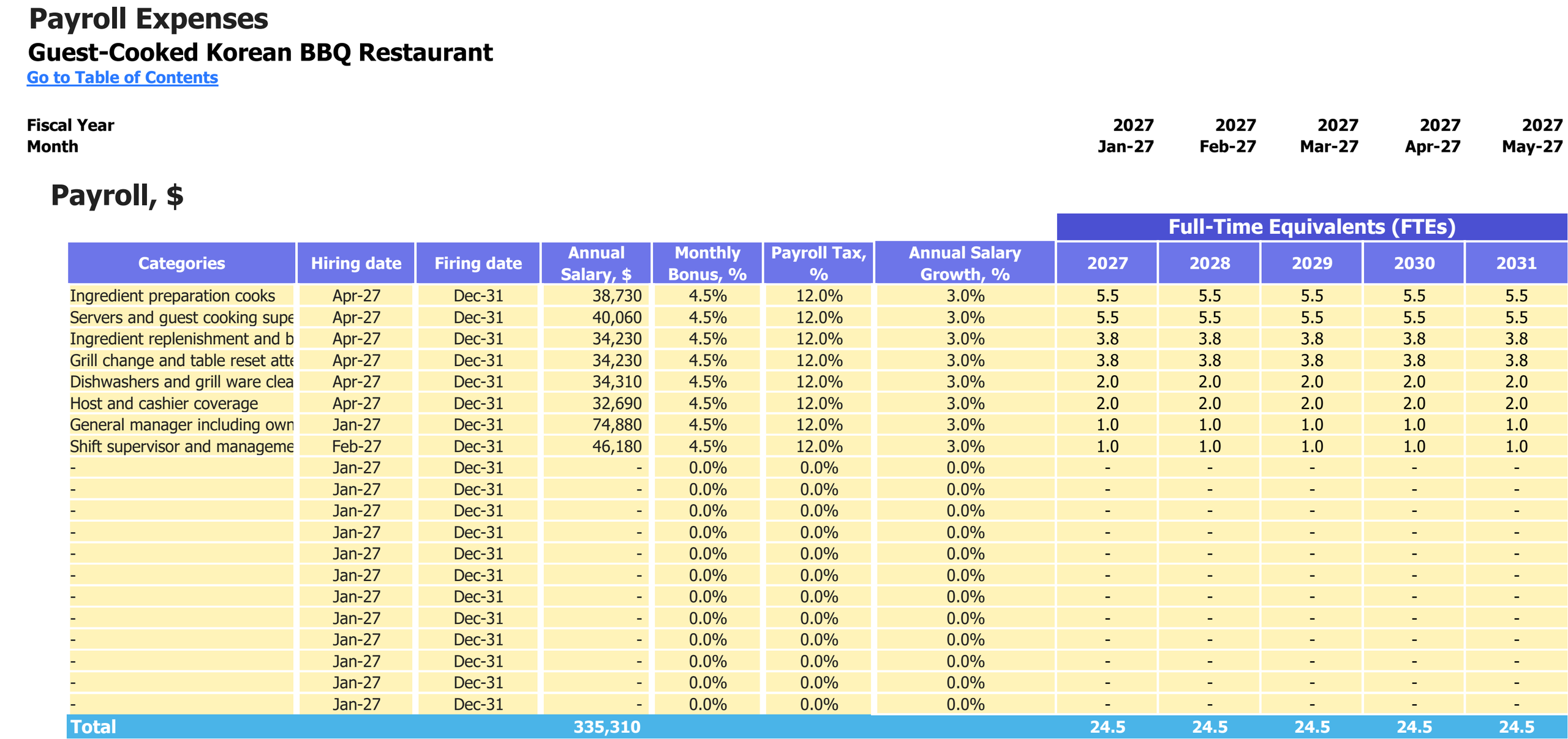
Paid roles, annual salary and employer-load assumptions, with staffing in full-time equivalents for 2027–2031. Salary amounts are USD; percentages and FTEs are labelled separately.
Enlarge image in a new tab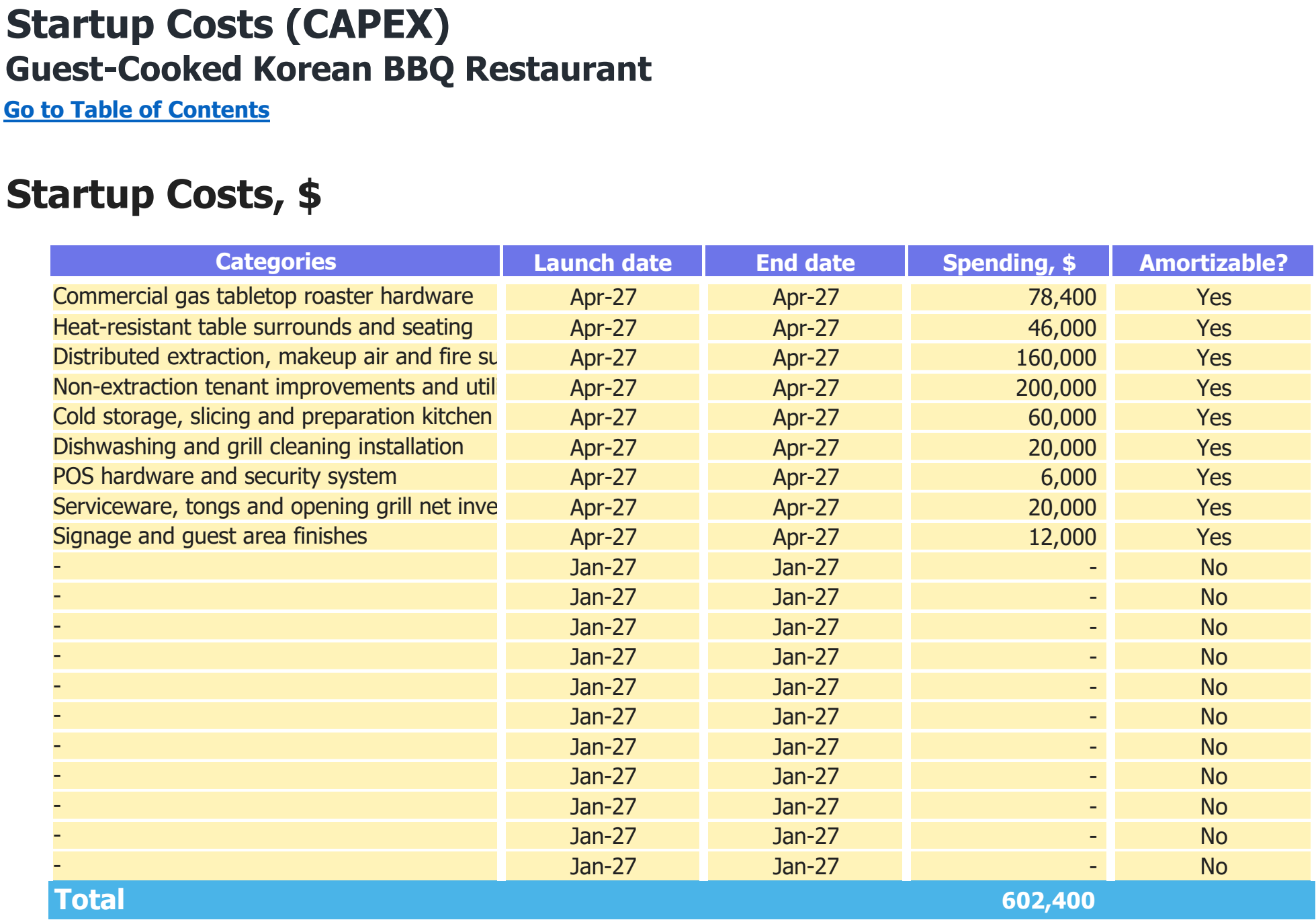
Asset categories, purchase dates and spending assumptions in USD. The total includes every scheduled purchase shown, including later replacements where present.
Enlarge image in a new tab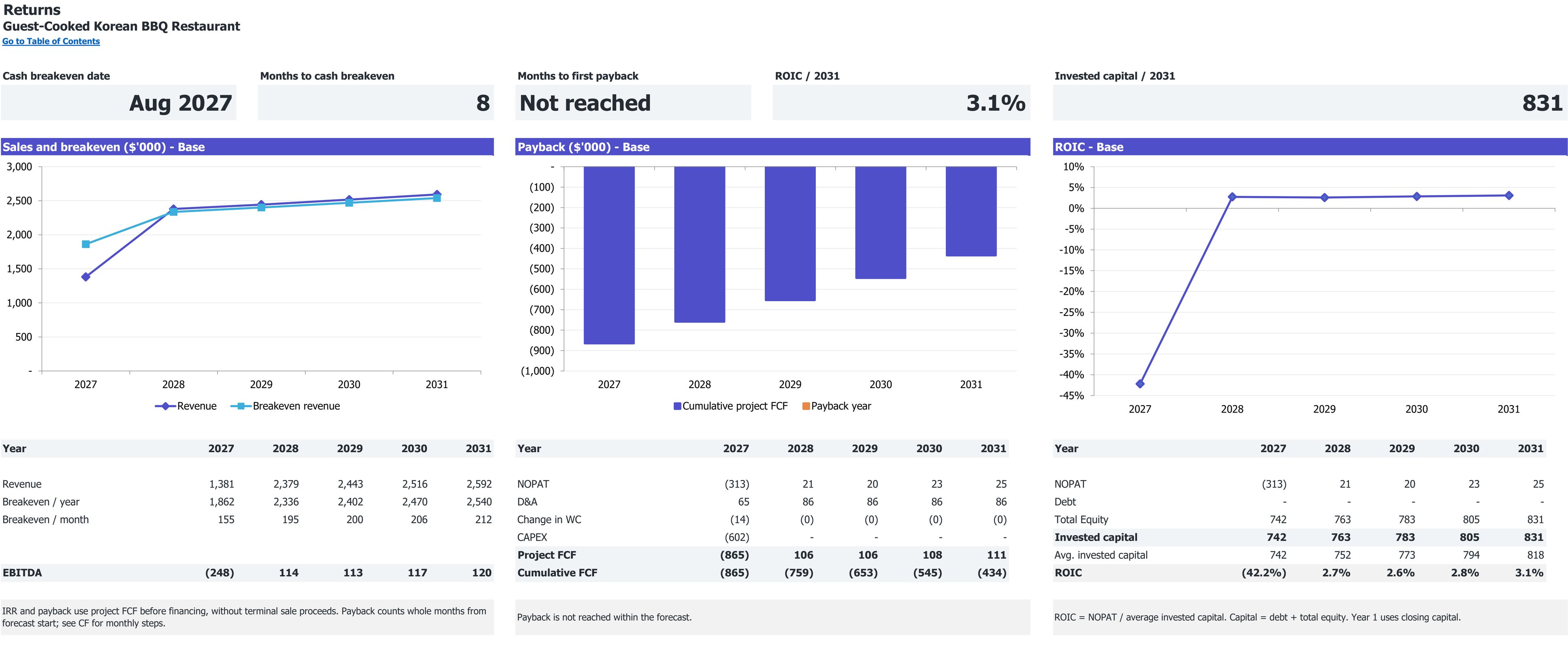
Excerpt from Returns: cumulative project free cash flow and first payback, if reached. 2027–2031 base case; dollar amounts in thousands.
Open full Returns view in a new tabExcerpt from Returns: revenue, annual and monthly break-even revenue, and EBITDA. 2027–2031 base case; dollar amounts in thousands.
Open full Returns view in a new tab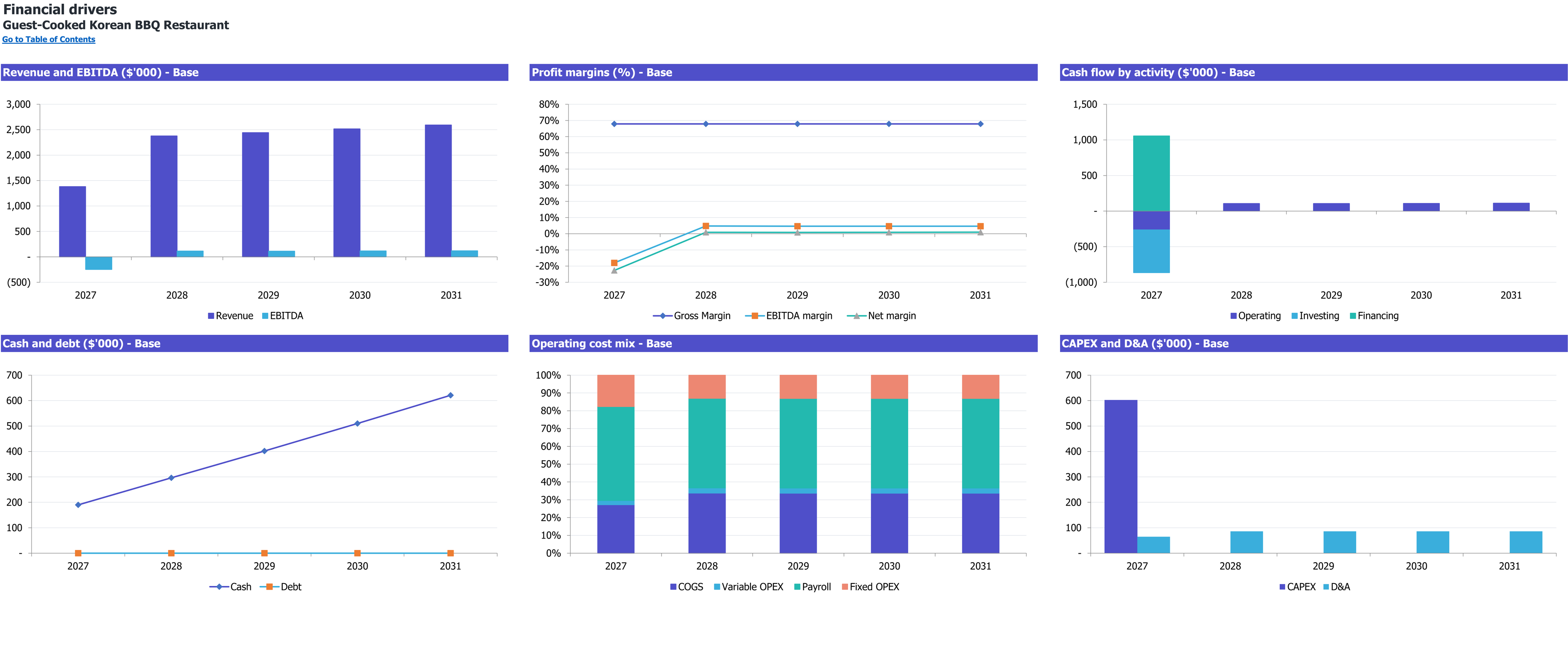
Six annual financial-driver charts for Guest-Cooked Korean BBQ Restaurant, 2027–2031 (Base scenario). Dollar amounts are in thousands; margins and cost mix are percentages.
Enlarge image in a new tab8 selected worksheet views. Figures show this workbook’s starting case.
Workbook availability
What is inside the Excel model
Connect unlimited dinner packages to private-table cycles, repeat portions and paid preparation and service teams. The saved case keeps funded cash positive but does not recover project investment within five years.
Selected worksheets from the documented workbook. Forecast period: January 2027–December 2031. Model reference: PHY001-15.
Inputs you control. Results you can inspect.
On a small screen, scroll within the table to read every column.
| Planning area | Inputs you review | How they connect | Results to inspect |
|---|---|---|---|
| Table schedule | 120 dining minutes; five active reset plus ten passive minutes. | Stagger readiness and require complete cycles within eight service hours. | 60 baseline visits / 180 target-fill guests daily. |
| Consumption | 16 usable raw protein ounces/guest; 90% trim yield; 5% prepared excess. | Separate delivered food, raw purchases and discarded preparation. | Ingredient cost and distinct prep/runner workloads. |
| Revenue | $32.99 package; $3.75 drink; 0.55 drink purchases/guest. | Bill the package once with optional drinks as additions. | Initial expected revenue of $35.0525 per paid guest. |
| Paid resources | 24.5 FTE; separately funded prep, runners, attendants and support. | Deduct relief once and check concurrent/task requirements. | Feasible daily service and loaded payroll. |
| Investment | $602,400 CAPEX; $1,055,000 initial equity; no debt. | Cover the financing-free cash trough plus $150,000 reserve. | Monthly liquidity and unrecovered project cash. |
Is this the right model for your business?
Check the starting case before changing the assumptions.
The starting operation
- A supplied-order restaurant where guests cook at private grill tables.
- An operator testing unlimited portions against prep, runner and reset capacity.
- A founder assessing a labor-heavy format with no assumed free owner labor.
Check the boundary
The saved case excludes shared tables with unrelated parties, child discounts, free covers, alcohol, delivery, hotpot and retail sales.
Compare the other restaurant typesHow this business makes money
Connect the unit sold to the resources required by this operating case.
Revenue logic
Each served paid guest buys one dinner package, with optional nonalcoholic drink purchases.
Repeated food orders are included: they add ingredients and handling workload, never another paid visit.
Does guest cooking remove the need for a large paid service team?
Not in this supplied-order design. Guests cook at the table, but staff prepare portions, carry repeats, supervise service, replace grills and clean equipment. Those tasks use different units and can bind before physical seats do.
- Consumption
- Four delivered protein equivalents per guest
- Private visits
- Whole visits rounded up from guest count
- Paid operation
- 24.5 initial FTE across distinct tasks
What to establish for your own operation
- Measure repeat portions and runner trips.
- Time readiness, grill changes and reset within one productive-hour budget.
- Test guest demand and reserve adequacy with baseline equity held fixed.
Follow the plan from demand to cash
Open each section for the assumptions, calculations, and limits of this workbook’s starting case.
Treat private-table visits as a separate operating unitRevenue
Twenty four-seat tables target three guests per private visit. The number of occupied visits rounds up from served guests, so 179 guests still require 60 visits. A partially filled final table consumes a complete cycle.
Two attendants share initial readiness, grill changes and reset work within their funded productive hours. Prep portions, runners, server task minutes and staffed warewashing supply additional limits. Purchased machines do not create unfunded staffing capacity.
- The baseline schedule supports 180 guests/day at target fill.
- Opening demand is 108 guests/day after one 60% ramp adjustment.
- Guests, table visits and payment checks are different counts.
Include the work behind guest cookingPayroll
The served protein recipe already includes plate leftovers. Purchases apply a 90% raw-trim yield and a separate 5% additive prepared excess. Prep handles 4.2 equivalents per guest while runners deliver four; the discarded excess is not billed or charged twice.
Initial full staffing is 24.5 FTE, including owner replacement management pay. Prep, supervision, replenishment, grill change, washing and host work remain paid even though guests cook the meat. Operating hires receive a full April training month before May sales.
- Initial blended ingredient cost is $11.2644814583 per guest including expected drinks.
- The saved no-tip case budgets full employer cash wages.
- Staffing does not automatically shrink with lower demand.
Fund installed grills and the preopening periodCAPEX
The nine capital bundles total $602,400, including grills, table surrounds, distributed extraction, tenant works, preparation and warewashing. The first six bundles must be purchased before service can begin in the following month.
The January equity contribution is $1,055,000. It includes startup purchases, wages, ramp losses and working capital once, plus a retained $150,000 reserve. Minimum funded cash is $150,318.72 in July 2027.
- There is no debt, later contribution, replacement CAPEX or dividend in the saved case.
- Seven-year book depreciation begins in April, before May opening.
- Changing table count requires a separate premises and utilities review.
Keep positive funded cash separate from investment recoveryCF
Base 2027 revenue is $1,381,139 and EBITDA is −$248,457. EBITDA and operating cash first turn positive in August 2027, but both become negative again in February 2029, 2030 and 2031.
Project payback is not reached within 60 months. Cumulative undiscounted unlevered project cash ends at −$433,995.96, despite a positive funded ending cash balance. That balance includes the original equity contribution.
- The baseline mature-demand test at 120 guests/day creates −$1,796,881 minimum cash with funding unchanged.
- The year-five ROIC card is not five-year investor ROI.
- Multiple cash-flow sign changes require the disclosed IRR qualifications.
Selected results from the starting case
Modeled results in USD unless stated otherwise. These describe the selected inputs, not an estimate for your location or a guaranteed outcome.
- 2027 revenue
- $1,381,139USD, Base; eight service months after May opening.
- 2027 EBITDA
- −$248,457USD, Base; includes preopening payroll and premises costs.
- Initial CAPEX
- $602,400USD; installed capital purchased in April 2027.
- Minimum cash
- $150,318.72USD, funded Base balance in July 2027.
- Project payback
- Not reached within 60 monthsCumulative undiscounted project FCF ends at −$433,995.96; funded cash is not investment recovery.
Make the case your own
Work from the operating plan toward the cash requirement.
Set package prices, drink attachment, demand and private-table fill.
Validate joint table schedules and separate task workloads.
Replace recipe, labor and installed extraction assumptions.
Review later loss months, downside funding gaps and unrecovered project cash.
Interpretation and scope
- This representative US case does not establish chain or local restaurant economics.
- The fixed annual package/drink mix supports the native percentage food-cost method.
- Same-month settlement and zero AR/AP omit timing float.
- The 26% tax allowance has no selected jurisdiction or interyear loss carryforward.
- Baseline equity sizing is fixed; edited scenarios do not refinance automatically.
The workbook is an Excel file for local planning. Learn how to interpret assumptions and evidence.
Other restaurant types
Each operating type calls for its own financial structure.
Questions
Do repeated orders earn another package price?
No. They are included and add consumption and workload only.
Are unrelated parties combined at tables?
No. The saved format uses private-table visits.
How many checks are used for 179 guests?
At baseline, 60 occupied visits produce 60 checks; the split-check factor can change this.
Is August 2027 sustained break-even?
No. Later February operating losses recur.
Does positive December cash establish payback?
No. Cash includes contributed equity; cumulative project cash remains negative at month 60.
Can I buy this model now?
No. Purchasing and workbook downloads are not available on this site.
Which software does the workbook use?
The documented file is an Excel workbook (.xlsx). Compatibility with other spreadsheet applications is not established by the file extension.
Read the planning guides
Explore the relevant operating questions and how to interpret a workbook’s assumptions.
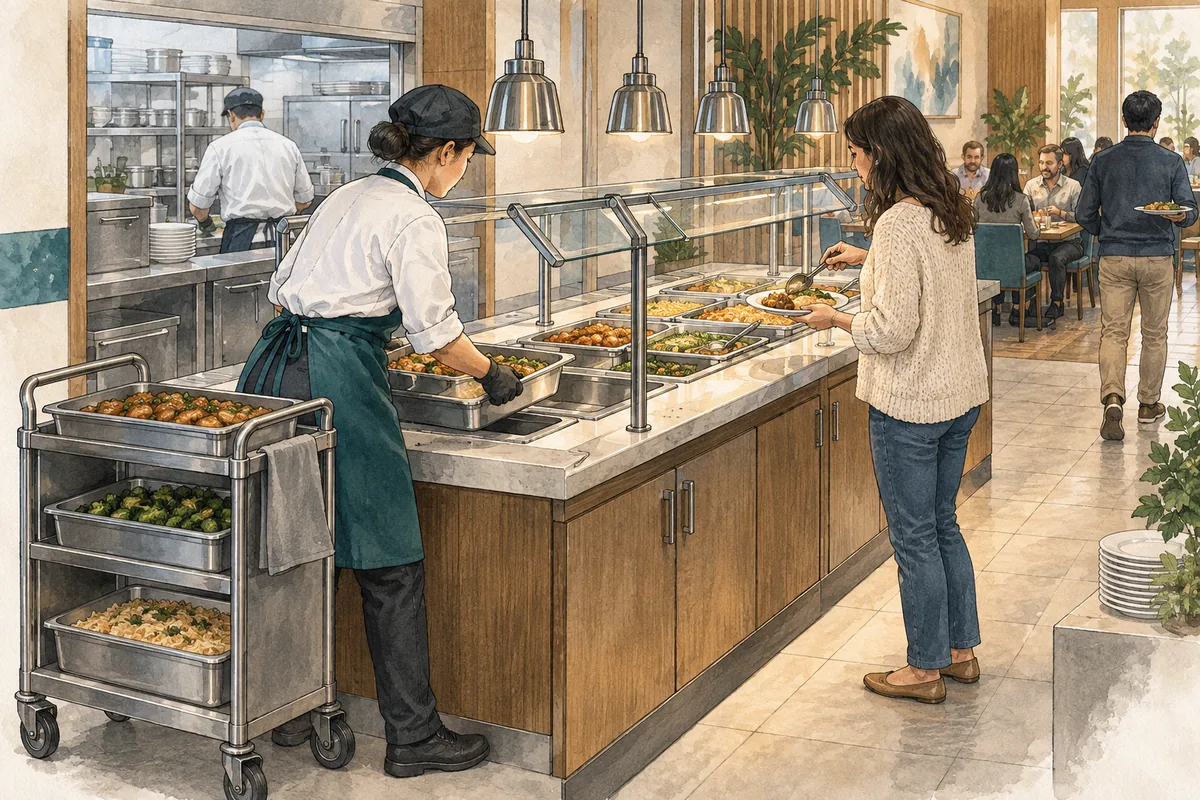
How should unlimited menus separate admission from food consumption?
Compare how a buffet and guest-cooked Korean BBQ case count paid visits, repeat portions, food losses, table capacity, and paid service work.
Read the guide
How to read financial assumptions before editing an Excel model
Follow the chain from operating assumptions to calculated results, check units and timing, and keep a useful record of changes to a financial workbook.
Read the guideEvidence and scope
Primary operator examples support only the operating features described in the source registry. This full configuration, all formulas, local feasibility and numerical economics remain analyst-authored and unverified.
The links below provide operating-format context; they do not verify the workbook’s selected inputs or calculated returns.
The workbook guide and figures describe model PHY001-15, revision r02, for January 2027–December 2031. These are a documented planning case, not observed results for a particular business.