
Restaurant Financial Model: Pop-Up Restaurant and Guest-Chef Residency
Plan finite chef residencies with host access, attendance, seasonal staff, portable assets and cash commitments between trading windows.
- Excel (.xlsx)
- Residencies: March–May in each of five forecast years
- Format: 40 seats / one sitting Thursday–Saturday
- Host access: Eight hours/date / up to 15 dates/month
Planning several types? Compare 17 restaurant formats
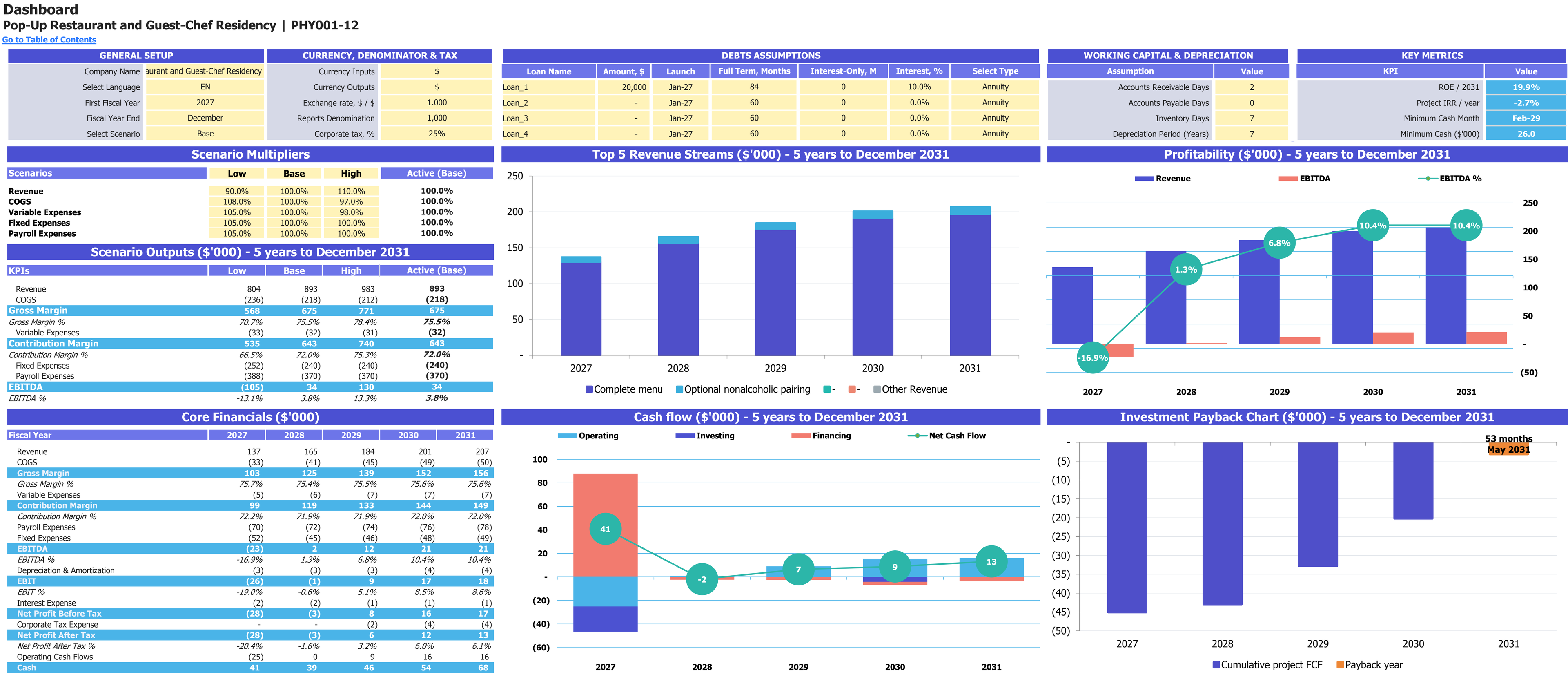
Base-case scenario controls, annual financial results and charts for 2027–2031. Financial report amounts are shown in thousands of USD; percentage measures retain their own units.
Enlarge image in a new tab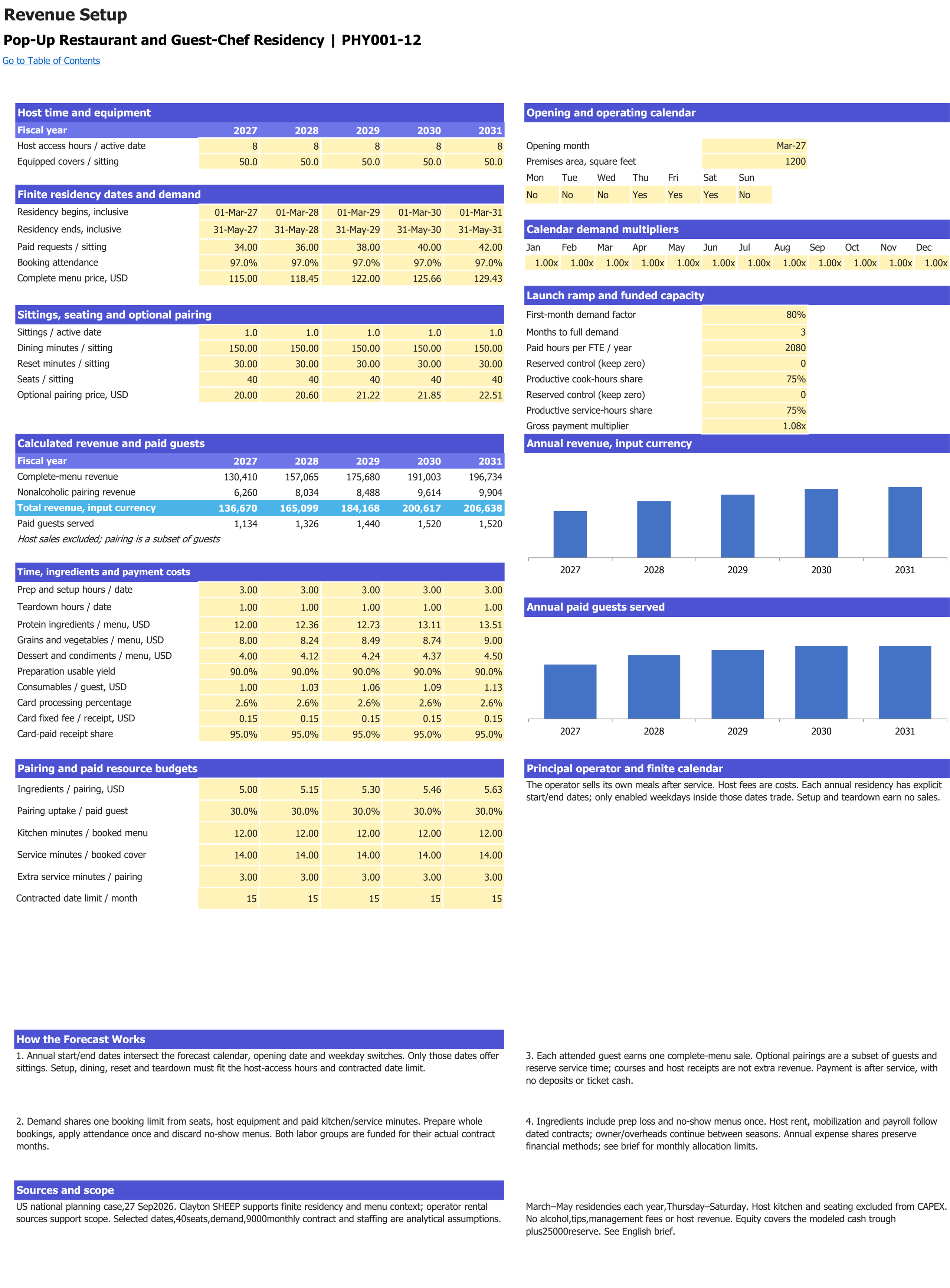
Residency dates, available sittings, seat demand and guest-chef service assumptions. Monetary inputs and sales use USD; operating volumes retain their labelled units. Forecast years are 2027–2031.
Enlarge image in a new tab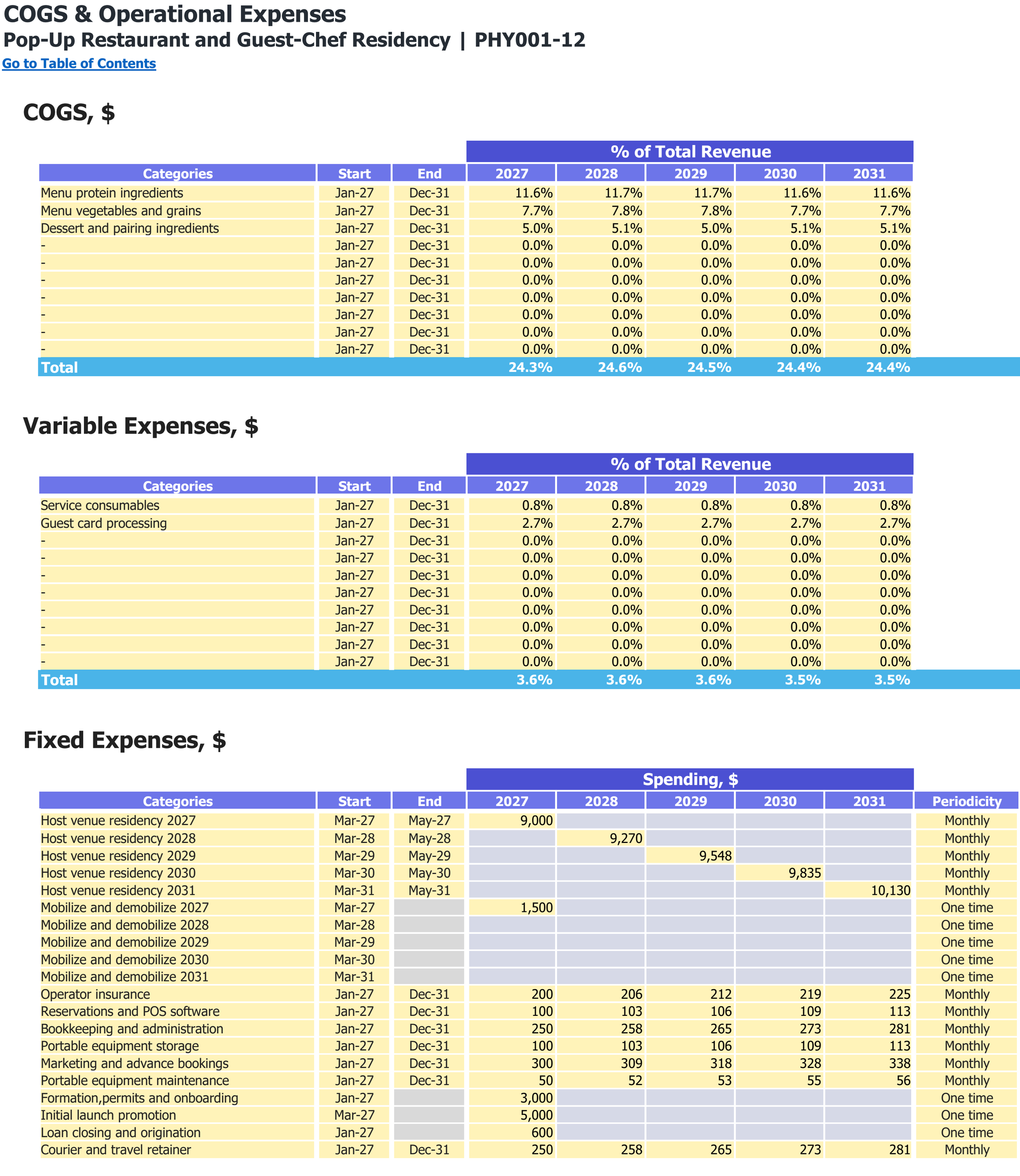
Food and other direct-cost categories, variable expense shares and fixed operating expenses. Monetary inputs are USD; the annual percentage columns are cost shares of revenue.
Enlarge image in a new tab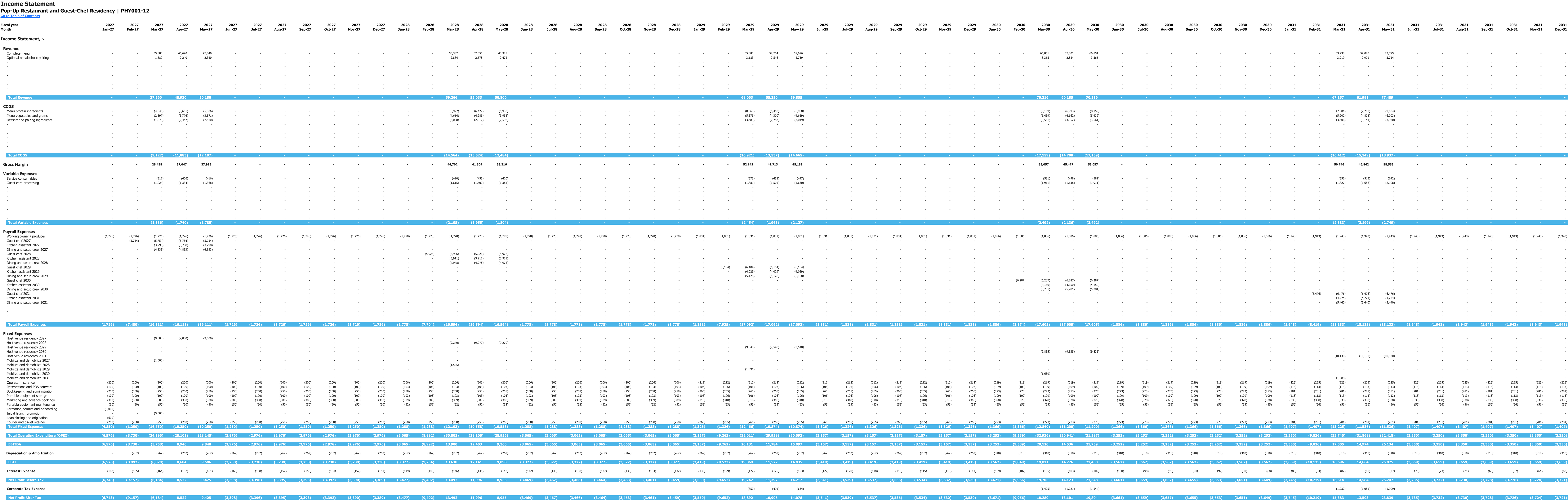
Monthly income statement for 2027–2031, in USD. This is an income statement view; it does not show payroll setup inputs. Enlarge to inspect the wide monthly table.
Enlarge image in a new tab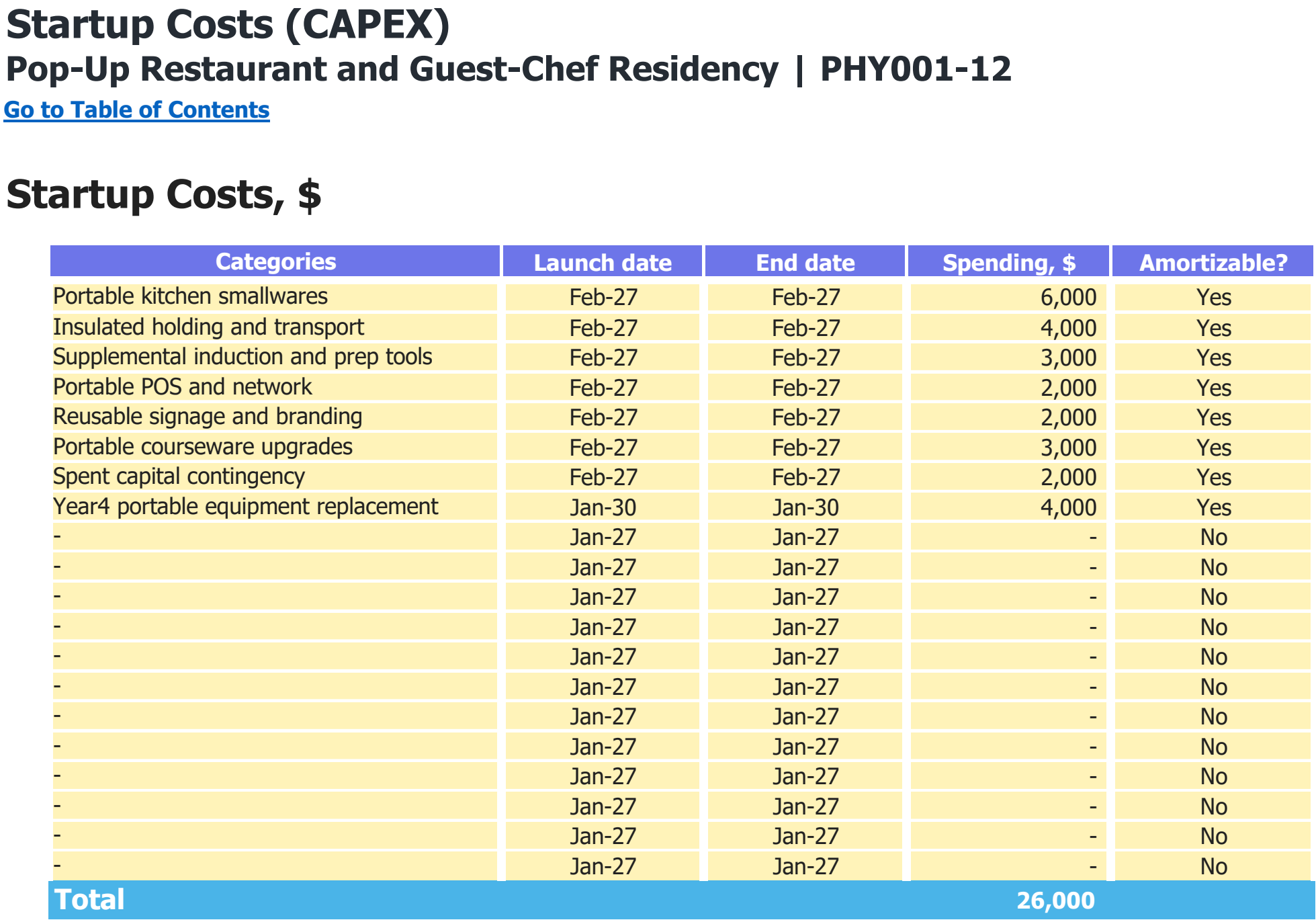
Asset categories, purchase dates and spending assumptions in USD. The total includes every scheduled purchase shown, including later replacements where present.
Enlarge image in a new tab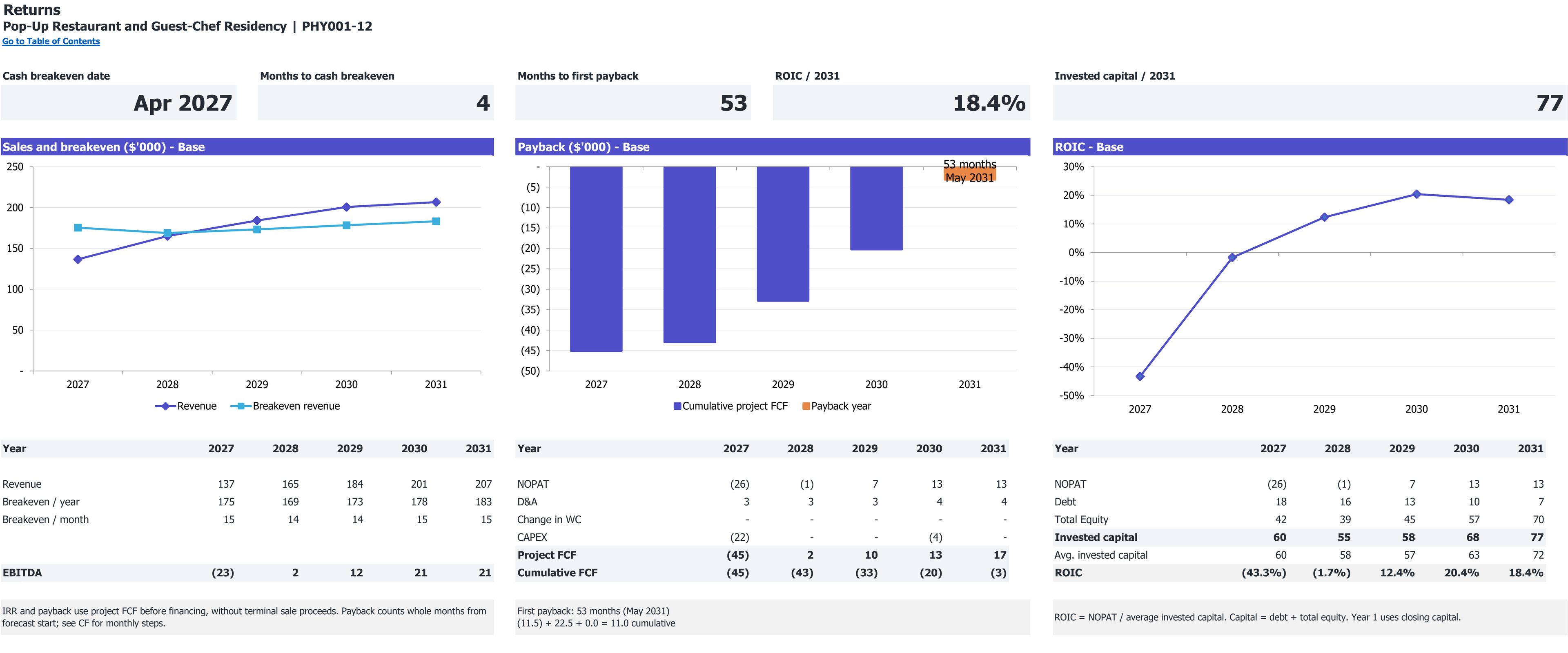
Excerpt from Returns: cumulative project free cash flow and first payback, if reached. 2027–2031 base case; dollar amounts in thousands. The first crossing reverses; payback is not sustained through 2031.
Open full Returns view in a new tabExcerpt from Returns: revenue, annual and monthly break-even revenue, and EBITDA. 2027–2031 base case; dollar amounts in thousands.
Open full Returns view in a new tab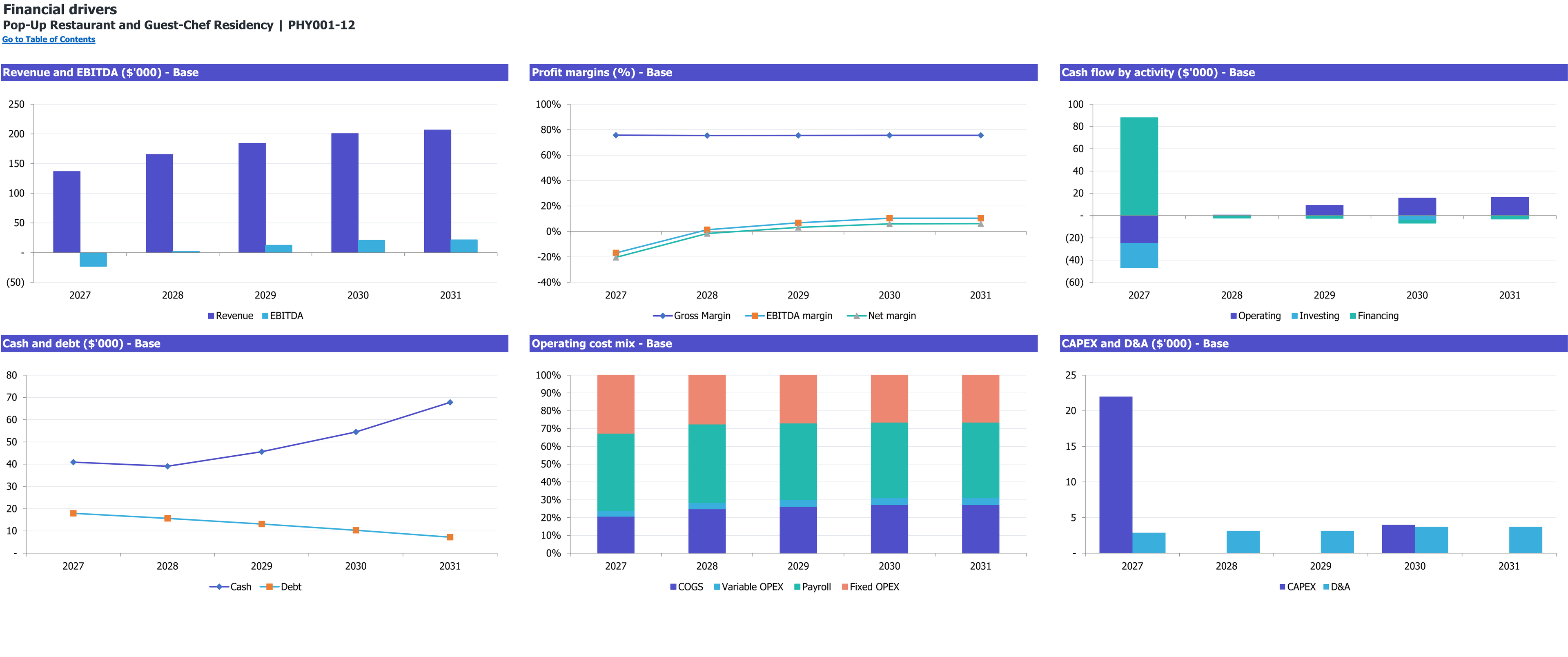
Six annual financial-driver charts for Pop-Up Restaurant and Guest-Chef Residency, 2027–2031 (Base scenario). Dollar amounts are in thousands; margins and cost mix are percentages.
Enlarge image in a new tab8 selected worksheet views. Figures show this workbook’s starting case.
Workbook availability
What is inside the Excel model
Budget a meal operator’s finite residencies in an equipped host venue, including the months between them. The saved case briefly reaches project payback in 2031, then reverses before the forecast ends.
Selected worksheets from the documented workbook. Forecast period: January 2027–December 2031. Model reference: PHY001-12.
Inputs you control. Results you can inspect.
On a small screen, scroll within the table to read every column.
| Planning area | Inputs you review | How they connect | Results to inspect |
|---|---|---|---|
| Calendar | Five separate March 1–May 31 windows. | Count enabled weekdays and enforce monthly host-date limits. | 39–40 service dates per year. |
| Bookings | 34 initial requests/sitting; 97% attendance. | Limit bookings by resources, then round attended covers down. | Served menus and discarded no-show menus. |
| Host time | Three setup hours, 150 dining minutes, 30 reset minutes, one teardown hour. | Check the complete date against eight contracted hours. | Valid single-sitting operation. |
| Seasonal commitments | $9,000 active-month host retainer; dated staff contracts. | Gate contracts by date while owner and overhead continue year-round. | Seasonal profit and off-season cash exposure. |
| Funding | $22,000 initial portable CAPEX; $70,000 equity; $20,000 loan. | Follow investment and repeated cash troughs over all 60 months. | Reserve coverage and durability of project recovery. |
Is this the right model for your business?
Check the starting case before changing the assumptions.
The starting operation
- A principal meal seller hiring equipped premises for finite windows.
- A guest-chef residency with dated staff and host commitments.
- An operator testing whether seasonal cash generation covers year-round overhead.
Check the boundary
The saved case excludes continuous restaurant trading, host hotel/bar revenue, advance tickets, deposits, alcohol and host asset ownership.
Compare the other restaurant typesHow this business makes money
Connect the unit sold to the resources required by this operating case.
Revenue logic
Served menus and optional nonalcoholic pairings sold during explicit residency dates.
Pairing buyers are existing diners. Prepared no-show menus cost money but earn no sales.
Can a profitable residency still leave the overall business short of payback?
Yes. Trading dates can generate positive cash while owner pay, storage and administration consume it between windows. The saved case’s temporary cash-recovery crossing disappears by year-end, making the full calendar essential.
- Selling dates
- 39–40 dates/year in three months
- Continuing commitments
- Paid owner and overhead outside each residency
- Recovery test
- First crossing followed by December 2031 reversal
What to establish for your own operation
- Confirm renewal dates and full-month retainers.
- Include setup, teardown and no-show preparation in operating budgets.
- Review cumulative project cash after the final off-season.
Follow the plan from demand to cash
Open each section for the assumptions, calculations, and limits of this workbook’s starting case.
Earn revenue only inside the contracted windowsRevenue
Five explicit March–May residencies provide one Thursday–Saturday sitting per date. The 40-seat case starts at $115 per served menu and $20 per optional pairing. Future windows are planning assumptions, not confirmed renewals.
Paid chef and assistant time supplies kitchen capacity; a separate dining crew supplies service. Bookings are capped before 97% attendance is rounded down per sitting. Every accepted menu is prepared, so no-shows retain food cost without sales.
- Setup and teardown earn no revenue.
- A second sitting does not fit the saved eight-hour host-access schedule.
- Pairings are a subset of menu guests, never additional diners.
Keep the nine nontrading months in the budgetPayroll
The $24 edible menu basket divided by 90% yield produces $26.6667 ingredient cost per prepared menu. A served pairing uses $5 ingredients; guest consumables start at $1. Each cost applies once.
The owner receives 0.25 FTE pay year-round. Each residency separately hires a chef for February–May and an assistant and dining crew for March–May. Those five dated contract sets are not simultaneous staff. The case funds 2,132 paid hours annually.
- Host rent includes equipped premises, basic courseware, utilities and host dishwashing.
- Insurance, software, storage, marketing and other commitments continue off-season.
- Shortened windows do not automatically remove full-month contracted retainers.
Separate portable assets from host ownershipCAPEX
Initial portable CAPEX is $22,000, including a spent $2,000 contingency. Tools, holding/transport equipment, POS, branding and courseware upgrades belong to the operator; the host kitchen and building do not. January 2030 adds $4,000 replacement spending.
January funding is $90,000: $70,000 equity and a $20,000 loan. The loan assumes 10% fixed interest over 84 monthly annuity payments with a $600 expensed fee. The lowest funded cash occurs in February 2029, well after the first opening.
- Minimum Base cash is $25,993 against a $25,000 reserve objective.
- The reserve stays cash rather than becoming another expense.
- Host scope, available dates and installed packages need actual agreements.
Distinguish a first crossing from durable paybackCF
Base 2027 revenue is $136,670 and EBITDA is −$23,103. Monthly EBITDA, EBIT and operating cash first turn nonnegative in April 2027, then reverse with later seasonal commitments.
Cumulative undiscounted unlevered project cash first crosses zero in May 2031, month 53, but ends at −$3,182 in December. Durable recovery is not reached within 60 months. The seasonal series has multiple sign changes, so a unique conventional IRR is not asserted.
- Low monetary stress produces −$62,385 minimum cash with Base funding unchanged.
- Project cash includes repeated seasonal deficits and replacement investment.
- Financing and terminal value are excluded from project recovery; no distributions are scheduled.
Selected results from the starting case
Modeled results in USD unless stated otherwise. These describe the selected inputs, not an estimate for your location or a guaranteed outcome.
- 2027 revenue
- $136,670USD, Base; only the March–May residency earns sales.
- 2027 EBITDA
- −$23,103USD, Base; includes all twelve months of costs.
- Initial CAPEX
- $22,000USD; portable assets including spent contingency.
- Minimum cash
- $25,993USD, funded Base balance in February 2029.
- First project cash crossing
- May 2031 / month 53Later reverses; cumulative unlevered project FCF ends at −$3,182 in December 2031.
Make the case your own
Work from the operating plan toward the cash requirement.
Enter confirmed host windows and service weekdays.
Validate setup, service and teardown against contracted access.
Replace tariffs, attendance, recipe and dated staffing assumptions.
Review all off-season cash troughs and later payback reversals.
Interpretation and scope
- This is a selected US case, not a signed host contract or renewal pipeline.
- Monthly representative sittings omit party packing and daily demand variation.
- Annual expense-share allocation approximates monthly recipe costs.
- The 25% tax allowance has no selected jurisdiction or loss carryforward.
- Multiple cash-flow sign changes limit interpretation of a conventional IRR.
The workbook is an Excel file for local planning. Learn how to interpret assumptions and evidence.
Other restaurant types
Each operating type calls for its own financial structure.
Questions
Does the model trade all year?
No. Each year has a separate March–May residency and nine nontrading months.
Are later residencies guaranteed?
No. Their dates are explicit planning assumptions requiring renewed agreements.
Does the operator buy the host kitchen?
No. CAPEX covers portable and supplemental assets.
Does 97% attendance apply exactly to annual diners?
No. Each sitting rounds down, which can produce a larger realized no-show share.
Is month 53 durable payback?
No. Project cash crosses zero in May 2031 and returns below zero in December.
Can I buy this model now?
No. Purchasing and workbook downloads are not available on this site.
Which software does the workbook use?
The documented file is an Excel workbook (.xlsx). Compatibility with other spreadsheet applications is not established by the file extension.
Read the planning guides
Explore the relevant operating questions and how to interpret a workbook’s assumptions.
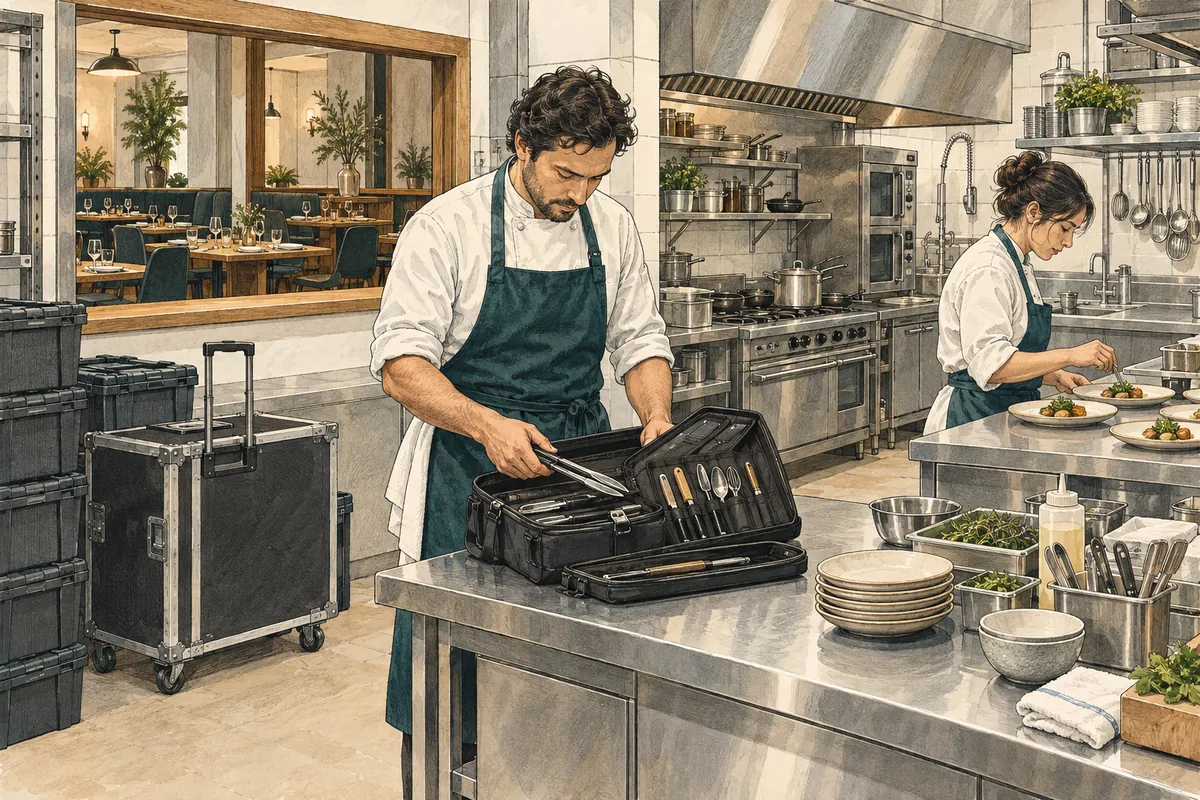
How should a finite restaurant residency cover costs outside its trading window?
Build a pop-up restaurant forecast around contracted access, dated staff commitments, and off-season costs, then check whether any capital recovery lasts.
Read the guide
Which restaurant business idea fits the way you want to operate?
Choose among dine-in, pickup, delivery, catering, and a temporary residency by comparing the customer promise, operating work, and commitments each creates.
Read the guide
How to read financial assumptions before editing an Excel model
Follow the chain from operating assumptions to calculated results, check units and timing, and keep a useful record of changes to a financial workbook.
Read the guideEvidence and scope
Primary operator examples support only the operating features described in the source registry. This full configuration, all formulas, local feasibility and numerical economics remain analyst-authored and unverified.
The links below provide operating-format context; they do not verify the workbook’s selected inputs or calculated returns.
The workbook guide and figures describe model PHY001-12, revision r01, for January 2027–December 2031. These are a documented planning case, not observed results for a particular business.